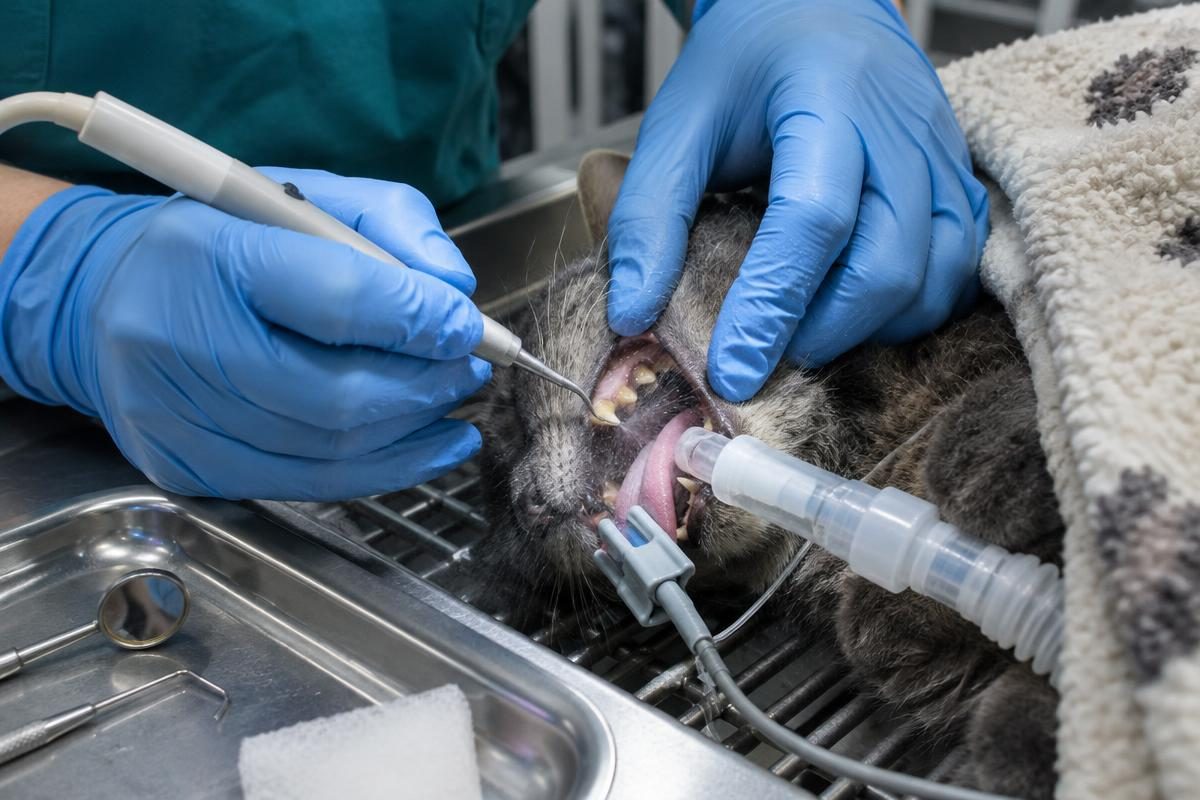
The average cat dental cleaning cost in the US is $375 for the cleaning itself, based on a 2025 survey of veterinary prices in every state and DC carried out for CareCredit. Most invoices carry more than that one line. Full-mouth x-rays add roughly $175 and IV fluids about $105, so a healthy adult cat at an average-priced animal hospital usually pays close to $655. Pull five teeth from a 10-year-old in California and the bill passes $2,500. A stomatitis case that needs every tooth out lands near $3,250 at US average prices.

What a Cat Dental Cleaning Cost Looks Like on a 2026 Invoice
Webvet’s vet-reviewed 2026 guide puts a professional dental cleaning under anesthesia at $300 to $700, and most owners end up paying $400 to $1,300 once bloodwork, x-rays and a few extractions are on the bill. Choose your state, your cat’s age, the clinic type and what the vet found. The tool prices each line separately.
Cat Dental Cleaning Cost Calculator
Enter your cat's age, your state, the clinic type and what the vet found in the mouth. The estimator starts from 2025 state averages for a feline teeth cleaning, then adds x-rays, extractions, bloodwork, IV fluids and medication line by line, and prices the same case at a nonprofit clinic for comparison.
Estimated Dental Bill
Estimates only, not a quote. The cleaning line starts from the 2025 ASQ360 survey for CareCredit (state feline cleaning averages). X-ray, per-tooth extraction, bloodwork, IV fluid and medication figures are midpoints of Webvet's July 2026 vet-reviewed feline ranges; the full-mouth figure is the midpoint of ThePricer's August 2026 range; nonprofit prices are the posted Texas Humane Heroes dental tiers. Every line is scaled by the state's cleaning average relative to the US average. Reviewed September 2026. Only an exam under anesthesia with x-rays shows the real treatment plan.
Two lines deserve a second look. “Same case, two clinic types” shows the posted nonprofit tier price next to an itemized hospital bill for the identical mouth ($295 versus $655 for a routine clean). The regional index tells you how far your state sits from the national figure: Mississippi averages $317 for the cleaning, Hawaii $710.
| Charge | Published range | Estimator figure | Where it comes from |
|---|---|---|---|
| Cleaning, anesthesia, monitoring | $300 to $682 | $375 (state average) | CareCredit 2025 survey |
| Full-mouth dental x-rays | $100 to $250 | $175 | Webvet 2026 |
| Simple extraction, each | $50 to $100 | $75 | Webvet 2026 |
| Surgical extraction or crown amputation, each | $150 to $400+ | $275 | Webvet 2026 |
| Bloodwork before anesthesia | $80 to $200 | $140 | Webvet, July 2026 |
| IV catheter and fluids | $60 to $150 | $105 | Webvet 2026 |
| Take-home pain relief or antibiotics | $20 to $80 | $50 | Webvet 2026 |
| Full-mouth extraction (stomatitis) | $1,500 to $5,000+ | $3,250 | ThePricer, August 2026 |
The Price Build-Up Behind Each Estimate
Nothing in the tool is a guess dressed up as a number. It works in four passes.
- Regional index. Your state’s average cost for a routine dental cleaning, divided by the $375 national figure. Texas comes out at 0.93, California 1.41, Hawaii 1.89. Every other line on the bill is multiplied by the same index, on the reasoning that a hospital charging above average for a scale and polish charges above average for surgery too.
- The mouth. A routine clean adds nothing. If the written estimate lists extractions, each simple tooth costs $75 and each surgical one $275 before the index. A full-mouth extraction for stomatitis replaces the cleaning line with a single $3,250 procedure fee that already covers x-rays, anesthesia and IV support.
- Extras. X-rays and IV fluids are on by default. Bloodwork switches on at age 7, the cutoff one Texas nonprofit uses before any dental anesthesia. Medication is off until you tick it.
- Clinic type. A nonprofit uses Texas Humane Heroes’ posted flat tiers ($275, $475, $675, x-rays included), converted from Texas prices to yours.
There’s no weight or size input, and that’s deliberate. Unlike dogs, adult cats fall into a narrow weight range, and the CareCredit survey reports a single feline price per state with no size bands. Dog owners will find a size factor on the dog dental cleaning cost estimator.
Tooth Resorption: Why Feline Bills Grow on the Table
Tooth resorption (older papers call it FORL, feline odontoclastic resorptive lesions) is the body slowly dissolving its own tooth structure, often starting at the gumline. VCA Animal Hospitals cites a study in which 53 percent of cats had an obvious lesion, and where none showed on the surface, x-rays found one almost half the time. Webvet’s figure is up to a third or more of adult cats. Either way, it ranks among the most common dental problems vets find in cats, and it erodes dental health quietly.
This is the main reason a feline dental estimate changes during the procedure. The lower third premolars are hit most. Lesions that reach the crown are painful, and cats hide that pain well, so owners often have no idea until radiographs are read under anesthesia. Treatment depends on the type the x-rays show:
- Type 1: the root still looks normal on x-ray, so crown and root both come out, a surgical extraction.
- Type 2: the root is already blending into bone, so the vet may amputate the crown and leave the root to resorb.
Either way, enter those teeth in the surgical line. At US average prices, a cat with three resorbed teeth plus take-home pain relief comes to about $1,530, more than double a routine clean. Skipping x-rays to save $175 is a false economy here, since the lesions they find are the costly part.
Stomatitis and What a Full-Mouth Extraction Costs
Feline chronic gingivostomatitis is severe, painful inflammation of the gums and the back of the mouth. The Cornell Feline Health Center puts it at somewhere between three and five percent of cats. The standard fix is surgical: removing most or all of the teeth.
Published prices run from $1,500 to more than $5,000 depending on the clinic and whether a board-certified veterinary dentist operates. One Colorado feline-only practice posts a $3,200 full-mouth package, which sits close to the $3,250 midpoint the estimator uses. At US average prices that single surgery equals about five routine cleanings.
Is it worth it? Cornell reports that about 60 percent of cats need no further medical management afterward, and recovery takes five to 10 days. VCA is more cautious, noting that up to 60 percent improve or resolve while 40 percent keep some degree of oral inflammation. Budget for follow-up visits and continued treatment in that second group, on top of the surgery itself.
Four Cats Run Through the Estimator
These cases sit in the calculator’s automated test file, so the numbers here and the tool can’t disagree.
A 4-year-old with mild tartar, US average
General practice, no extractions expected, x-rays and IV on, no bloodwork under the age-7 rule. Cleaning $375, x-rays $175, fluids $105: $655. A nonprofit routine tier would charge about $295 for the same visit.
A 10-year-old in California with resorption lesions
The written estimate lists 2 simple extractions and 3 surgical ones for resorbed premolars, medication included. California’s index is 1.41. Cleaning $527, x-rays $246, extractions $1,370, bloodwork $197, fluids $148, medication $70: $2,558. A nonprofit complex tier plus the same bloodwork and medication comes to about $1,283.
A 6-year-old in Mississippi with stomatitis
Full-mouth extraction at a general practice, medication included, no bloodwork under the auto rule (worth adding; many hospitals require it). Mississippi’s index is 0.85. Procedure $2,747 plus medication $42: $2,790. The nonprofit complex tier would be about $654, if the clinic accepts stomatitis cases at all.
An 8-year-old in Texas at a nonprofit clinic
Four loose teeth, all simple. The moderate tier is the posted $475, plus bloodwork at $131: $606. An itemized hospital estimate for the same mouth comes to $1,022, so the nonprofit saves about $416.
Nonprofit Tier or Itemized Hospital Bill?
The saving at a nonprofit is real, but so are the trade-offs. Tier pricing works well for predictable dental cleanings: a routine clean or a handful of loose teeth. It works less well when x-rays reveal resorption, since the tier may jump from $475 to $675 on the day, and take-home medication is billed separately.
- Nonprofit or low-cost clinic: flat tiers with dental x-rays included. Expect waiting lists, income or residency rules at some clinics, and bloodwork booked as a separate visit for pets 7 and older.
- General practice hospital: an itemized estimate, usually with IV fluids and monitoring built in. Ask whether radiographs are included in the “dental” price or listed apart.
- Veterinary dental specialist: worth a referral for stomatitis that returns after surgery, jaw fractures, oral masses or a cat with heart or kidney disease. We found no published feline specialist price we trusted enough to model, so the tool doesn’t offer one.
Veterinary teaching hospitals are another lower-cost route that Webvet names. If money is tight, a phone call to the nearest vet school costs nothing.
Insurance, Wellness Plans and Anesthesia-Free Offers
A standard accident and illness insurance policy rarely pays for routine dental cleanings, which count as preventive, routine dental care. Extractions for disease are a different matter: many policies cover them if the condition wasn’t present before enrollment or during the waiting period. Stomatitis diagnosed before you bought the policy will almost always be excluded. Wellness add-ons and clinic pet dental plans sometimes contribute a fixed sum toward a cleaning. For premium math, try the pet insurance cost calculator.
Anesthesia-free scaling costs $100 to $200 per Webvet, which describes it as cosmetic and not recommended. It scrapes visible tartar from the crown. It can’t probe pockets or x-ray roots, which is where resorption and periodontal disease live. VCA states that proper evaluation needs the cat under general anesthesia.
Where This Estimate Can Miss
- Surprises under anesthesia. Webvet says the majority of cats have some periodontal disease by age three, and resorption often only shows on x-ray. Ask the clinic to phone you with a revised number before extra teeth come out.
- City pricing. The state averages mix rural and urban practices. San Francisco or Manhattan will run above the California or New York figure.
- Health conditions. Kidney disease, hyperthyroidism or a heart murmur can add work before any oral health treatment: chest x-rays, an echocardiogram or a referral. Unplanned complications are covered on the emergency vet cost page.
- Bundled pricing. Some hospitals sell one dental package, others bill anesthesia by the quarter hour. Totals tend to land close; line items won’t match.
A sensible first step: book an oral exam and request an itemized written quote, with the cleaning, the radiographs and every planned tooth on its own line. Enter those counts in the calculator and compare the total with your state average. If a quote is well above it, get a second estimate or phone a nonprofit clinic. Knowing the realistic cat dental cleaning cost before the appointment turns the estimate into something you can question. For the rest of the yearly budget, see our cat spay cost guide and the cat age calculator, which prices care by life stage.
Cat Teeth Cleaning Questions Owners Ask
Are cat dental cleanings worth it?
For most cats, yes. Resorption and other dental disease hurt, and cats rarely show it. Treating dental disease early keeps the bill near $655 at US average prices; waiting until several teeth need surgery can push it past $1,500, and a full-mouth extraction toward $3,250.
Why are cat teeth cleanings so expensive?
You’re paying for general anesthesia with an airway tube, a technician monitoring vital signs, full-mouth x-rays, IV fluids and the vet’s time, not just a polish. The $375 average teeth cleaning cost covers only the first of those lines.
Can I scrape tartar off my cat’s teeth at home?
Not in any useful way. Scraping only reaches visible tartar on the crown, the same limit Webvet gives for anesthesia-free cleaning, and does nothing below the gumline where disease starts. Daily brushing with a feline toothpaste slows new tartar; removing what’s there needs anesthesia.
Is dental cleaning painful for cats?
The cat is fully asleep during the procedure. Afterward, a routine clean causes little discomfort, while extractions are sore for several days, which is why take-home pain relief is common after surgery.
How often should cats get their teeth professionally cleaned?
Plan on a yearly mouth check at the wellness visit, with a cleaning booked whenever tartar, gingivitis or a suspected lesion turns up. Some cats need one every year; others go several years between visits.
How we priced cat dental cleaning cost: CareCredit’s 2025 ASQ360 state survey, Webvet’s July 2026 vet-reviewed feline line items, ThePricer’s August 2026 extraction ranges, Texas Humane Heroes’ posted tiers, and clinical facts from VCA Animal Hospitals and the Cornell Feline Health Center. Treat every figure as an estimate, not veterinary advice: your cat’s real treatment plan comes from radiographs taken while it is asleep. Last reviewed: September 2026.