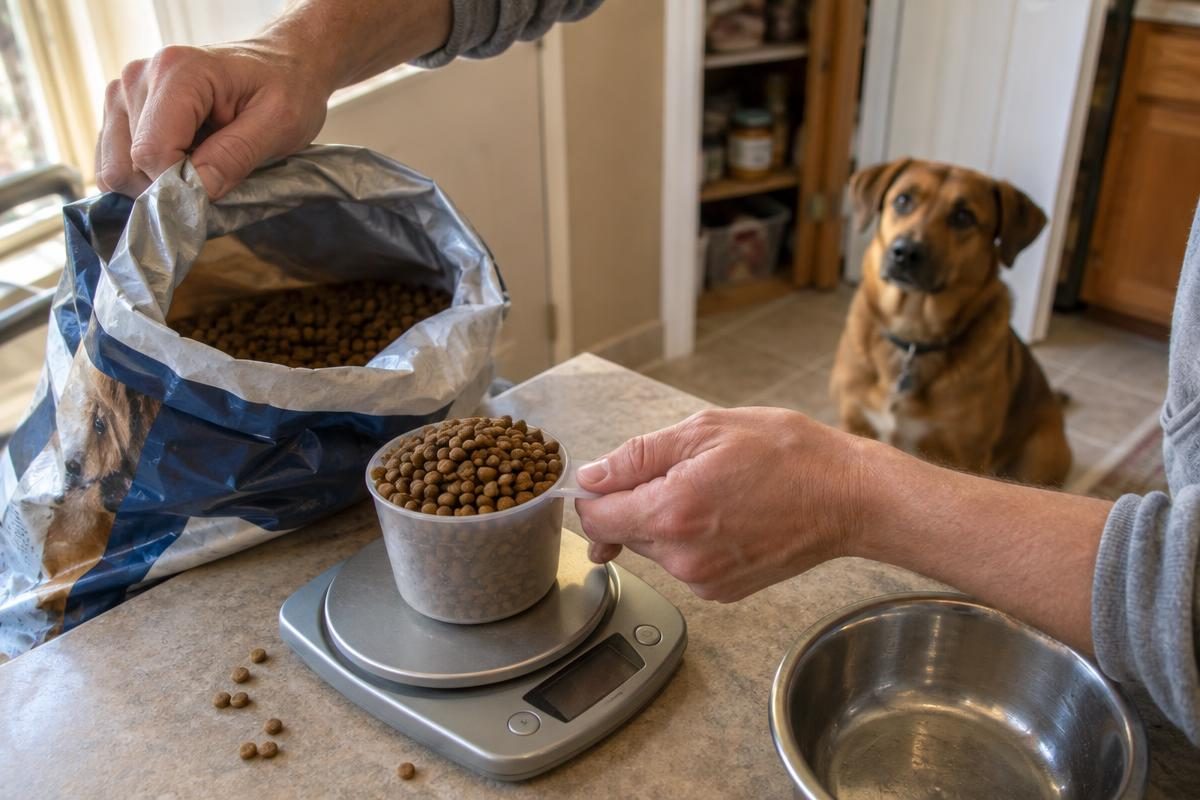
Dog food cost per month depends on two numbers most owners never write down: how many calories the animal actually needs, and what each calorie costs in the bag you buy. The price on the shelf tells a dog owner neither. A 30 lb neutered adult on a mid-range kibble runs about $33 a month before treats. Move the same dog to a fresh cooked subscription and the bill is closer to $180. Put a 70 lb dog on that fresh plan and you are at $380. The calculator below does the arithmetic with the same formula veterinary nutritionists use, then shows the result three ways: per day, per month and per year.

Dog Food Cost Per Month Calculator
Enter the weight, pick a life stage, choose the closest food type, and add treats if you buy them. Typical 2026 US prices and calorie densities are pre-filled for each food type. If you know your bag price or the kcal per kg printed on the label, enter those instead; the result gets noticeably tighter.
Dog Food Cost Per Month Calculator
Enter your dog's weight, life stage and the food you buy. The calculator works out daily calories with the veterinary RER formula, converts that to pounds of food, and turns it into a monthly and yearly food bill. Compare kibble, wet, fresh, raw and freeze-dried on cost per 1,000 calories.
Your Dog's Food Budget
Estimates only. Daily calories use the resting energy requirement (RER = 70 x body weight in kg to the 0.75 power) with the maintenance factors published by veterinary nutrition services (WSAVA Global Nutrition Committee, Ohio State University Veterinary Medical Center). Individual dogs can need up to 50 percent more or less; feed to body condition, not to the calculator. Typical calorie densities and prices are US averages reviewed September 2026 and will drift. Do not put a dog on a weight loss diet without a veterinary check first.
The “cost per 1,000 calories” line is the one to compare between two foods. Cups, cans and pounds all mislead because calorie density varies by a factor of four between a can and a bag of freeze-dried raw. Tufts Cummings School’s Clinical Nutrition Service recommends this comparison basis for exactly that reason.
How the Calculator Gets to a Dollar Figure
Four steps, none of them guesswork.
1. Resting energy requirement
RER is the energy a dog burns at rest in a neutral temperature, and it does not scale in a straight line with body weight. The accepted formula is 70 multiplied by body weight in kilograms raised to the power of 0.75. A 30 lb dog (13.6 kg) has an RER of about 496 kcal. A 70 lb dog (31.8 kg) comes to 936 kcal, not the 1,157 you would get by doubling and adding a bit. Small dogs burn more per pound; large dogs burn less.
2. Life stage factor
Maintenance energy is RER multiplied by a factor that reflects what the animal is doing with its day. The calculator uses the factors published by Ohio State University’s Veterinary Medical Center and the WSAVA Global Nutrition Committee:
| Life stage | Factor | Daily kcal for a 30 lb dog |
|---|---|---|
| Puppy under 4 months | 3.0 x RER | 1,488 |
| Puppy 4 months to adult | 2.0 x RER | 992 |
| Adult, intact | 1.8 x RER | 893 |
| Adult, spayed or neutered | 1.6 x RER | 794 |
| Senior | 1.4 x RER | 694 |
| Inactive or gains weight easily | 1.3 x RER | 645 |
| Weight loss (at target weight) | 1.0 x RER | 496 |
| Working or sporting | 2.5 x RER | 1,240 |
Two things about this table matter for the budget. Neutering drops the factor from 1.8 to 1.6, so a dog that was fed the same after surgery as before gains weight for a reason that has nothing to do with the brand. And a puppy at 3.0 x RER eats nearly twice what it will as an adult of the same weight, which is why the first year’s food bill surprises people even though the animal is small.
3. Calories to pounds
Divide daily calories by the food’s calorie density. Kibble sits around 3,500 to 3,800 kcal per kg. Canned food is near 1,050 because it is mostly water. Fresh cooked runs about 1,450, raw frozen about 1,650, and freeze-dried raw about 4,600 because the water has been removed. The label prints the exact figure under the guaranteed analysis, usually as kcal/kg and kcal/cup. The calculator’s typical values are averages across mainstream brands, so a label figure always wins.
4. Pounds to dollars
Multiply pounds per day by price per pound, then by 30.44 days. The 2026 US averages the calculator starts with, all for a large bag or a full subscription, are $1.20 per lb for grocery kibble, $2.25 mid-range, $3.50 premium, $4.75 for a veterinary therapeutic diet, $3.75 for canned, $5.50 for fresh cooked, $7.00 for raw frozen and $30 for freeze-dried. The therapeutic tier is the prescription food a vet uses for a food allergy, usually signaled by itching, skin issues or diarrhea; those formulas rely on hydrolyzed protein or a novel protein such as duck, rabbit or venison, which is why they sit near the top of the price range. Small bags run 20 to 30 percent more per pound than the largest size of the same product, which is the single cheapest saving available to most owners.
Four Worked Examples
Each of these is reproduced exactly by the calculator with treats set to zero. They are also the scenarios in the calculator’s automated test file, so the page and the tool cannot drift apart.
A 30 lb neutered adult on mid-range kibble
RER 496 kcal, times 1.6, gives 794 kcal a day. At 3,600 kcal/kg (1,633 kcal per lb) that is 0.49 lb of kibble daily, about 2 cups, or 14.8 lb a month. At $2.25 per lb the month costs $33 and the year $399. This food is $1.38 per 1,000 calories, the baseline every other result is compared against. Add the default treat allowance (5 percent of calories, $15 a month) and the total is $47.
A 70 lb neutered adult on fresh cooked food
RER 936 kcal, times 1.6, gives 1,498 kcal a day. Fresh food at 1,450 kcal/kg means 2.3 lb a day, or 69 lb a month, which is why the boxes arrive every two weeks. At $5.50 per lb the month is $381. That is $8.36 per 1,000 calories, 6.1 times the kibble baseline, and about $319 a month more than the same dog on mid-range kibble. Published fresh subscription quotes for a 70 lb dog cluster between $180 and $410, so the calculator’s figure lands inside the real range.
A 10 lb senior on canned food
RER 218 kcal, times 1.4, gives 305 kcal a day. Canned food at 1,050 kcal/kg works out to 10 oz a day, about 0.8 of a 13 oz can, and 19.5 lb of food a month. At $3.75 per lb that is $73 a month. Per calorie, canned costs 5.7 times what mid-range kibble does. For a small dog the absolute difference is only $60 a month, which is why wet feeding is common in small breeds and rare in large ones.
A 50 lb adult and a $68 bag
Enter the bag price and weight instead of a per-pound figure and the calculator reports bags per month. A 50 lb neutered adult needs 1,164 kcal a day. On a 30 lb bag priced at $68 ($2.27 per lb, 3,600 kcal/kg) the dog eats 21.7 lb a month, 0.72 bags, for $49. Switch that dog to grocery kibble at $1.20 per lb and the month drops to $27, 45 percent less per calorie.
What Moves the Pet Food Bill Most
Size of dog and type of food dominate. Between a 10 lb pup and a 70 lb adult, calories scale by about 4.3 times, so every average cost you read online that quotes a single monthly figure without a weight is close to useless. Between grocery kibble and fresh cooked, the cost per calorie scales by about 6 to 7 times. Brand tier inside dry food matters far less: the gap from mid-range to premium kibble is about 55 percent per calorie, and the gap from budget to mid-range is similar. Moving up a tier changes the bill less than changing the category.
Household size multiplies everything. The results are for one dog; set the count to two and quantities and cost double, so two 30 lb neutered adults on mid-range kibble come to $67 a month instead of $33.
Treats are the leak. Veterinary nutrition guidance caps them at 10 percent of daily calories, and the calculator subtracts the treat share from the food ration so food and treats together stay at the requirement. What it cannot fix is the spend. Owners who buy jerky, dog biscuits and dental chews often pay $30 to $60 a month on top of the food line, which for a smaller dog can exceed the food itself.
Waste is the other leak. Kibble in an open bag loses palatability over four to six weeks, and a small dog will not finish a 30 lb bag before it goes stale. Buying the bag size the dog can finish in a month usually beats the per-pound saving on a bigger one.
Using the Result as a Feeding Guide
The cups-per-day line is a starting point, not a prescription. The formula has a wide confidence band; healthy dogs of the same weight and stage vary by up to 50 percent in what they need. Feed the calculated amount for three to four weeks, then check body condition. Ribs should be easy to feel under a thin fat layer and the waist should be visible from above. If the dog gets heavier, cut the ration by 10 percent and re-check in another three weeks. If it is losing unintentionally, add 10 percent. The monthly cost tracks those adjustments one to one.
Puppies need a new calculation every few weeks. A Labrador that is 15 lb at ten weeks and 60 lb at eight months will have its ration recomputed five or six times, and the food bill for that pup roughly quadruples across that stretch even before the food type changes. The puppy weight calculator projects adult size so you can budget the whole first year rather than the current month.
For a dog on a weight loss plan, enter the target weight and choose the weight loss stage, which feeds at 1.0 x RER of the target. Do this only after a veterinary check; sudden restriction in a dog with an undiagnosed condition is a common way to make things worse.
Raw and Fresh Have Their Own Arithmetic
Raw feeders usually portion by percentage of body weight (2 to 3 percent a day for adults) rather than by calories, and commercial raw products range from 1,300 to 2,000 kcal/kg depending on fat content. The raw dog food calculator handles that percentage method and the cost of each protein separately. This page’s calculator uses the calorie method for raw, which gives a similar quantity for lean recipes and a lower one for fatty recipes.
Fresh subscription pricing is quoted per day per dog, and the services build their own calorie estimate from a customizable questionnaire. Run this calculator first, then compare the service’s daily price against the daily cost shown here. If the service’s portion is far above the calculated calories, it is priced for a dog that will get fat.
Food is the largest recurring line in the cost of owning a dog but not the only one; a May 2026 Rover survey put it at 35 to 50 percent of monthly spending. The pet cost calculator adds vet bills, vaccination, flea and tick prevention, pet insurance, grooming and boarding to give a full annual figure for dog ownership, and the dog dental cleaning cost page covers the single expense most owners forget to budget for.
Frequently Asked Questions
How much does dog food cost per month for an average dog?
A 30 to 50 lb adult on mid-range kibble costs $33 to $49 a month at 2026 prices. Small dogs on grocery kibble can be under $20. A large dog can cost $300 to $450 on fresh or raw food. The spread is so wide that an “average” figure only means something once you know the weight and the food type.
How many cups should I feed my dog a day?
Divide the daily calorie requirement by the kcal per cup on the bag. For a 30 lb neutered adult that is about 794 kcal, which is 2 cups of a 400 kcal per cup kibble or 2.3 cups of a 350 kcal per cup kibble. The calculator prints cups using an average 110 g cup; the label figure is more exact.
Is fresh dog food worth the extra cost?
Per calorie it costs 4 to 8 times as much as kibble, and there is no controlled evidence that a healthy dog lives longer on it. Owners who see a benefit usually cite stool volume, coat and palatability. If the budget is the constraint, a half-fresh plan or a fresh topper on kibble captures most of the palatability at a fraction of the price.
Does neutering change how much a dog eats?
Yes. Maintenance energy drops from 1.8 to 1.6 x RER once you spay or neuter, about 11 percent. Owners who keep the old portion see steady weight gain over the following year. The calculator applies the lower factor automatically when you select the neutered adult stage.
Why does the calculator show cost per 1,000 calories?
Because it is the only unit that compares fairly across food types. A $70 bag that lasts 45 days is cheaper than a $50 bag that lasts 25 days, and a 13 oz can is mostly water. Dividing price by calories removes bag size, moisture and density from the comparison.
How long does a 40 lb bag of dog food last?
For a 30 lb neutered adult on mid-range kibble at 3,600 kcal/kg, about 82 days, a little under three months. A 50 lb adult on the same food finishes it in about 56 days. Both run past the four to six weeks an open bag stays palatable, so for a smaller dog a mid-size bag often beats the per-pound saving.
Once you know the calories, dog food cost per month is a multiplication, not a mystery. Run the calculator with your own bag price, check body condition in a month, and adjust the ration before you adjust the brand.
This page is general information, not veterinary advice. Energy formulas follow the NRC 2006 Nutrient Requirements of Dogs and Cats, the WSAVA Global Nutrition Committee toolkit and the Ohio State University Veterinary Medical Center calorie factors. Prices and calorie densities are US averages checked in September 2026 and change over time. Last reviewed: September 2026.