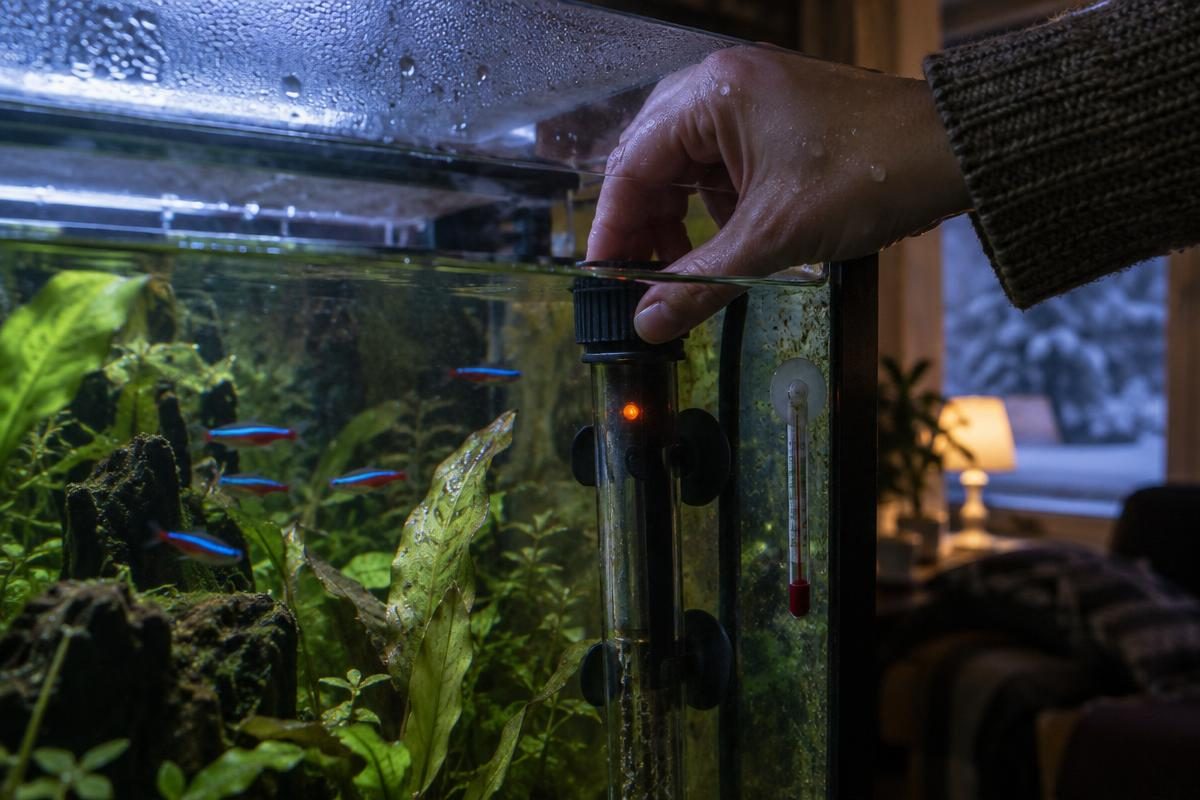
A fish tank heater calculator should answer two questions: how many watts keep the water warm on the coldest night, and what that costs on the power bill. The usual shortcut, 3 to 5 watts per gallon, ignores the thing that actually drains heat, which is the glass and the water surface. Our tool works out that loss for your tank’s shape, lid and room, doubles it for reserve, rounds up to a standard size, and prices the electricity at the EIA’s July 2026 average of 18.31 cents per kWh.
Size a Heater From Heat Loss, Not Just Gallons
Pick a standard tank size or enter outside measurements, say what covers the top, set the target water temperature, and give two room temperatures: the coldest the room gets and where it usually sits. The first sets the wattage. The second sets the running cost.
Aquarium Heater Size Calculator
Sizes a fish tank heater from how fast the tank loses heat: side panels, the top and evaporation, at the coldest room temperature you expect. It recommends one or two standard wattages, then prices the electricity at the room temperature you usually keep.
Heater Size and Running Cost
Estimates only. Heat loss uses ASHRAE still-air surface film resistances, glass and acrylic conductivity, and the latent heat of your measured top-off water; the bottom panel, filter pump heat and drafts are left out. Heaters are sized at twice the loss and rounded up to standard sizes. Electricity default is the EIA US average residential price for July 2026. Reviewed September 2026.
The one number you’ll need to measure is top-off: the water you pour back each week because it evaporated. Put a strip of tape at the waterline after a water change and check it seven days later. Evaporation carries off a surprising share of the warmth, and your own top-off captures your room’s humidity and airflow better than any formula could.
How the Fish Tank Heater Calculator Gets Its Wattage
Heat loss is the rate, in watts, at which warm water hands energy to a cooler room. Once the water reaches its set point, the heater only has to replace that loss, so heater wattage should follow the loss rather than the tank volume. To calculate it, the tool adds up three leaks:
- Side panels. A thin layer of still air clings to every surface and does most of the insulating. ASHRAE puts that air film at 0.68 (hr ft² °F per Btu) on a vertical surface. A quarter inch of glass adds only 0.036, because glass conducts at 0.578 Btu per hour per foot per degree. Acrylic conducts at 0.12, so a half-inch acrylic wall adds 0.347 and loses about 30 percent less.
- The top. A lid traps a second air film (0.61 on each side of a horizontal surface), which halves the loss through the top. A mesh screen or open top gets one film and loses more.
- Evaporation. Each gallon that evaporates takes 8.317 lb times 1,048 Btu per lb with it (the latent heat at 80°F). Spread over a week, that’s 15.2 watts for every gallon of weekly top-off.
Add the three, multiply by 2, and round up to one of the nine EHEIM sizes from 25 to 300 watts. Why 2? It’s our design choice, not a published standard: at twice the loss, the heater runs about half the time on the coldest night and still has headroom to warm a fresh refill.
The air film matters more than the glass. BeanAnimal’s reef thermodynamics article works a 75 gallon with 3/8-inch glass at an 8-degree gap and gets 3,596 Btu per hour, about 1,054 watts, from glass conduction alone. No one runs a kilowatt on a 75. The still air on the outside of the pane is what keeps real losses near 100 watts.
Why Watts per Gallon Breaks on Small and Large Tanks
Most aquarium heater size calculator tools we checked start from gallons, sometimes adjusted for the temperature gap. Volume grows with the cube of a tank’s size, but surface grows with the square. So a small tank has far more glass per gallon than a large one and cools faster. The flat rule can’t see that. Here’s the heater size our version gives for standard glass tanks with a lid and a quarter gallon of weekly top-off, targeting 78°F:
| Tank (outside, inches) | Loss, room at 68°F | Heater to buy | Loss, room at 58°F | Heater to buy |
|---|---|---|---|---|
| 10 gal (20 x 10 x 12) | 27.5 W | 75 W | 51.2 W | 125 W |
| 20 long (30 x 12 x 12) | 38.3 W | 100 W | 72.8 W | 150 W |
| 29 gal (30 x 12 x 18) | 52.6 W | 125 W | 101.4 W | 250 W |
| 40 breeder (36 x 18 x 16) | 63.4 W | 2 x 75 W | 123.0 W | 2 x 125 W |
| 55 gal (48 x 13 x 21) | 86.7 W | 2 x 100 W | 169.7 W | 2 x 200 W |
| 75 gal (48 x 18 x 21) | 96.6 W | 2 x 100 W | 189.4 W | 2 x 200 W |
At a 10-degree temperature difference, the 10 gallon needs 5.3 watts per gallon of box volume and the 75 needs 2.5. EHEIM’s own sizing chart leans the same way: its 50-watt model is listed for 25 to 60 liters and its 300-watt model for 600 to 1,000 liters, so the rating per liter falls as tanks grow. Drop the room to 58°F and every tank roughly doubles, which is why a basement setup blows past the rule’s upper end.
Four Tanks Sized and Priced
Every example uses quarter-inch glass unless noted and the $0.1831 national rate. Enter the same inputs and the tool returns the same results.
1. A 20 long with a glass lid
Target 78°F, coldest room 68, usual 72, 0.25 gallon of top-off a week. Side panels lose 28.7 watts, the lidded top 5.8, evaporation 3.8, for 38.3 watts total. Doubled, that’s 77, so one 100-watt heater. At the usual 72°F room, the tank averages 24.5 watts: 17.9 kWh and $3.28 a month, $39.31 a year. Two identical tanks: $6.55 a month.
2. An open-top 55 in a cool room
Coldest room 65, usual 70, 1 gallon of top-off a week. Walls 94.7 watts, open top 27.1, evaporation 15.2: 136.9 in all. The minimum is 274 watts, so Auto picks two 150-watt heaters. Running cost is 65.8 kWh, $12.06 a month. If one dies, the survivor still holds 78°F until the room falls below 63.6.
3. A betta’s 10 gallon at 80°F in a 62-degree room
That 18-degree gap pushes the loss to 44.2 watts and the minimum to 88. The 3 to 5 watt rule says 31 to 52 watts, which would leave this tank cold every winter night. Buy a 100-watt unit. Cost: 25.4 kWh, $4.64 a month at a usual 66°F.
4. A 180-gallon acrylic build in California
Custom 72 x 24 x 24 inches, 3/4-inch acrylic, mesh top, 2 gallons of top-off a week, target 79, coldest 66, usual 70, and California’s July 2026 residential rate of 33.61 cents. Loss is 206.9 watts, minimum 414, so two 250-watt heaters. The rule would have said 539 to 898 watts. Running cost: 111.5 kWh, $37.47 a month, $449.58 a year.
One Heater or Two?
Two smaller heaters are safer than one large one because a thermostat can fail in either direction. Top Shelf Aquatics recommends splitting the load on tanks above 40 to 50 gallons; the calculator’s Auto setting switches at 40 and adds more units whenever one would need over 300 watts. Redundancy works both ways:
- Stuck on. A single 300-watt unit on the 55 in example 2 would push the water up about 1.5°F an hour if its thermostat welded shut. One of the two 150s climbs about 0.4°F an hour, under 10 degrees in a full day.
- Stuck off. Because each of the pair covers at least the full heat loss, one dead unit leaves the other holding the target down to a colder room than you sized for. The calculator shows that floor temperature.
Splitting adds cost only at the register. Two heaters draw the same total energy as one, since the loss is the loss. Put them at opposite ends of the tank so they heat more evenly, and keep a separate thermometer so you’ll notice a drift before the fish do.
What Does a Heater Cost to Run Each Month?
Aquarium heater running cost depends on the tank’s heat loss at your usual room temperature, not on the heater’s rating. A 300-watt unit on a tank that loses 90 watts cycles on about 30 percent of the time and uses the same 90 watts on average as a 150-watt unit that runs 60 percent. That’s why the calculator uses a second, warmer room temperature for cost: sizing looks at the coldest night, the bill looks at a typical day.
Your rate matters as much as the tank. The EIA’s July 2026 residential averages were 12.72 cents per kWh in Louisiana, 15.88 in Texas, 29.90 in New York, 33.61 in California and 48.00 in Hawaii. The same 55 gallon from example 2 costs about $8.37 a month in Louisiana and $31.60 in Hawaii. Swap in the rate from your own bill.
When This Estimate Is Off
The model is simple on purpose, and a few things push real numbers away from it:
- Equipment heat. Pumps, powerheads and lights warm the water too, so real heater use is often lower. Canister and sump systems lose extra heat through plumbing.
- Drafts. ASHRAE’s film values assume still air. A vent blowing on the glass, or a fan across an open top, raises both conduction and evaporation.
- Bottom and back panels. The bottom is ignored because it sits on the stand; a tank on a cold concrete floor loses more. A back panel against an outside wall is colder than the room reading.
- Box volume. Warm-up time and stuck-on climb use outside dimensions. Actual aquarium volume ran 12 to 26 percent less in the examples on our fish tank volume calculator, so the water warms slightly faster than shown.
Before you shop, measure a week of top-off and note the coldest reading from a thermometer near the tank, not the thermostat on the hallway wall. Run the fish tank heater calculator with those two numbers, buy the size it names (two if Auto says so), and plan the rest of the build with our fish stocking calculator and fish tank gravel calculator. If the listed wattage is out of stock, go one size up, never down.
Heater Sizing Questions
What size heater does a 20 gallon tank need?
A 20 long with a glass lid needs a 100-watt unit when the room drops to 68°F and the target is 78. If the room gets down to 58, step up to 150 watts. An open top in a drafty room can push it higher.
Is a 50W heater too big for a 5 gallon tank?
No, as long as its thermostat works. Oversizing only hurts when a thermostat fails. A 5.5 gallon (16 x 8 x 10 inches) with a lid loses 17.2 watts at a 10-degree gap, so the minimum is 34 and 50 is the next standard size. The risk is a stuck thermostat: 50 watts in that little water climbs about 2.9°F an hour.
How much does a 300W aquarium heater cost to run?
At most $40.13 a month at the 18.31 cent US average, and only if it never switched off (219.2 kWh). Sized correctly, it cycles. The open-top 55 in our example loses about 90 watts on a typical day, which is $12.06 a month.
Does a bigger heater use more electricity?
Not over a month. A heater’s thermostat switches it off once the water reaches the set point, so the energy used matches the heat the tank loses. A larger unit just runs in shorter bursts. The extra risk is overheating if it sticks on.
Does a lid save on heating?
Yes. On the 20 long, swapping a glass lid for a mesh screen raises the loss from 38.3 to 44.5 watts before counting the extra evaporation an open top usually brings. A lid also cuts top-off, and every gallon less a week saves 15.2 watts.
Rerun the fish tank heater calculator each fall with that winter’s coldest room reading. Rooms change, lids get swapped for screens, and a heater that was plenty in June can fall short in January.
General information only, not veterinary advice. Surface film values are ASHRAE figures as tabulated by h2x Engineering; glass and acrylic conductivity come from BeanAnimal’s reef thermodynamics article; latent heat is from Engineering ToolBox and water weight from the USGS; heater sizes are EHEIM’s thermocontrol range; the two-heater threshold and watts-per-gallon rule follow Top Shelf Aquatics; electricity prices are EIA Electric Power Monthly Table 5.6.A for July 2026. Last reviewed: September 2026.