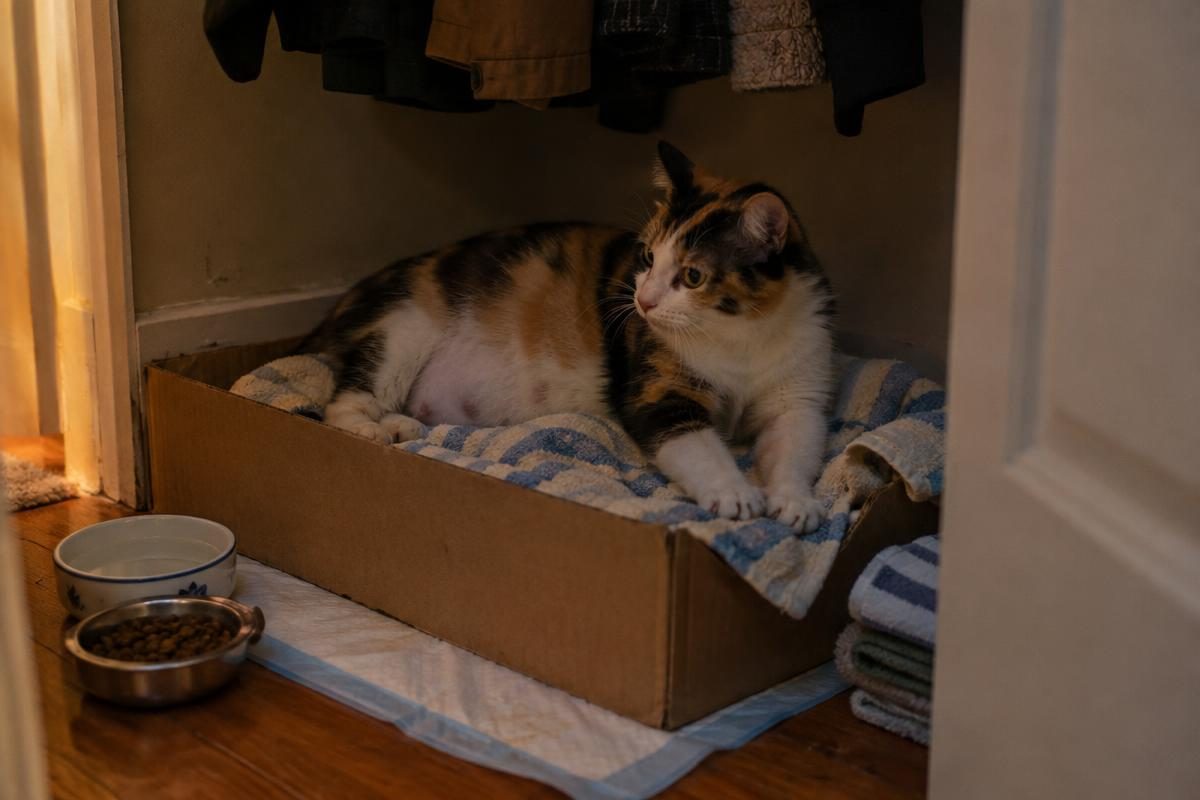
A cat gestation calculator turns one date into a birth plan. Enter the first mating and you get a due date 65 days out, a normal birth window that opens at day 58 and closes at 68, and the calendar dates for the ultrasound, the kitten count x-ray and the twice-daily temperature checks. Queens don’t ovulate until they mate, so the mating date is a solid anchor for a feline pregnancy. The same form prices the litter: about $1,262 for a typical five-kitten litter at a private vet, with $240 of that set aside in case she needs a C-section.
Cat Gestation Calculator: Due Date From a Mating or a Scan
This cat pregnancy calculator works both ways. Pick the first mating date, or switch to the vet’s estimate if you took in a pregnant cat and never saw the tom. The top rows give the expected due date, the window and a progress line for any date you choose; the milestone rows follow in order. Prices sit below and never move the dates.
Cat Pregnancy Calculator
Pick the first mating date, or the date of a vet scan and how many days along the vet judged her, and get the due date, the normal 58 to 68 day queening window and the dates for each pregnancy check. The same form prices the vet visits, extra food for the queen, first kitten shots and a C-section reserve from the 8.0 percent rate in a UK study of 1,056 litters.
Due Date, Milestones and Budget
Estimates only, not veterinary advice. Dates use a 58 to 68 day normal gestation (Niles Animal Hospital, Dr. Debra Primovic) and a 65 day due date from the 65.1 day mean in Sparkes and colleagues (2006), with 63 days as an option. Prices are US figures reviewed September 2026 from Catster, Gentle Vet Animal Hospital, East Bay SPCA, WebVet and Lemonade. Your clinic's quotes will differ.
How Long Are Cats Pregnant? 63 Days or 65?
Normal gestation in cats runs 58 to 68 days, according to a client handout by Dr. Debra Primovic of Niles Animal Hospital, which gives 63 as the average. That 63 is the number almost every online calendar uses. The best field data we found points two days later. Sparkes and colleagues collected 1,056 litters from 14 pedigree breeds across 942 UK households for the Journal of Feline Medicine and Surgery in 2006, and the mean gestation came to 65.1 days. The Merck Veterinary Manual agrees: queening follows 64 to 66 days after the hormone surge that mating sets off.
So the calculator defaults to 65 and lets you switch to 63. Either way, the normal range for the cat gestation period stays 58 to 68. Two details from the UK study matter here. Bigger litters tended to arrive sooner, and gestation length differed between breeds.
Why does a cat mate more than once? A queen in heat often accepts a tom several times over a few days. Enter the first and last dates and the far end of the window is counted from the last one, while the due date still runs from the first.
Week-by-Week Pregnancy Calendar for a Queen
Each milestone below comes from the Primovic handout unless marked. Day 0 is the first mating.
| Day | What happens | What you do |
|---|---|---|
| 21 to 24 | Ultrasound can confirm the pregnancy | Book the scan; there’s no practical blood or urine test for cats |
| 26 to 35 | A vet can often feel kittens by palpation | Don’t press on her belly yourself |
| After week 4 | Weight gain begins | Switch to a diet made for pregnant and nursing queens |
| Last 5 weeks | Food needs may double or triple | Feed several small meals |
| After 45 | Kitten skeletons show on an x-ray | Count the kittens |
| 1 week before the due date | Pelvic exam and palpation | Vet recheck to spot a kitten too big for the birth canal |
| From 58 | Rectal temperature drops nearly 2 F within about 24 hours of labor | Take it morning and evening; normal is 100.5 to 102.0 F |
| 1 to 2 days before birth | Mammary glands may leak milk | Have the queening box ready and quiet |
Nipples that turn pink and swell early in a pregnancy (breeders call it pinking up) are a common first sign, but they tell you nothing about the date. A queening box is a covered, quiet box lined with newspaper or a soft towel where you hope she will give birth. Put it out early so she gets used to it. Many cats hide before delivery, and that’s normal.
The Arithmetic Behind Each Date and Dollar
Here is how the tool will calculate each date, by simple addition:
- Day 0. The first mating. In vet mode, the scan date minus the vet’s estimate.
- Due date. Day 0 plus 65, or plus 63 if you choose the textbook rule.
- Window. Day 0 plus 58 through the last mating plus 68.
- Milestones. Ultrasound from day 21, palpation from 26, x-ray from 45 and temperature checks from 58. Extra food starts five weeks before the due date, the recheck lands a week before it, and the first kitten shots fall 6 weeks after it, the earliest age in the 2020 AAHA/AAFP feline vaccination guidelines.
The budget adds five lines, each at a September 2026 US price you can overwrite:
- Early visit: $94.50 exam, a $200 ultrasound, and a $90.37 FeLV and FIV test for the mother. Exam and test prices come from Gentle Vet Animal Hospital’s posted cat fees. The scan is the low end of the $200 to $500 range in a vet-reviewed Catster guide, since pregnancy scans are shorter than full abdominal ones.
- Late visit: another $94.50 exam plus a $175 x-ray, the midpoint of Catster’s $100 to $250 abdominal range.
- C-section reserve: your chance of surgery times the surgery price. The defaults are 8.0 percent and $3,000.
- Food: her usual monthly bill times one extra helping (double) or two (triple), over five weeks.
- Kittens: a first FVRCP shot for each at $45 plus one $94.50 litter exam at a private vet, or $18.50 per shot at the East Bay SPCA nonprofit clinic. Spaying the mother afterward adds $400 privately or $215 at that nonprofit.
Four Queens, Four Due Dates
Each of these scenarios is locked into a test suite that runs against the calculator code.
One mating on March 3, 2027
With every default, the due date is Friday, May 7, 2027, and the window runs April 30 to May 10. Checked on April 2, she’s on day 30 (week 5) with 35 days to go. Book the ultrasound from March 24, raise her food from April 2, and schedule the x-ray from April 17. The recheck and the first temperature reading both fall on April 30. Vet care comes to $654, the reserve $240, extra food $48, and five kittens’ first shots with the litter exam $320. Budget: $1,262, or $252 per kitten. If surgery happens, the total becomes $4,022. Kittens can start vaccines from June 18.
Four days with the tom, counted the textbook way
A breeder logged matings on February 10 through 13, 2027, and prefers the 63-day rule. Due date: Wednesday, April 14. Because the last mating was three days after the first, the window stretches from April 9 to April 22. She eats from a $30 monthly bill and the breeder plans for triple rations, so extra food is $69. Four kittens get their first shots at the nonprofit for $74, and the queen is spayed there afterward for $215. Total: $1,252, or $313 per kitten.
A pregnant stray, dated by ultrasound
A rescuer took in a heavily pregnant stray. On October 20, 2026 the vet’s scan put her at about 30 days along, which places the start on September 20. The due date is Tuesday, November 24, with a window of November 17 to 27, and the x-ray could go ahead from November 4. By November 15 she is in week 9, nine days from the due date. Four kittens vaccinated at the nonprofit bring the budget to $1,017, or $3,777 with surgery.
A high-risk breed, now overdue
A breed club reports C-sections in 18.5 percent of its litters, the top of the range in the UK study, and the local emergency hospital quotes $4,500. Mated June 14, 2027, she is due Wednesday, August 18, with a window of August 11 to 21. The reserve jumps to $833, three kittens and the exam cost $230, and the owner adds $150 for a heating pad and milk replacer. Total: $1,915, or $638 per kitten. Checked on August 25, she is four days past the window. That is a same-day call to the vet.
What a Litter Costs Before the Kittens Leave
Surgery risk is the line that swings. In the Sparkes study, 8.0 percent of pregnancies ended in a caesarean. Individual breeds ranged from 0 to 18.5 percent, though breed on its own didn’t hold up as an independent factor; small litters did, and they carried a higher risk.
Two other studies show which queens have trouble. Gunn-Moore and Thrusfield surveyed breeders on 2,928 litters from 735 queens for the Veterinary Record in 1995. Dystocia, meaning a birth that stalls or needs help, hit 5.8 percent of litters overall. It ran from 0.4 percent in a large colony of mixed-breed cats to 18.2 percent in Devon rex litters, with Siamese-type and Persian litters also high. Pedigree litters carried 22.6 times the odds of mixed-breed ones, and both flat-faced and long-headed breeds had more trouble than cats with a medium skull. A 2016 Swedish insurance study by Ström Holst and colleagues found that 56 percent of queens with dystocia ended up in surgery, with British Shorthair (2.5 times), Oriental (2.2 times) and Birman (1.7 times) at higher risk, and Norwegian Forest Cat and Maine Coon lower.
We couldn’t find a US price survey for a feline C-section. The $3,000 default is the midpoint of Lemonade’s $1,500 to $4,500 range for exploratory abdominal surgery in cats, the closest procedure with a published price. Replace it with a real quote. Nights and weekends at an emergency hospital cost more, which our emergency vet cost guide covers.
Food is the smallest line. Doubling a $42 monthly bill for five weeks adds about $48. Work out her real intake with the cat calorie calculator; an unspayed adult needs more than a neutered one, and nursing adds more on top. After the birth, the kittens’ full vaccine series is priced on the cat vaccination cost page, and the mother’s surgery on the cat spay cost page.
Signs Labor Is Close, and When to Call the Vet
Nesting, a temperature drop, milk in the glands and a sudden wish to hide are the signs to watch for. The UK data gives a sense of normal pace. The first stage of labor, restlessness before any pushing, lasted under two hours in 82.9 percent of queens, and 85.7 percent delivered the whole litter within six hours of the first kitten.
Call your vet if:
- She passes the last day of the window with no kittens.
- She stops eating, seems lethargic, or has heavy vaginal discharge at any stage.
- Her temperature has dropped and labor hasn’t started within 24 hours.
- She strains hard for a long stretch without producing a kitten.
Losses happen even in well-managed litters. In the Sparkes survey 7.2 percent of kittens were stillborn, and 9.1 percent died between birth and eight weeks, most in the first week. Larger litters and litters with a birth defect had more stillbirths.
The date estimate itself goes wrong when the start date is wrong: a mating you didn’t see, a vet’s estimate read from kitten size, or a queen that isn’t pregnant at all. Mastitis, mammary tumors, fluid in the abdomen and pyometra (a uterine infection) can all swell a belly. Confirm with an ultrasound before planning around the date.
Cat Pregnancy Questions
How can you tell how far along a cat is in her pregnancy?
Count from the first mating if you know it. Otherwise a vet can judge the stage from kitten size on an ultrasound from about three weeks, by feeling the abdomen from about day 26, or by x-ray after 45 once the skeletons show. Enter the scan date and the vet’s estimate in the calculator to get a due date.
Can a cat have kittens 3 days apart?
Not normally. In the UK pedigree study, 85.7 percent of queens delivered every kitten within six hours, and the longest gap between two kittens in an unassisted birth was 48 hours. Only three cats took more than 48 hours from first to last. If more than a day passes and she still seems to have kittens inside, call a vet.
How many kittens are in a typical litter?
The UK study averaged 4.6 kittens, varying by breed. The Primovic handout gives a range from one to more than ten, with smaller litters from young and old queens and the largest when the mother is three to four years old. The x-ray count is the number to plan around.
Does a cat gestation calculator work for every breed?
It works as an estimate for any queen, because the 58 to 68 day window covers normal variation. Mean gestation did differ between breeds in the UK data, so a breeder who logs several litters from one line can switch between the 63 and 65 day rules to match what they’ve seen.
Does pet insurance pay for a cat C-section?
Usually not. Standard accident and illness plans treat pregnancy and birth as an exclusion, so check the policy wording before breeding and keep the full surgery price available rather than just the reserve.
Enter the first mating date in the cat gestation calculator now, save the milestone dates to your phone calendar, and ask your vet for a C-section quote before day 58. If breeding again isn’t the plan, book her spay for after the kittens are weaned.
This page is general information, not veterinary advice. Gestation and milestone timings follow Dr. Debra Primovic’s Niles Animal Hospital handout, the Merck Veterinary Manual and Sparkes and colleagues (2006); dystocia and surgery rates come from Gunn-Moore and Thrusfield (1995) and Ström Holst and colleagues (2016). Prices are US figures from Catster, Gentle Vet Animal Hospital, East Bay SPCA, WebVet and Lemonade, checked in September 2026. Last reviewed: September 2026.