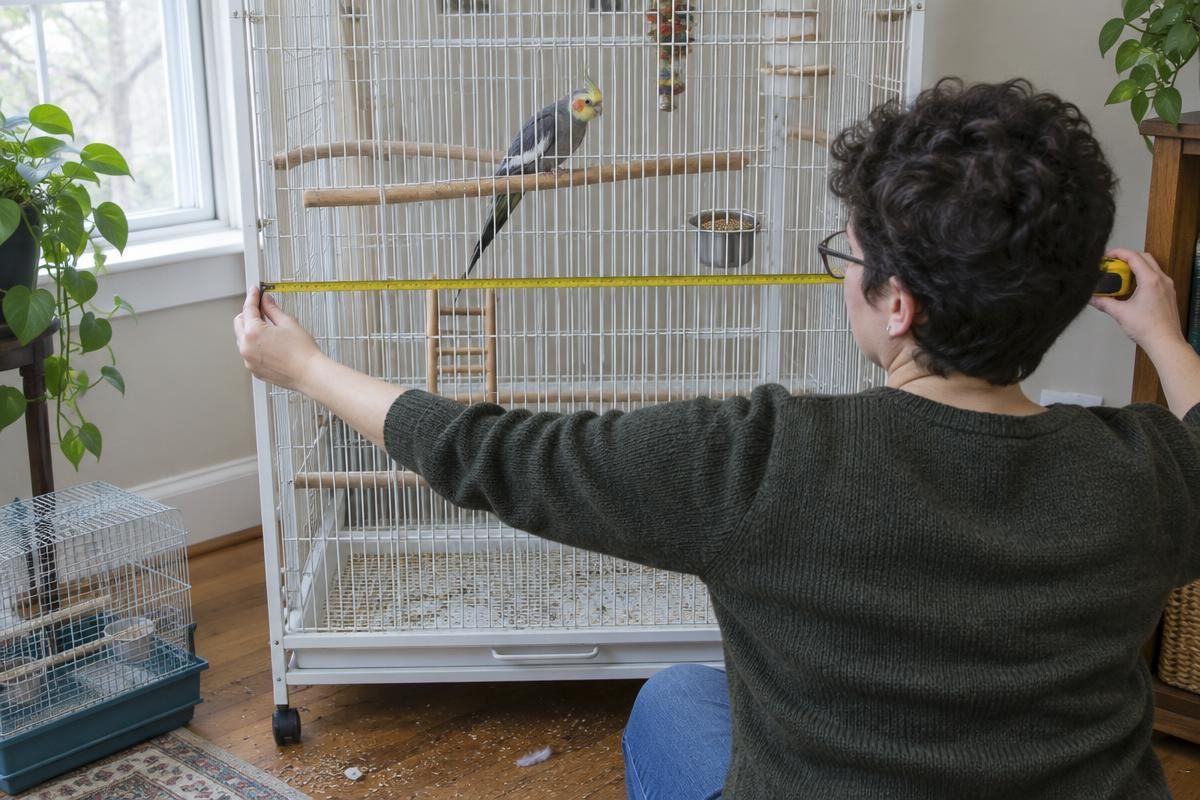
A single budgie needs an enclosure at least 24 inches wide, 20 deep and 30 tall, with bars 1/2 inch apart. A cockatiel needs 38 × 29 × 30. Those figures come from this bird cage size calculator, which checks two published standards side by side: the minimum table in the Merck Veterinary Manual and the flying wingspan rule in UK government guidance for pet sellers. On each side it keeps whichever number is larger. Many US guides, Chewy’s among them, print only the first, and it’s the smaller one.
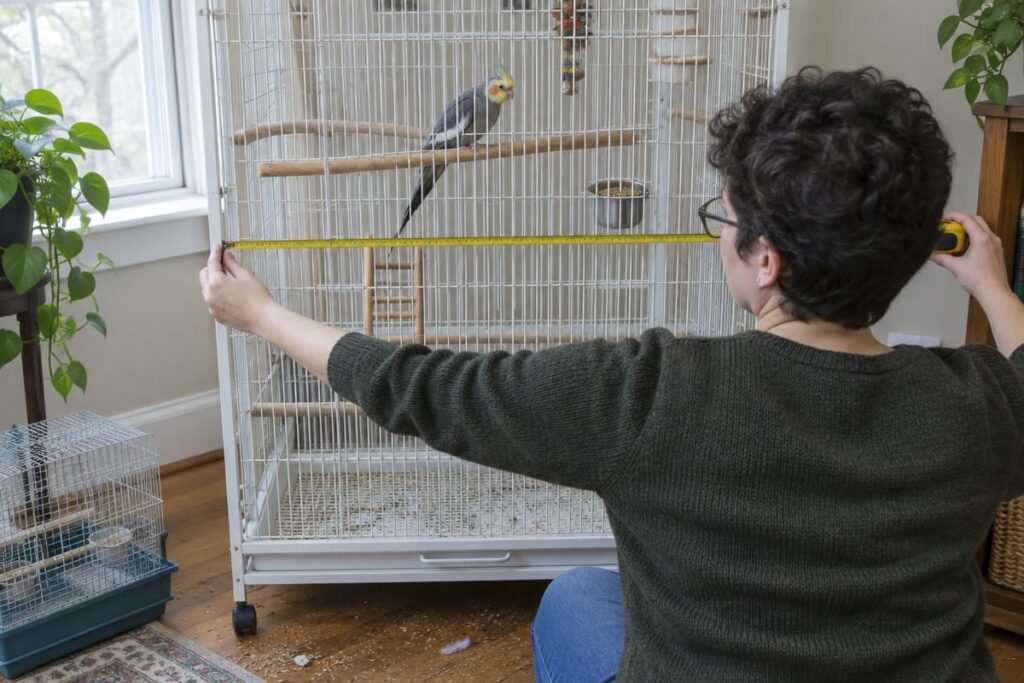
Bird Cage Size Calculator: Width, Depth, Height and Bars
Choose a species, say how many birds will share the space, and pick how much of the day they spend inside it. Tick the box at the bottom to test a cage you already own or have open in another tab.
Bird Cage Size Calculator
Pick a species, how many birds share the enclosure and how much of the day they spend inside it. The tool compares the Merck Veterinary Manual minimum with the UK flying wingspan rule, returns the larger figure on each side with bar spacing and a price band, and can check a cage you already own.
Enclosure Size for Your Flock
General guidance only. Sizes compare the Merck Veterinary Manual minimum table with the flying wingspan rule in the UK Defra guidance for pet sellers (updated June 2026). Price bands come from a July 2026 published price guide and a January 2026 macaw guide. Bigger is better, and an avian vet can advise on a bird with special needs. Reviewed September 2026.
The results show the vet manual figure and the UK figure on separate lines, so you can see which one set each measurement. Width is listed first, then depth (front to back), then height.
Two Standards That Disagree: a Vet Manual Table and a Wingspan Formula
The Merck Veterinary Manual groups pet species into four rows and gives one minimum per row. Budgerigars, cockatiels, lovebirds and parrotlets all share 20 × 20 × 30 inches. Chewy’s species guide, reviewed by a veterinarian in September 2026, prints the same four rows.
The UK approach is different. Defra’s statutory guidance for licensed pet sellers, updated in June 2026, starts from each species’ flying wingspan:
- One animal caged most of the day: width at least twice the wingspan, depth and height at least 1.5 times.
- One that only sleeps inside and spends the day in a flight aviary: 1.5 times the wingspan on every side.
- Two or more sharing: twice the wingspan on every side. For each one over two, width grows by 5 percent (under 50 g, such as budgies), 10 percent (50 to 100 g, such as cockatiels and lovebirds) or 20 percent (over 100 g, the larger parrots).
Neither rule is wrong. They answer different questions. The vet table sets one floor for a whole group of species; the wingspan rule ties the box to each species’ span, so it asks whether the bird can actually spread its wings and flap from perch to perch. A cockatiel’s 48 cm wingspan is why its UK figure lands so far above the shared small-species row.
Minimum Cage Size by Species
Each row assumes one pet that lives in its enclosure most of the day. Sizes are width × depth × height in inches, rounded up to a whole inch.
| Species | Vet manual minimum | UK wingspan rule | Recommended (larger of the two) | Bar spacing |
|---|---|---|---|---|
| Budgie (parakeet) | 20 × 20 × 30 | 24 × 18 × 18 | 24 × 20 × 30 | 1/2 in |
| Lovebird | 20 × 20 × 30 | 23 × 17 × 17 | 23 × 20 × 30 | 1/2 in |
| Cockatiel | 20 × 20 × 30 | 38 × 29 × 29 | 38 × 29 × 30 | 1/2 in |
| Green-cheek conure | 36 × 24 × 48 | 28 × 21 × 21 | 36 × 24 × 48 | 3/4 in |
| Amazon parrot | 40 × 30 × 60 | 48 × 36 × 36 | 48 × 36 × 60 | 3/4 in |
| African grey | 40 × 30 × 60 | 56 × 42 × 42 | 56 × 42 × 60 | 3/4 in |
| Umbrella cockatoo | 48 × 36 × 66 | 87 × 65 × 65 | 87 × 65 × 66 | 1 1/2 in |
| Blue-and-gold macaw | 48 × 36 × 66 | 87 × 65 × 65 | 87 × 65 × 66 | 1 1/2 in |
The conure is the only species where the vet row wins on all three sides. For everything bigger than a lovebird, the UK width dominates. Height almost always comes from the vet table, because long tails need vertical room even when wings don’t.
The macaw row deserves a plain warning: 87 inches is over seven feet. Few households have room for a cage that wide, and the UK sets that figure for animals held in a shop, not in a home with daily free flight. Treat the vet manual’s 48 × 36 × 66 as the floor for a macaw and the UK number as the goal a bird room or aviary should reach.
How the Tool Picks Each Measurement
- Look up the species. Its vet manual minimum and bar spacing, and its average flying wingspan from the UK table (30 cm for a budgie, 48 for a cockatiel, 70 for an African grey, 110 for the large cockatoos and macaws).
- Apply the UK multiplier for the number of birds and the time spent inside, then convert centimeters to inches (divide by 2.54).
- Keep the larger figure on each side and round up to the next whole inch.
- Report floor space (width times depth), the bar gap and a typical price for that class of enclosure.
- If you entered a cage, compare each side, flag any shortfall, compare bar gaps and give its volume as a percentage of the minimum.
Four Flocks Measured
These four scenarios are the calculator’s test file. The page and the tool produce the same numbers.
One budgie, caged most of the day
The vet table says 20 × 20 × 30. The UK rule says 60 × 45 × 45 cm, about 24 × 18 × 18 inches. The recommendation is 24 × 20 × 30 inches (61 × 51 × 76 cm), 480 square inches of floor, 1/2 inch bars. Expect to pay $80 to $250. Only the width changed from the vet figure, and only by four inches.
One cockatiel, caged most of the day
Here the gap is large. Twice a 48 cm wingspan is 96 cm, or 38 inches. Result: 38 × 29 × 30 inches (97 × 74 × 76 cm) and 1,102 square inches of floor, more than double the budgie’s. The Oregon Humane Society’s care sheet asks for at least 25 inches on every side, wider and deeper than the vet row but short of the UK figure. The cockatiel cost guide prices the rest of the setup.
An African grey that sleeps inside and flies free all day
With a bird room, the UK rule drops to 1.5 times a 70 cm wingspan: 105 cm, about 42 inches, on each side. The result is 42 × 42 × 60 inches (107 × 107 × 152 cm) with 3/4 inch bars and a $350 to $900 price band. Caged most of the day, the same grey needs 56 × 42 × 60. That 14-inch difference is what daily flight time buys you.
Two cockatiels and a 30 × 18 × 18 inch cage
For a pair, every side becomes twice the wingspan: 38 × 38 × 38 inches (97 cm a side). The cage on hand is 8 inches short on width and 20 short on both depth and height. Its 1/2 inch bars are fine. By volume it offers 18% of the minimum. With only 18 inches of depth, a cockatiel with a 19-inch wingspan can’t spread its wings front to back.
Add a third bird to a budgie flock and the width grows 5 percent: three budgies need 25 × 24 × 30 inches. Each further budgie adds another 5 percent.
Bar Spacing: Why the Gap Matters as Much as the Box
A gap that’s too wide lets a head through. A small parrot that pushes its head between bars can get stuck or injured, and the UK guidance requires mesh openings small enough that a head or wing can’t pass. The vet manual’s spacing is 1/2 inch for budgies through parrotlets, 3/4 inch for conures, greys and Amazons, and 1 1/2 inches for macaws and large cockatoos.
Watch for this when buying up. A cage built to the conure spacing of 3/4 inch suits the conure and is too wide for a budgie. The calculator flags any bar gap wider than the species figure.
Width beats height for flyers. Chewy’s guide puts it simply: usable space matters more than any one dimension. Tall, narrow “tower” enclosures give a small flyer nowhere to go but up and down.
What an Enclosure That Size Costs
Master Parrot’s July 2026 price guide puts a small-parrot cage at $80 to $250, a medium one at $150 to $450 and a large one at $350 to $900. For macaws and big cockatoos, The Vet Desk notes cages “can cost upwards of $2,000,” so the calculator uses $350 to $2,000 for that class. Two retail examples from Chewy’s guide: an A&E flight cage 32 × 21 inches at $324.82 and a Prevue wrought iron model at $599.99.
The enclosure is usually the biggest single setup purchase. Perches, toys, a carrier and the first avian exam come on top, and the parrot cost estimator adds them up by species, first year and beyond. For a small flock, the budgie cost guide covers food and vet bills.
Where a Minimum Isn’t Enough
- US law sets a far lower floor. Florida’s captive wildlife code allows up to four cockatiels or parakeets in a cage 1 foot by 2 feet and 10 inches high, adding 25 percent to the perimeter per extra occupant. It’s the only US state caging rule for parrots we found, and it’s a legal minimum, not a welfare target.
- Species mapping is approximate. Both sources lump the umbrella cockatoo with macaws. An umbrella is smaller, so its UK number may run large.
- Time out counts. The MSPCA advises at least half an hour to an hour of interaction a day. No enclosure replaces that.
- Species not listed. The UK guidance estimates wingspan at 2 to 3 times body length, bill tip to tail tip, when no figure exists. Choose the listed species closest in size and check the bar gap by hand.
Cage Size Questions Owners Ask
What size cage does one budgie need?
At least 24 inches wide, 20 deep and 30 tall with 1/2 inch bar spacing. That meets both the Merck Veterinary Manual minimum and the UK wingspan rule. Wider is better, since budgies fly side to side.
Can a bird cage be too big?
Not for the pet’s health. The practical limits are your floor space and the bar gap: cages built for large parrots use 3/4 to 1 1/2 inch spacing, too wide for budgies and lovebirds.
How do you measure a bird cage?
Measure the living space, not the stand or the play top. Width runs across the front, depth runs front to back, height runs from the grate to the roof. Measure the gap between two neighboring bars for spacing.
Can two birds share one cage?
UK guidance allows it if every side is at least twice the wingspan: 38 inches a side for two cockatiels. Chewy’s vet-reviewed guide says each bird should be able to move away from the other, so ask an avian vet before housing two large parrots together.
Is there a legal minimum cage size in the US?
We found no federal cage size for pet parrots. Florida’s captive wildlife rule is the only state standard we found, and it allows cages far smaller than veterinary guidance.
Run the bird cage size calculator before you shop, then take the width, depth and height with you to the store or the product page. If a listing misses on any side, keep looking; if it only misses the UK width, weigh it against how many hours your bird spends outside it.
This page is general information, not veterinary advice. Sizes come from the Merck Veterinary Manual minimum table, Defra’s statutory guidance for pet sellers (updated June 2026), Chewy’s vet-reviewed cage guide, the Oregon Humane Society and the MSPCA; prices from Master Parrot (July 2026) and The Vet Desk (January 2026); the Florida rule from the Florida Administrative Code, R. 68A-6.01215. Last reviewed: September 2026.