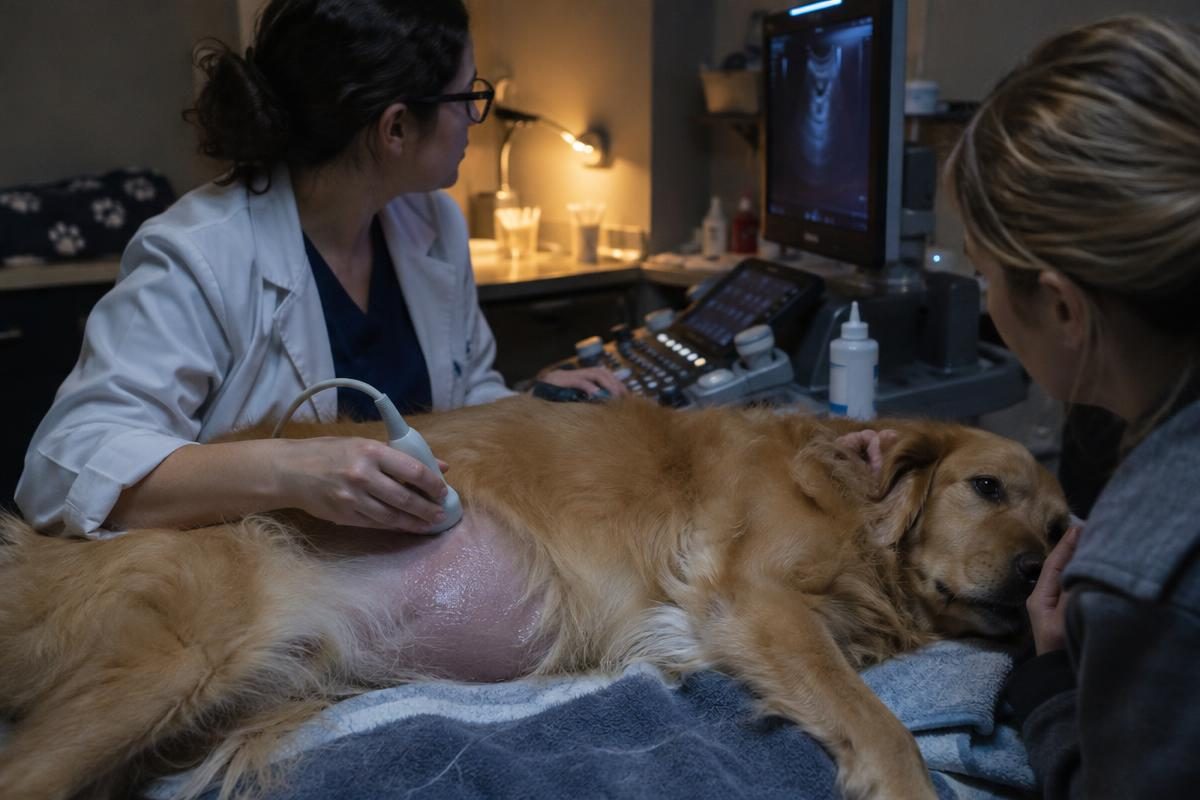
A dog calculator for pregnancy should answer two questions at once: when the puppies arrive and what the litter will cost before a single one goes home. Canine gestation averages 63 days from the first mating, but a normal birth can land anywhere from day 58 to day 72. Count from a progesterone-timed LH surge instead and the window shrinks to three days. The money side is just as wide. A Labrador litter with a paid stud, timing tests, an ultrasound and an x-ray comes to about $3,200 before food and supplies, and a French bulldog with a scheduled C-section passes $5,100.
Dog Calculator for Pregnancy: Due Date and Litter Budget
This dog pregnancy calculator starts from the date you actually know. Enter it, then swap in any prices you have quotes for. The top rows give the due date, the whelping window and four milestone dates; the rest add up the litter. Cost inputs never change the dates.
Dog Pregnancy Calculator
Enter the first mating date, or the LH surge or diestrus date from your vet's tests, and get the due date, the normal whelping window and the dates for the ultrasound, the puppy count x-ray and temperature checks. The same form adds up a litter budget: stud fee, progesterone timing, pregnancy checks, a planned C-section or a breed-based emergency reserve, and puppy care.
Due Date and Litter Budget
Estimates only, not veterinary advice. Due dates use the gestation intervals in the Merck Veterinary Manual (58 to 72 days from first mating, 64 to 66 from the LH surge, 56 to 58 from diestrus day 1) and the VCA 63-day average. Costs are US averages reviewed September 2026 from vet-reviewed price guides and breed club cost lists; C-section rates come from Evans and Adams (2010). Your clinic's quotes will differ.
Which Date Should You Count From?
Use the most precise date you have, because each one gives the whelping date a different margin of error. The Merck Veterinary Manual gives three reference points for the gestation period:
| Counting from | Due day used | Normal range | Where the date comes from |
|---|---|---|---|
| First mating | Day 63 | Day 58 to 72 | Your own notes on the first tie |
| LH surge or first progesterone rise above 2 ng/mL | Day 65 | Day 64 to 66 | Progesterone blood tests during heat |
| First day of diestrus | Day 57 | Day 56 to 58 | Vaginal smears read by a vet |
Why is the mating date so loose? A female often accepts the male before or after she ovulates, and Merck states plainly that breeding dates and conception dates don’t correlate closely enough to predict whelping. So a due date counted from the mating date is a middle guess, not an appointment. If the pair tied on several days, enter the first one.
Ovulation timing is the reason reproductive vets run progesterone tests. The LH surge is the hormone spike that triggers ovulation, and it shows up on a progesterone report as the first reading above baseline. From that day, birth arrives 64 to 66 days later in a normal canine pregnancy.
How the Calculator Builds the Timeline and the Bill
The dates come first:
- Due date. Start date plus 63, 65 or 57 days, depending on the reference you picked.
- Window. The Merck range for that reference, so 15 days wide from mating and 3 days wide from hormone data.
- Milestones. Placed on a 63-day scale that ends at the due date. An ultrasound is reliable from about day 28, according to VCA Animal Hospitals. Food goes up after week six (day 42), building toward 1.5 times normal over the last three weeks. The puppy count x-ray goes from around day 45, once the skeletons show.
- Temperature checks. Start on the first day of the window. A rectal temperature drop to about 98.8 F usually means whelping within 8 to 24 hours. Restlessness, panting and nesting in the whelping box tend to show up in the same stretch.
The budget follows in five lines:
- Breeding: stud fee, progesterone tests at $80 each, and an $80 brucellosis test.
- Pregnancy checks: a vet ultrasound at $325 or a relaxin blood test at $250, plus a late x-ray at $215, each with a $55 office visit.
- Delivery: a scheduled C-section at $2,000, or an emergency reserve equal to the breed’s C-section rate times a $4,500 emergency surgery.
- Puppies: $65 each for first shots, deworming and a microchip, plus AKC litter registration at $25 and $2 per puppy.
- Other costs: whatever you enter for the whelping box, heat lamp, milk replacer and travel.
Office visit, ultrasound, relaxin and x-ray prices are midpoints of the ranges in a January 2026 vet-reviewed guide from Hepper. The C-section figures are midpoints of the planned ($1,000 to $3,000) and emergency ($3,000 to $6,000 or more) ranges Dogster published in September 2026.
Four Litters Worked Through
The calculator reproduces each scenario exactly; all four sit in its automated test file.
A Labrador bred on March 2, 2027
With every default in place, the mating date gives a due date of Tuesday, May 4, 2027 and a window of April 29 to May 13. Book the ultrasound from March 30, raise her food from April 13 and schedule the x-ray from April 16. Breeding costs $1,320, the two vet checks $650, and five puppies with AKC registration $360. Labradors had a 20.2 percent C-section rate in the UK study, so the reserve is $909. The litter budget is $3,239, or $648 per puppy. If she does need emergency surgery, the real total is $6,830.
A French bulldog timed by progesterone
The LH surge fell on April 14, 2027. Due date: Friday, June 18, with a window of June 17 to 19. The owner paid a $1,800 stud fee, ran four progesterone tests and booked a C-section, which 81.3 percent of French bulldog litters needed in the same study. Breeding comes to $2,200, checks $650, surgery $2,000 and four puppies $293. Total: $5,143, or $1,286 per puppy.
An unplanned Chihuahua litter
The neighbor’s male got over the fence on November 20, 2026. No stud fee, no tests, no early pregnancy check. The due date is Friday, January 22, 2027, but the real window runs January 17 to 31. The only vet visit is an x-ray at $270 to count the puppies. With a 34.4 percent C-section rate the reserve is $1,548, and three puppies cost $195. The budget is $2,013; an emergency C-section turns that into $4,965.
A mastiff dated from diestrus
Vaginal smears put diestrus day 1 on June 1, 2027, so the due date is Wednesday, July 28 and the window July 27 to 29. A $1,500 stud fee brings breeding to $1,820. Mastiffs had a 64.6 percent C-section rate, so the reserve climbs to $2,907. Eight puppies cost $561 in shots and registration. Total: $5,938, or $742 per puppy.
What Drives the Cost of Breeding a Litter
Breed decides the delivery line, and delivery is the biggest swing in the budget. Evans and Adams surveyed 22,005 litters from 151 breeds for the Journal of Small Animal Practice in 2010. Their C-section rates:
| Breed | Litters by C-section | Reserve at $4,500 |
|---|---|---|
| Boston terrier | 92.3% | $4,154 |
| French bulldog | 81.3% | $3,659 |
| Mastiff | 64.6% | $2,907 |
| Chihuahua | 34.4% | $1,548 |
| Labrador retriever | 20.2% | $909 |
| Golden retriever | 17.7% | $797 |
| Border collie | 10.6% | $477 |
Boston terrier, bulldog and French bulldog litters all ran above 80 percent. For those breeds a scheduled surgery at about $2,000 is usually cheaper than waiting for an emergency one, which is exactly why owners of flat-faced breeds book the date.
The stud fee is the second big line. The Doberman Pinscher Club of America puts it at $500 to $1,800, and titled or imported sires cost more. Litter size matters less than people expect. A Norwegian study of 10,810 litters found an average of 5.4 puppies, rising with breed size from 3.5 in miniature breeds to 7.1 in giant breeds, and each extra puppy adds only $67 in shots, microchip and registration.
What we see missed most often is the reserve. Most pet insurance policies exclude breeding and birth, so the emergency C-section money has to exist before the mating, not after the first puppy gets stuck. The same breed club advises setting aside about $5,000 per litter.
When the Due Date or the Budget Is Wrong
The date is off when the start date is. A wrong mating date, a female that tied on four days, or a false pregnancy (the hormonal pattern that mimics nesting and milk without any puppies) all break the estimate. Confirm pregnancy with an ultrasound or a relaxin test before you plan around it. An x-ray count also tells you whether a female who has stopped pushing still has a puppy inside.
Call the vet if she passes the last day of the window, strains without producing a puppy, or her temperature drops and nothing follows within a day. The emergency vet cost page covers after-hours pricing.
The budget runs low when the extras pile up: a cardiologist ultrasound at $500 to $600, repeat progesterone draws, a second x-ray, or supplies you forgot. It also leaves out ongoing food for the dam. Her intake rises to about 1.5 times normal over the last three weeks, so run her through the dog food cost per month calculator at 1.5 times her usual portion. Puppies also need a second round of shots at about 10 weeks; see dog vaccination cost for the full series, and the puppy weight calculator to size the litter as it grows.
Frequently Asked Questions
How long is a dog pregnant?
About 63 days on average, or nine weeks, according to VCA Animal Hospitals. The normal range counted from the first mating is 58 to 72 days. Counted from the LH surge it is 64 to 66 days, which is why progesterone-timed breedings have far tighter due dates.
How can you tell how far along a pregnant dog is?
Count from the first mating if you know it. Without a date, a vet can estimate from an ultrasound, which is reliable from about day 28, or from an x-ray after about day 45, when the puppy skeletons are visible. Belly size is a poor guide because it depends on litter size.
How do I tell how many puppies my dog is pregnant with?
An x-ray late in pregnancy is the most accurate method, according to VCA. Ultrasound confirms the pregnancy earlier but often miscounts because the puppies overlap. The x-ray costs about $180 to $250 plus the visit, and the count tells you when the last puppy is out.
How much does it cost to breed a dog?
For a Labrador with a $1,000 stud fee, timing tests, one ultrasound, one x-ray and five puppies, about $3,200 including an emergency reserve. A flat-faced breed with a scheduled C-section runs $5,000 or more. Food, a whelping box and your time are extra.
Does pet insurance cover a dog C-section?
Usually not. Standard accident and illness policies exclude pregnancy and birth, though a few cover complications. Read the exclusions list before you breed, and plan to pay from savings or with vet financing.
Run the dog calculator for pregnancy with your own start date and quotes, print the milestone dates, and have the emergency reserve in the bank before the window opens. If the reserve is more than you can cover, talk to your vet about a scheduled C-section or about spaying instead; the dog spay cost page prices that option.
This page is general information, not veterinary advice. Gestation intervals follow the Merck Veterinary Manual and VCA Animal Hospitals; C-section rates come from Evans and Adams (2010) and litter sizes from Borge and colleagues (2011). Prices are US ranges from Hepper, Dogster and the Doberman Pinscher Club of America, checked in September 2026. Last reviewed: September 2026.