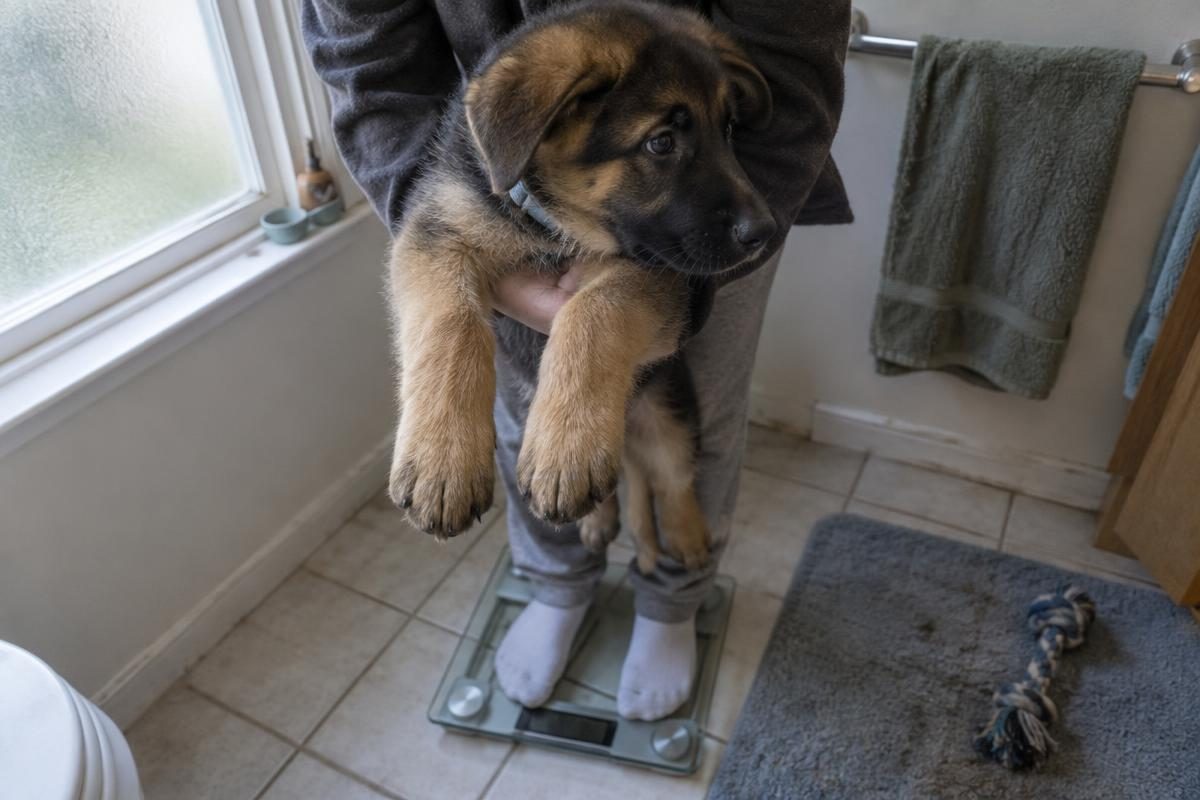
A puppy calculator weight estimate takes two numbers you already have, today’s weight and age in weeks, and reads them against a growth curve for the right size of dog. A large-breed puppy at 12 weeks has reached only about 28 percent of its adult weight. A small breed at the same age is already past half. That gap is why a dog size calculator with one formula for every dog gets small breeds badly wrong. The tool below estimates how big your puppy will get, then does the part most puppy size predictors skip: it prices what that body will cost to feed and protect from fleas, ticks and heartworm every year.
Puppy Weight Calculator With a Yearly Budget
Enter your puppy’s current weight and age, and the breed size if you know it. Mixed breeds and rescues can leave size on automatic, since the tool can estimate adult size class from the numbers alone. Then pick the food you plan to feed your dog once the growth stage ends.
Puppy Weight Calculator
Enter your puppy's current weight, age and breed size. The calculator reads how far along the growth curve for that size class the puppy is (built on the AKC growth chart), predicts adult size, and prices what that size costs a year in food and parasite prevention.
Predicted Adult Size and Yearly Budget
Estimates only. Adult size is the current weigh-in divided by the share of adult weight reached for the chosen size class, using the AKC growth chart (reviewed June 2026) with 50 percent anchors from breed council guidance, straight-line between points. Individual puppies vary, genetics and diet move the result, and mixed breeds are the least predictable. Food cost uses the veterinary RER formula (NRC 2006, Ohio State University factors) with 2026 US prices; prevention uses retail list prices by dose band reviewed September 2026. Ask your veterinarian to score body condition at each visit.
The headline figure is the likely adult weight, a midpoint. Treat it as the center of a range, and re-run it every few weeks until the curve settles, because each new weigh-in narrows the answer.
How the Puppy Calculator Weight Estimate Is Built
To estimate adult weight, the method is division. Current weight divided by the share of adult weight reached at this age gives the puppy’s adult weight. Everything depends on getting that share right, and it depends on size class far more than on age alone.
The shares come from the puppy weight chart published by the American Kennel Club, updated June 2026, which splits dogs into four size categories by adult weight:
| Age | Small (up to 20 lb) | Medium (21 to 50 lb) | Large (51 to 100 lb) | Giant (100+ lb) |
|---|---|---|---|---|
| 6 months | 75% | 66% | 60% | 50% |
| 9 months | 90% | 85% | 75% | 65% |
| 12 months | 100% | 95% | 85% | 80% |
| 15 months | 100% | 100% | 95% | 90% |
| 18 months | 100% | 100% | 100% | 100% |
Most owners weigh long before six months, so the tool adds one earlier point per class from the German Shepherd Dog Council of Australia’s puppy feeding guidance: small dogs hit half their adult size by 12 weeks, medium dogs by 16 weeks, large dogs by about 5 months and giants by 6 months. Between points it draws a straight line. Before the first point the line starts at birth, which is an assumption rather than published data, so treat any result from 8 to 11 weeks as provisional.
On automatic, the calculator works by trying all four curves. It keeps the one whose answer lands inside its own weight range. A puppy that would be 26 lb on the small curve (too heavy for small) and 30 on the medium curve (inside medium) gets the medium answer.
Why the Weeks Times 52 Shortcut Misses
The formula most free puppy weight calculators use is weight divided by age in weeks, times 52. It assumes every dog grows in a straight line and stops on its first birthday. Neither is true. Salt and colleagues at the WALTHAM Centre for Pet Nutrition, working from records of more than 6 million young dogs at Banfield hospitals (PLOS ONE, 2017), note that very small dogs reach adult size at 8 to 12 months while larger breeds need up to 24 months to reach full size.
Run the shortcut on a 3 lb toy pup at 10 weeks and it says 15.6 lb. The size curve says 7 lb, less than half as much. For a 20 lb large-breed pup at 12 weeks the shortcut says 87 lb; the large curve says 72. They come close for a giant at six months (120 lb against 119.6), where the straight line happens to cross the real curve.
Four Puppies, Four Forecasts and Their Budgets
All four use mid-range kibble and a spayed or neutered adult. They are also the scenarios in the tool’s automated test file, so the page and the numbers you see in the results box cannot drift apart.
Large breed, 20 lb at 12 weeks
At 12 weeks a large-breed puppy is 27.6 percent grown, so 20 lb points to an adult weight of 72 lb (32.9 kg), reached at about 18 months. At that size, kibble costs $64 a month or $774 a year. Puppy food through the remaining 15 months of growth costs about $1,006, because young dogs eat two to three times their resting energy need. Parasite prevention in the 44.1 to 88 pound band adds $447.62 a year, for $1,221 combined. Switching to grocery-brand kibble drops the food line to about $35 a month.
Small breed, 3 lb at 10 weeks
The small curve puts a 10-week puppy at 41.7 percent, so the forecast is 7.2 pounds. Food for an adult dog that size is $11 a month, $137 a year. Prevention costs $400.62 a year and is now the bigger line. Weigh again at 12 and 16 weeks; results before 12 weeks move the most.
Unknown parentage on automatic, 15 lb at 16 weeks
The medium curve fits: 50 percent grown, 30 lb when finished at around 15 months. Food runs $33 a month and $399 a year, the growth stretch about $406, and prevention in the 22.1 to 44 pound band $434.96. Total: $834 a year at full size.
Giant breed, 60 lb at 6 months
Entered as 6 months, this pup is halfway, so the forecast is 120 lb (54.4 kg) at 18 months. Kibble costs $94 a month and $1,130 a year, the rest of the growth period about $1,162, and prevention $451. That is $1,581 a year before a single vet visit.
What Grown Size Does to Food and Vet Costs
Food scales with size; prevention barely does. A 72 lb dog eats about 5.6 times the kibble bill of a 7 lb dog ($774 against $137 a year), while a monthly flea, tick and heartworm chewable such as Simparica Trio costs only about 13 percent more in its largest band than in the 11.1 to 22 pound band. Chewy’s September 2026 list prices for a six-month supply run from $200.31 to $225.50.
- Food: every extra 10 lb of adult weight adds about $79 a year in mid-range kibble for a 72 lb dog, and more on fresh food. An 8 kg intact medium puppy on a fresh subscription adds $651 a year per 10 lb.
- Prevention: dose bands change as the puppy grows, so expect to buy two or three box sizes in the first year.
- Procedures: anesthesia and many drugs are dosed per kilogram, which is why clinics price surgery by the dog’s weight. See the dog spay cost and dog dental cleaning cost guides for those lines.
For the full grocery picture, the dog food cost per month calculator uses the same calorie formula with treats, bag sizes and label calorie density, so its numbers match this page. The pet insurance cost calculator covers premiums, which insurers set by breed and age, and which are lowest before anything is diagnosed.
When the Prediction Will Be Wrong
We check every forecast against the trend in the puppy’s weight, and three situations throw it off most:
- Weighing before 12 weeks. The WALTHAM growth charts are validated only from 12 weeks because early growth varies so much between litters.
- A mixed breed with parents of different sizes. The automatic setting picks a curve, but a Lab and Beagle cross can follow either parent.
- A puppy that is too fat or too thin. The curves assume a healthy weight and ideal body condition. An overweight pup’s forecast is inflated; the fix is the ration, not the estimate.
Spaying or neutering matters less than owners expect. The PLOS ONE study found surgery before 37 weeks shifted growth slightly up and after 37 weeks slightly down, but both shifts were small next to the normal differences between individual dogs.
WALTHAM recommends weighing every 2 to 4 weeks until 6 months, then every 1 to 3 months until growth ends. Three weigh-ins two weeks apart after 12 weeks show which curve the puppy’s growth is really following. Once growth ends, WALTHAM advises a vet check if weight changes by more than 5 percent.
Start today: weigh your puppy on the same scale before breakfast, run the puppy weight calculator again, and note the yearly budget. Repeat at the next vaccine visit and adjust the food plan when the forecast moves. The dog age calculator picks up where this one leaves off once growth is done.
Frequently Asked Questions
At what age can you tell how big a puppy will get?
Around 16 weeks for most dogs, and 6 months for large and giant breeds. By then small breeds are over half grown and giants have reached 50 percent, so dividing by the right share gives a stable answer. Earlier estimates can shift by several pounds.
Can you predict size from paw size?
Not reliably. Big paws hint at a bigger frame, but no published growth standard uses paw measurements. Weight at a known age against a size-specific curve is the method growth charts use.
Is it normal for a 5-month-old to weigh 30 pounds?
It depends on the breed class. On the large curve, a pup at 5 months is about half grown, so 30 lb points to roughly 60 lb, squarely inside the large range. On the small curve the same weight would be far outside the range, which tells you the pup is not a small breed.
How much will a bigger dog cost to feed?
With mid-range kibble at 2026 prices, a 7 lb dog costs about $137 a year, a 30-pounder $399, a 72-pounder $774 and a 120-pounder $1,130. Calories rise more slowly than weight, so a dog ten times heavier eats roughly 5.6 times as much.
Do male and female puppies grow differently?
Yes, male dogs usually finish heavier. The WALTHAM charts are split by sex for that reason. This tool uses one curve per size class, so it will tend to under-read a large male and over-read a small female slightly.
A good puppy calculator weight forecast is a habit, not a single reading: weigh, re-run, and let the budget follow the curve.
This page is general information, not veterinary advice. Growth shares come from the American Kennel Club puppy growth chart and German Shepherd Dog Council of Australia guidance, with context from Salt et al. (PLOS ONE, 2017) and the WALTHAM Puppy Growth Charts. Food cost uses the NRC 2006 energy formula with Ohio State University factors; prevention prices are Chewy list prices checked in September 2026. Last reviewed: September 2026.