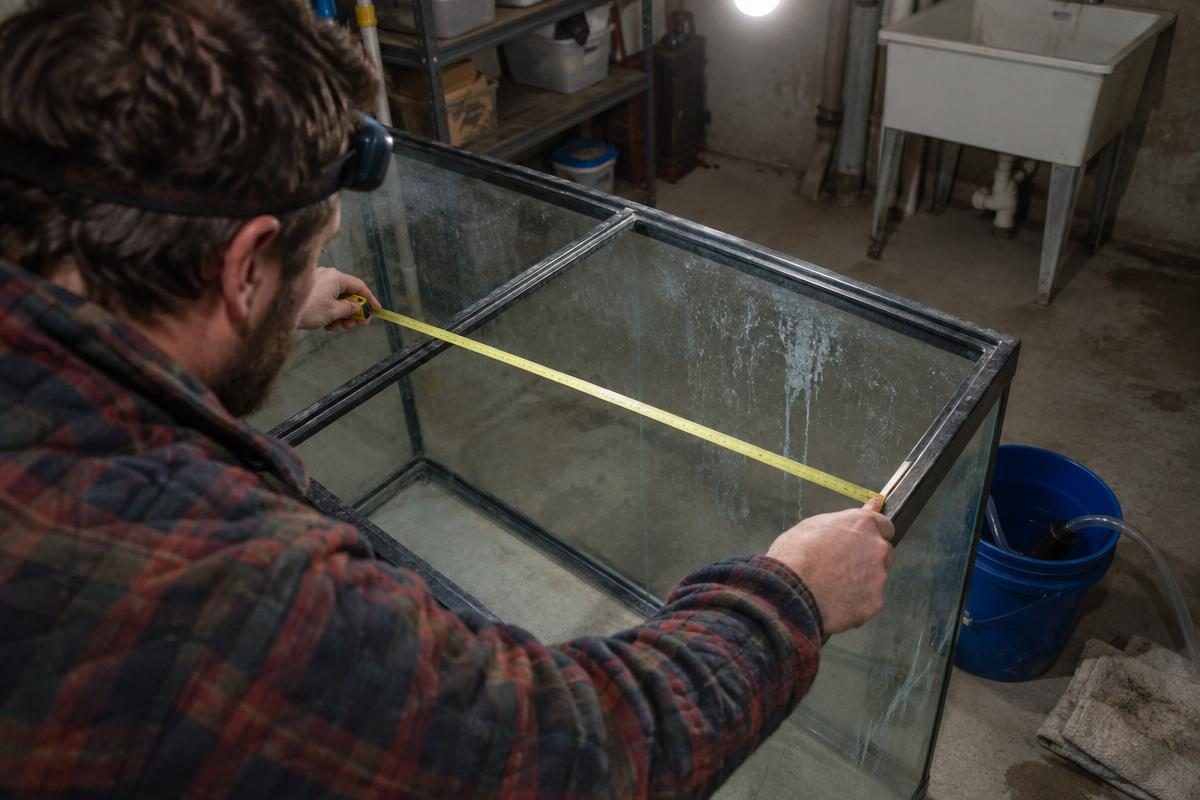
A fish tank capacity calculator turns three or four tape measurements into US gallons and liters, and the good ones then tell you how much water is really in there. Those are different numbers. A standard 55 gallon measures 48 x 13 x 21 inches on the outside, which is 56.7 gallons of box. Leave an inch of air under the rim and add 2 inches of gravel and it holds 48.6 gallons, about 86 percent. The tool below does both calculations for rectangle, cube, cylinder, bow-front and hexagon shapes, then prices a freshwater setup for that size from September 2026 shelf prices.
Fish Tank Capacity Calculator
Pick the tank shape, choose inches or centimeters, and enter the outside tank dimensions. On its own, the first block is a plain fish tank volume calculator in gallons and liters. The second block subtracts the displacement from glass, the gap below the rim, substrate and rock, leaving the usable water. The third builds a setup budget.
Fish Tank Volume Calculator
Pick the tank shape, enter its measurements in inches or centimeters, and get the full volume and the water it really holds in US gallons and liters. Glass, the gap below the rim, substrate and rock are subtracted, and a setup budget for a freshwater tank up to 75 gallons is priced from September 2026 shelf prices.
Your Aquarium in Gallons and Liters
Estimates only. Volumes use standard geometry for each shape with 231 cubic inches per US gallon and 3.785 liters per gallon (NIST); real tanks have rounded corners, braces and rims that shave off a little more. Water weight uses the USGS density of water at 70 F. Setup prices are PetSmart and Aquarium Co-op shelf prices reviewed September 2026 and will change with sales and region.
Use the “water it actually holds” line for water conditioner, fertilizer and medication doses. Use the full volume only when comparing tank sizes on a shelf or reading a manufacturer’s spec sheet.
Box Volume or Real Water: Which Number Do You Need?
Gross volume is the space inside the dimensions you measured, filled to the brim. Real water volume is what’s left after the glass walls, the unfilled strip at the top, the substrate and any stone. Manufacturers name a size after something close to the gross figure, rounded to a familiar number. Nobody runs an aquarium that way.
Four things reduce the real water volume:
- Glass. Outside measurements include two panels on every side plus the bottom. Three-eighths-inch glass on a 75 gallon cuts the footprint from 48 x 18 to 47.25 x 17.25 inches.
- The gap below the rim. Most people keep the water level an inch or so below the top so the lid and filter lip clear it. On a 48 x 13 footprint, each inch is 2.7 gallons.
- Substrate. Two inches of gravel in that same footprint takes 5.4 gallons of space. The calculator subtracts the whole layer, because water trapped between grains doesn’t circulate with the rest.
- Rock. Stone weighs about 2.7 times as much as the same volume of water (marble, slate and dense limestone run 2.67 to 2.84 g/cm3 in LibreTexts’ rock density table), so 100 lb of rock pushes out about 4.4 gallons. Driftwood and hollow resin ornaments displace much less.
Stack them up and a tank loses about 12 to 26 percent in our examples below. At the high end, dosing by the full volume puts in a third more than intended.
Formulas for Rectangle, Cube, Cylinder, Bow Front and Hexagon Tanks
Every aquarium shape is a prism: a flat base shape pushed straight up. So you calculate the area of the footprint, multiply by the height, and convert. Here’s each formula with one example worked to the brim.
| Shape | Footprint area | Example (inches) | Full volume |
|---|---|---|---|
| Rectangular | length x width | 48 x 13, 21 tall | 56.7 gal |
| Cube | side x side | 18 on every edge | 25.2 gal |
| Cylinder | 3.1416 x radius x radius | 20 across, 30 tall | 40.8 gal |
| Bow front | length x end depth, plus 3.1416 x (length / 2) x bow depth / 2 | 30 long, 12 to 15 deep, 24 tall | 44.7 gal |
| Hexagon (six equal sides) | 2.598 x side x side | 12 per side, 24 tall | 38.9 gal |
Conversion is the step people fumble. One US gallon is exactly 231 cubic inches and 3.785 liters, per the National Institute of Standards and Technology. For metric tape measures, cubic centimeters divided by 1,000 give liters directly. A cylindrical tank measured in centimeters never needs to touch the number 231.
The bow front formula treats the curved glass as half an ellipse sitting on a rectangle. “End depth” is front to back at a flat side panel; “bow depth” is how far the curve sticks out past that, so a tank that is 12 inches deep at the ends and 15 at the center has a 3 inch bow. Inch Calculator publishes the same formula. The shortcut of taking the rectangle and adding 15 to 20 percent lands close on most commercial bow fronts but drifts on deep bows.
For hexagons, measure one side panel from corner to corner. The 2.598 factor only holds when all six panels match. Flat-back hexagons and corner (quarter-cylinder) tanks are different shapes; measure them as the nearest shape and treat the answer as a planning estimate.
Standard Aquarium Sizes: Dimensions, Weight and Setup Cost
Here are the common glass sizes run through the calculator with a 1 inch gap and 2 inches of gravel, then priced as a tropical freshwater setup. Dimensions are outside measurements from Top Shelf Aquatics’ size chart; filled weights are theirs too and include glass and gravel.
| Tank size | L x W x H (in) | Full volume | Real water | Filled weight | Setup with stand | Setup, no stand |
|---|---|---|---|---|---|---|
| 10 gal | 20 x 10 x 12 | 10.4 gal | 7.8 gal | about 111 lb | $354 | $258 |
| 20 long | 30 x 12 x 12 | 18.7 gal | 14.0 gal | about 225 lb | $481 | $361 |
| 29 gal | 30 x 12 x 18 | 28.1 gal | 23.4 gal | about 330 lb | $528 | $408 |
| 40 breeder | 36 x 18 x 16 | 44.9 gal | 36.5 gal | about 458 lb | $790 | $565 |
| 55 gal | 48 x 13 x 21 | 56.7 gal | 48.6 gal | about 625 lb | $880 | $655 |
| 75 gal | 48 x 18 x 21 | 78.5 gal | 67.3 gal | about 850 lb | $993 | $768 |
Notice the 20 long and the 29 share a footprint and a stand. The 29 costs only about $47 more to set up and holds 9 more gallons of real water, which is why it’s the usual advice for a first community tank. The jump from 29 to 40 breeder is the expensive one: filter, heater, light and stand all move up a class at once.
Floor load matters more than most buyers think. A 75 gallon at 850 lb sits on four stand feet. On an upper floor, place it along a load-bearing wall and across the joists rather than in the middle of a span.
Measuring and Pricing Four Example Setups
Each of these runs through the calculator exactly as written. They’re also the scenarios in its automated test file, so page and tool can’t drift apart.
A standard 55 gallon with gravel
48 x 13 x 21 inches outside, glass left at 0, a 1 inch gap and 2 inches of gravel. The box is 56.7 gallons (214.7 L). The water column is 18 inches, so 48 x 13 x 18 / 231 = 48.6 gallons, or 184.1 liters. That water alone weighs 405 lb at 8.33 lb per gallon, the USGS figure for water at 70 F. The setup budget comes to $880: tank $207, filter $75, 300 W heater $70, 48 inch LED $180, stand $225, 57 lb of gravel $76 and starter supplies $48. That’s $15.52 per gallon. Coldwater fish such as goldfish drop the heater and bring it to $810.
A labeled 75 gallon with thick glass and a rock wall
48 x 18 x 21 inches outside with 3/8 inch glass, the same gap and gravel, and 100 lb of stone. Full volume is 78.5 gallons. Inside, the footprint is 47.25 x 17.25 and the column 17.6 inches, giving 62.2 gallons before rock. The stone takes 4.4 gallons, leaving 57.7. That’s 74 percent of the number printed on the box. Setup with stand prices at $993.
A bow front, 30 inches long
12 inches deep at the ends, 15 at the center of the bow, 24 tall. The rectangle part is 360 square inches, the half ellipse adds 70.7, and the full volume is 44.7 gallons. With the gap and gravel it holds 39.2 gallons (88 percent). Setup prices at $789, but that uses the rectangle glass price; a curved-front tank usually costs more than a flat one of the same size.
A round column in centimeters
50 cm across, 60 cm tall, 0.8 cm acrylic, a 2.5 cm gap and 5 cm of sand. Full volume is 117.8 liters (31.1 US gallons). The inside diameter is 48.4 cm and the water column 51.7 cm, so the aquarium volume in liters is 95.1, or 25.1 gallons. The acrylic wall, the gap and the sand take 19 percent of the full volume between them.
What the Setup Budget Buys at Each Size
We priced one product per size class from PetSmart and Aquarium Co-op on September 30, 2026, rather than averaging random guides. The lines are:
- Tank. Aqueon standard glass at PetSmart list price: 5.5 gal $32.99, 20 gal $79.99, 29 gal $99.99, 55 gal $199.99, 60 gal $219.99. Sizes in between are interpolated by gallons. Tick “I already own the tank” to drop it.
- Filter. A hang-on-back filter rated for 20 to 30 gal ($34.95) up to 30 gal of box volume, then a power filter rated to 75 ($74.95).
- Heater. Wattage follows Aquarium Co-op’s size table: one 50 W preset up to 15 gal, two 50 W units to 30, then a 300 W adjustable. The aquarium heater size calculator goes deeper on wattage.
- Light. Fluval AquaSky LEDs by length class: $79.99, $134.99 or $179.99.
- Stand. $96 to $230 depending on class. Optional, since plenty of small tanks go on a dresser.
- Gravel. 1 lb per gallon, Aquarium Co-op’s rule of thumb, bought in 5 or 20 lb bags. For depth-based amounts by the bag, use the fish tank gravel calculator.
- Starter supplies. Test strips for ammonia and general water parameters, a bacteria starter and a gravel vacuum, $47.96.
Fish, a lid and live plants aren’t in the default total. Enter a decor and plants budget to add your own number. Reef tanks need lighting, flow and filtration this list doesn’t cover, so treat the total as a freshwater figure.
Why Your Gallon Count Might Still Be Off
Rounded corners, center braces and the plastic rim all shave a little off. Rimless tanks with thin glass come closest to the math. If your filter hangs inside the tank, subtract its volume by hand.
Canister and sump systems go the other way. Water sitting in a sump or canister counts toward the system total for dosing, so add it. A 10 gallon sump under a 40 breeder adds roughly a quarter to the real water.
If the numbers matter to the ounce, for example when dosing copper, measure it the old way: count buckets of known volume as you fill. It’s slow, but it’s the only fully accurate water volume you’ll get.
Knowing the real gallons is also step one for stocking. The fish stocking calculator takes that number and works out how many fish the tank can hold for the species you pick, and the pet cost calculator adds food, water care and electricity to the yearly budget.
Quick Answers on Aquarium Capacity
How do I calculate how many gallons my fish tank holds?
Measure length, width and height in inches, multiply them, and divide by 231. That’s the full volume. For the water actually in the tank, use the water height from the top of the substrate to the waterline instead of the full height, and measure inside the glass.
How many liters is a 55 gallon aquarium?
A true 55 US gallons is 208.2 liters. A standard 48 x 13 x 21 inch tank measures 214.7 liters to the brim from outside dimensions, and holds about 184 liters with an inch of air at the top and 2 inches of gravel.
Does substrate reduce aquarium volume?
Yes. Every inch of substrate costs one inch of water column across the whole footprint. On a 55 gallon that’s about 2.7 gallons per inch, so a 3 inch planted bed takes roughly 8 gallons out of circulation.
How much does a filled 55 gallon tank weigh?
About 625 lb with glass and gravel, per Top Shelf Aquatics’ chart. The water alone in a typical setup is around 405 lb. The stand, rock and equipment come on top of that.
Should I dose by the label size or the real water volume?
By the real water volume, following the product’s own label directions. Dosing a 55 by its name when it holds 48.6 gallons puts in about 13 percent more than intended, and a heavily aquascaped tank can be off by a quarter or more.
Run the fish tank capacity calculator once with outside measurements for the box size, then again with your real gap, substrate and rock, and write the second number on a piece of tape on the stand. That’s the figure every bottle, stocking plan and heater guide will ask you for.
This page is general information, not veterinary advice. Volume conversions follow NIST (231 cubic inches and 3.785 liters per US gallon); water weight uses the USGS Water Science School density table; rock density follows the LibreTexts rock and soil density table; bow front geometry follows Inch Calculator; standard dimensions and filled weights come from Top Shelf Aquatics; setup prices are PetSmart and Aquarium Co-op shelf prices checked September 30, 2026 and will change. Last reviewed: September 2026.