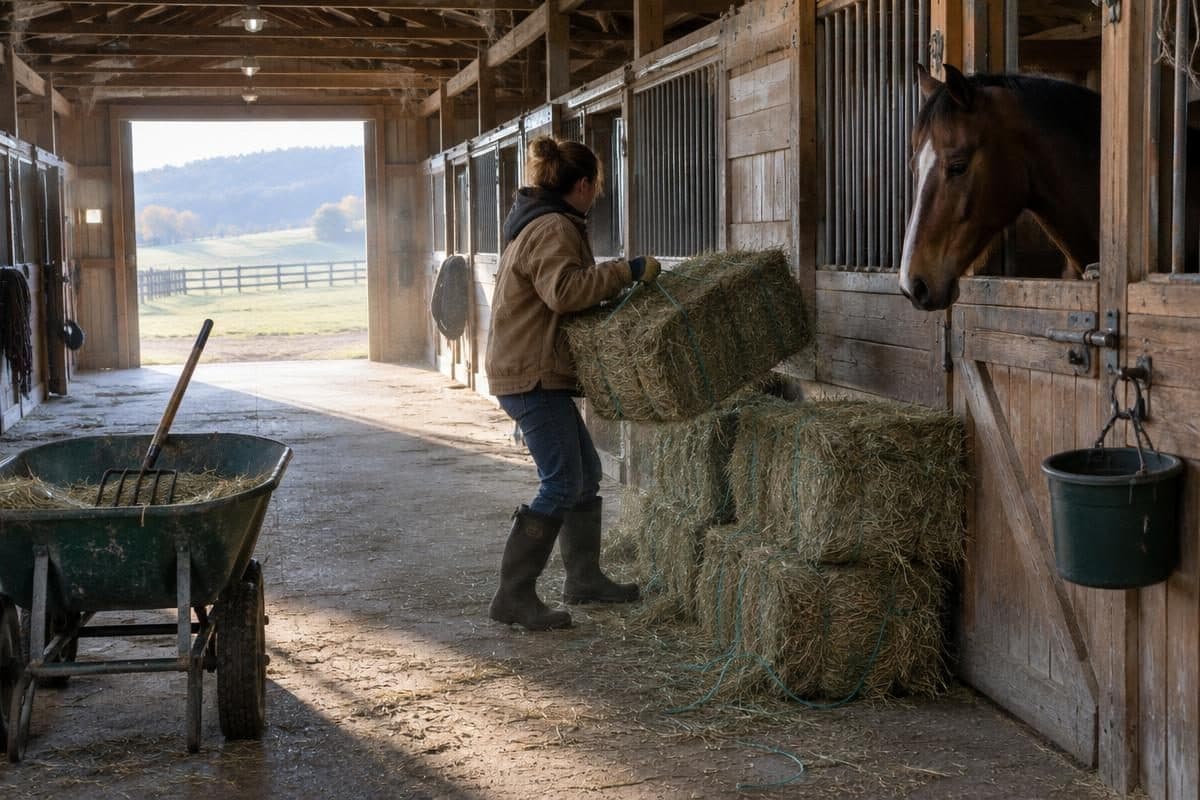
A typical horse cost per month is about $624 on full board and $214 to $256 when the animal lives at home, before insurance or emergencies. Those figures use the 2026 national trim average ($61), owner-reported veterinary and dental bills, and USDA’s August 2026 hay price. The stable fee is the line that decides the overall cost: it’s 84 percent of the full-care total. Move the animal home and hay takes over as the biggest bill, which is why the calculator below asks for body weight and what you pay per bale.
Price Your Barn, Hay and Hoof Care in One Monthly Figure
Pick where the animal lives, then replace any default with a number from your own barn sheet, hay receipt or hoof care invoice. The estimate adds the stable fee, hay, grain, hoof care, routine veterinary expenses, insurance and savings, and shows which one costs you the most.
Horse Cost Per Month Calculator
Choose where your animal lives, how you buy hay and feed, trims or shoes, the level of routine vet care and optional insurance. The estimator builds a monthly budget line by line from 2026 USDA hay prices, the 2026 American Farriers Journal price survey, a university extension forage rule and published owner surveys.
Your Monthly Budget
Estimates only. Stable fee defaults come from a national owner survey and a 2025 study of boarding facilities, hay from USDA's August 2026 price and a University of Kentucky 2026 bale range, forage intake from University of Minnesota Extension, farrier prices from the 2026 American Farriers Journal survey, vet and dental from owner-reported averages, and insurance from a 2025 agency rate guide. Prices vary by region and barn. Reviewed September 2026.
Every default is a published 2026 or recent survey figure, listed at the bottom of this page. Horse costs can vary a lot from barn to barn, and many horse owners pay well above or below the averages, so your own prices always beat ours.
What Does a Horse Cost Per Month on Each Kind of Board?
Board is the fee a stable charges to house and care for your horse. What it includes varies. A 2025 study of 112 equine boarding facilities, run through university Extension programs in Arkansas, Illinois and Tennessee, defined full board as covering facility use, feed and daily care, and partial arrangements as covering some of those. Neither kind includes farrier costs or veterinary care.
| Arrangement | What the fee covers | Monthly fee | Monthly total (trim, exam, vaccines, dental) |
|---|---|---|---|
| Full board | Stall, hay, grain and daily care | $526 | $624 |
| Pasture board | Field, shelter, water, hay when grass runs short | $241 | $339 |
| Self care or partial | Space only; you feed and clean | $241 | $455 with bales at $9.50 |
| At home, small squares | Nothing; you own the land | $0 | $214 |
| At home, hay by the ton | Nothing | $0 | $156 at $190 a ton |
The $526 default is what recreational riders reported paying in the Synchrony CareCredit ownership survey ($6,311 a year). The facility study found a full-care mean of $520 and every other type averaging $241, and boarding a horse can cost anywhere from $100 to $2,000 a month. Board costs vary widely with location, and so does the average cost of everything else. TheHorse.com reported $1,600 a month for full care in South Florida.
Keeping a horse on your own property looks cheap in this table because it leaves out the farm. Fencing, a run-in shed, water lines, bedding and a tractor are part of the real cost of owning a horse, just not monthly items you can price from a survey.
Hay and Feed Costs by Body Weight and State
An adult horse eats 1.5 to 2.5 percent of its body weight in forage every day, according to University of Minnesota Extension, and 2.5 percent is close to the most one will eat voluntarily. At 2 percent, a 1,000-pound gelding eats 20 lb a day, about 7,305 lb or 3.65 tons a year when there’s no grass.
Hay costs vary depending on where you buy them. USDA’s August 2026 survey of prices farmers received put the national all-hay average at $190 a ton, up $29 from a year earlier. State prices for the same month:
| State (all hay, August 2026) | Price per ton | Hay a month, 1,000 lb at 2 percent |
|---|---|---|
| New Mexico | $275 | $83.70 |
| Kentucky | $231 | $70.31 |
| Pennsylvania | $227 | $69.09 |
| California | $226 | $68.79 |
| United States | $190 | $57.83 |
| Texas | $144 | $43.83 |
| Minnesota | $113 | $34.39 |
Here’s the catch most budgets miss. USDA’s figure is a farm-gate price, mostly for large bales sold by the load. Horse owners buying a few small squares at a time pay retail. In Kentucky, University of Kentucky extension specialist Bob Coleman told TheHorse.com that small square bales ran $7 to $12 in summer 2026. At 50 lb a bale that’s $280 to $480 a ton, or $85 to $146 a month for the same 20-lb-a-day animal. Buying by the bale can double the hay line.
Owners who buy their own hay have two ways to cut feed costs: buy a winter’s supply at once from a grower, and feed from a slow feeder or rack so less gets trampled. Grass cuts hay needs to zero only when pasture is good enough to replace it completely, so count those months honestly.
Hoof Care, Vet and Dental: Horse Care Costs a Stable Never Covers
A farrier is the professional who trims hooves and fits shoes. A trim typically costs $61 and a trim with four keg shoes $184, the national averages in the 2026 American Farriers Journal survey. Regional prices ran from $54 and $166 in the central states to $75 and $197 in the far west, and respondents said they plan a 4 percent raise for 2027.
A typical horse needs a trim or reset every six to eight weeks, about seven visits a year. At seven weeks that’s $37.89 a month barefoot and $114.30 in shoes. The choice between the two moves the monthly bill by $76, more than the whole routine veterinary line.
For routine veterinary care, the CareCredit survey asked horse owners what they actually paid. We added three lines, exam, vaccinations and an equine dental float, into an annual cost by type of horse:
- Backyard or pasture horse: $277 exam, $233 vaccination, $167 dental. $677 a year, $56.42 a month.
- Recreational riding horse: $271, $253 and $198. $722 a year, $60.17 a month.
- Competition horse: $332, $402 and $240. $974 a year, $81.17 a month.
Those are average costs, and they skip deworming, fecal tests and the Coggins test many shows and boarding barns require. Coleman estimated routine veterinary care with a Coggins and health certificate approaches $1,500 a year in Kentucky. If your equine veterinarian charges a farm call fee, add it. Each of those visits helps keep your horse healthy, so leave room for them.
How the Monthly Estimate Is Built
- Board. Your fee, or the default for your arrangement: $526 full, $241 pasture or self care, $0 at home.
- Hay. Weight x forage percent x 365.25 days x (12 minus grass months) / 12 gives pounds a year. Divide by bale weight and multiply by bale price, or divide by 2,000 and multiply by the ton price. Divide by 12.
- Grain or ration balancer. Pounds a day x 365.25 x bag price / 50, divided by 12.
- Hoof care. Price per visit x 365.25 / (7 x weeks between visits), divided by 12.
- Veterinary and dental. $677, $722 or $974 a year, divided by 12.
- Insurance. 3.35 percent of insured value a year, plus $250 for a medical endorsement, divided by 12.
- Total. The lines plus emergency savings, times the number of horses. Per day is the monthly total divided by 30.44.
Four Horses, Four Monthly Budgets
1. A trail horse in a full-care barn
$526 a month with hay and grain included, a barefoot trim every seven weeks, recreational-level veterinary care. Total $624.06 a month, $7,488.70 a year, or $20.50 a day. Switch to shoes and it rises to $700.46.
2. A backyard gelding on small squares
Kept at home, 1,000 lb, 2 percent forage, 50-lb bales at $9.50, 3 lb a day of grain at $25 a bag, barefoot, backyard veterinary level. Hay $115.66, grain $45.66, trims $37.89, veterinary $56.42: $255.63 a month and $3,067.52 a year. Hay is 45 percent of it, 3.65 tons a year. A second animal doubles it to $511.25.
3. Self care with five months of grass
$241 for self-care space, an 1,100-lb mare eating 22 lb a day, hay bought by the ton at $190 with five months on pasture, the same grain, trim and recreational veterinary care. Hay drops to 2.34 tons a year and $37.11 a month. Total $421.82 a month, $5,061.87 a year.
4. A show horse in South Florida
$1,600 full care, shoes at $184 every seven weeks, competition-level veterinary care, and a $25,000 mortality policy with medical cover ($837.50 plus $250 a year). Total $1,886.09 a month, $22,633.05 a year. The stable fee is 85 percent of it.
Compare those with the survey totals. CareCredit’s basic annual cost of horse ownership was $8,600 at the backyard level, $11,800 for recreational and $26,000 for competition, about $717, $983 and $2,167 a month. Our defaults come in lower because they price only what it takes to keep a horse fed, trimmed and vaccinated: stable fees, feed, hooves, routine veterinary care and insurance. The other ownership costs, such as lessons and bedding, are extra costs you add.
Insurance and the Emergency Fund Question
Mortality insurance is a policy that pays the insured value if the animal dies or has to be euthanized. Marshall & Sterling, an equine insurance agency, quotes full mortality for show and pleasure horses through age 14 at 3.0 to 3.7 percent of value a year: $300 to $370 on a $10,000 horse, so a more expensive horse costs more to insure at the same rate. Medical and surgical endorsements start at $250 a year for a $5,000 limit, and the agency’s full mortality policies include up to $5,000 of emergency colic surgery cover for animals with no colic history.
Insurance isn’t the same as a savings account, though. Veterinarian Mike Pownall told TheHorse.com that vets suggest setting aside $6,500 a year for health care, about $542 a month. That’s a lot for most owners, and it’s meant for the costs associated with illness and injury. Even $100 a month in the emergency field moves the total more than switching from bales to tons does.
Hidden Costs of Owning a Horse the Monthly Number Leaves Out
These ownership expenses sit outside the calculator:
- Purchase price. The initial purchase price is a one-time cost of buying a horse, so it isn’t in the monthly figure. Enter the purchase price of a horse as its insured value if you want the premium.
- Riding lessons and training costs. TheHorse.com reported just under $50 a lesson and a little over $70 per session of training in Tennessee, and $100 or more for a private lesson in the mid-Atlantic.
- Bedding, tack and blankets. Shavings for a stalled horse, saddle fitting and replacements. Put a monthly figure in emergency savings if you’d rather see one total.
- Property maintenance. Ongoing maintenance costs include fencing repairs, pasture seeding, water and electricity for a home barn.
- Hay testing and waste. Coleman puts a hay test at $20 to $40, and hay fed on the ground loses some to trampling. Pick the 2.5 percent option if you see a lot left over.
- Older or special-needs horses. An older horse may cost more each month, since it can need senior feed, metabolic testing or corrective shoeing, and each one pushes ongoing expenses past the averages.
Start with the two numbers you can get today: your barn’s price sheet and your price per hoof care visit. Enter them, weigh the animal with a weight tape, and price hay the way you actually buy it. That gives you a horse cost per month you can budget against. Then add emergency savings until the monthly cost of owning a horse is one you’d still pay in a bad month. For the rest of your animals, the pet cost calculator covers other species, and it’s worth knowing what an emergency vet visit costs for small animals too. Dog owners can run the same kind of budget with the dog food cost per month tool, and the pet insurance cost calculator compares cover for cats and dogs.
Questions New Horse Owners Ask
How much does a horse cost per month on average?
About $624 in a full-care barn and $214 to $256 at home, using national averages for board, hay, trims and routine vet care. Owners in CareCredit’s survey reported basic yearly costs equal to $717 to $2,167 a month, depending on whether the horse was a backyard, recreational or competition animal.
Is keeping a horse at home cheaper than boarding?
Month to month, usually. With no stable fee, that leaves hay, grain, hooves and vet care, about $156 to $256 in our examples. The savings pay for fencing, shelter, water, bedding and your own daily labor, which the monthly number doesn’t include.
How much hay does a horse eat in a month?
A 1,000-lb horse eating 2 percent of its weight needs about 20 lb a day, roughly 609 lb or twelve 50-lb bales a month. At 2.5 percent, University of Minnesota Extension’s upper figure, that rises to about 761 lb.
How often does a horse need the farrier?
Every six to eight weeks for most horses, about seven visits a year. At 2026 national averages that’s $455 a year barefoot or $1,372 a year with four shoes.
Does full board cover the vet and farrier?
No. Full board covers the facility, feed and daily care. Trims and shoeing, vaccinations, dental floats and emergencies are billed to you, and they added $98 a month to the full-care example above.
This horse cost per month estimate is general information, not veterinary advice. Stable fees come from the Synchrony CareCredit horse ownership survey and TheHorse.com, and from Thompson, Kibler and Ivey’s 2025 boarding facility study; hay prices from USDA NASS (August 2026) and the University of Kentucky; forage intake from University of Minnesota Extension; farrier prices from the 2026 American Farriers Journal survey; insurance rates from Marshall & Sterling (2025); feed bag prices from retailer listings. Prices vary widely by region and barn. Last reviewed: September 2026.