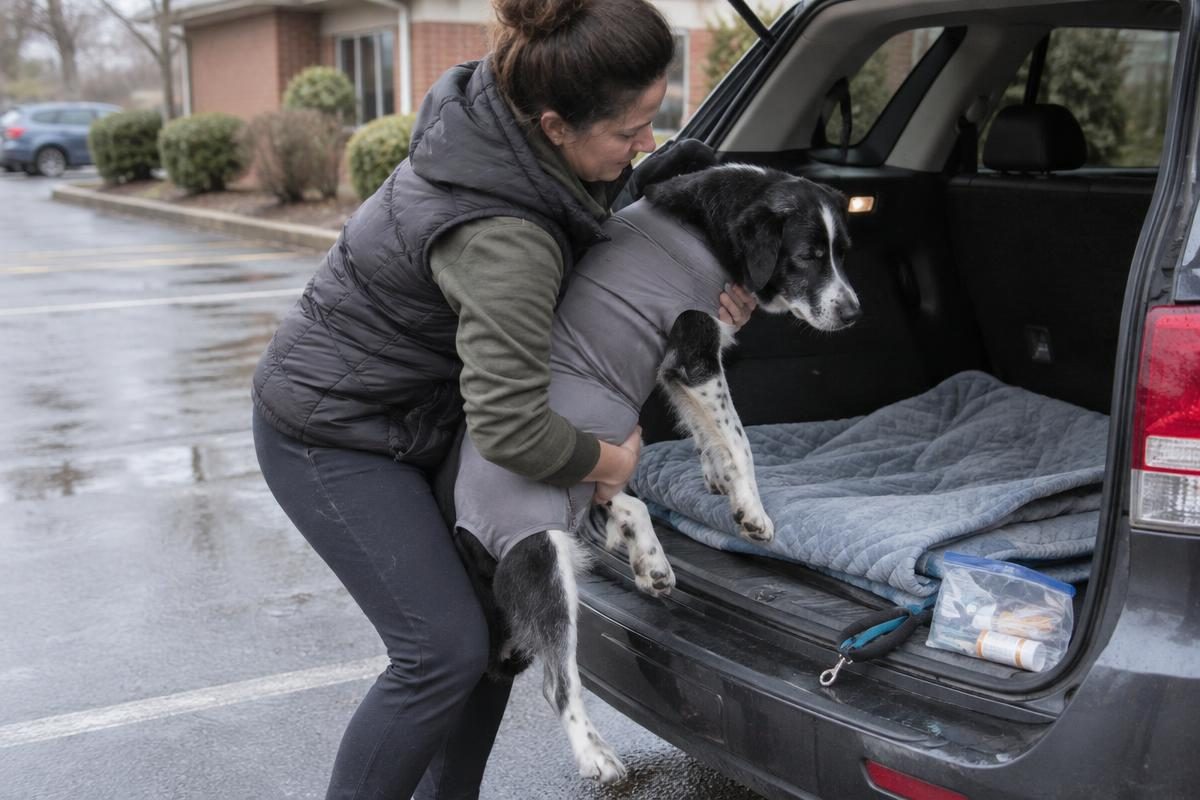
Dog spay cost in 2026 runs about $200 to $400 at a private animal hospital for a 40 lb female before extras, and $330 at the big-city nonprofit clinic we priced. Weight sets the base fee. Clinic type sets the tier. Bloodwork, IV fluids, a cone and surcharges for heat, pregnancy or extra weight can add $100 to $400 more. A spay is the surgical removal of the ovaries and uterus (an ovariohysterectomy); a neuter removes the testicles, and because it doesn’t open the abdomen it usually costs $50 to $200 less for a dog of the same size.
Estimate Your Dog Spay Cost
Pick spay or neuter, enter the weight, choose the clinic type and tick what’s on your quote. The estimator prices the surgery, adds each extra as its own line, and shows what the other kind of clinic would charge for the same case.
Dog Spay and Neuter Cost Calculator
Enter sex, weight, clinic type and region, then tick the extras your clinic quotes. The calculator prices the surgery from a nonprofit clinic's posted 2026 fee schedule or the midpoint of published private hospital ranges, adds each surcharge line by line, and shows what the other clinic type would charge for the same case.
Estimated Surgery Bill
Estimates only. Low-cost figures are the posted 2026 fees of one US nonprofit spay and neuter center; private hospital figures are the midpoints of vet-reviewed 2026 price ranges by size, adjusted for region. Your clinic's written quote always wins. Reviewed September 2026.
Low-cost figures are the posted fees of the East Bay SPCA Spay/Neuter Center in California, updated July 2026. Private hospital figures are the middle of the vet-reviewed 2026 ranges WebVet publishes by size, scaled for where you live.
Spay and Neuter Prices by Weight Band
Every price list we audited sets these surgical procedures by weight, because a bigger patient needs more anesthetic drug, a longer incision and more time on the table. Here’s how the two clinic types compare before any extras.
| Weight | Nonprofit spay | Private spay (range) | Nonprofit neuter | Private neuter (range) |
|---|---|---|---|---|
| Under 25 lb | $330 | $120 to $300 | $285 | $70 to $250 |
| 25 to 49 lb | $330 | $200 to $400 | $285 | $150 to $350 |
| 50 to 55 lb | $355 | $200 to $400 | $285 | $150 to $350 |
| 56 to 90 lb | $355 | $300 to $550 | $285 to $330 | $250 to $450 |
| 91 to 120 lb | $355 to $432 | $400 to $700 | $330 to $407 | $350 to $600 |
Two things jump out. A small female can cost less at a rural private vet than at a big-city nonprofit, so “low-cost” isn’t always lowest. And the nonprofit’s flat $285 neuter up to 65 lb is steep for a 15 lb dog but a bargain for a 60 lb one, where a big-metro private hospital’s midpoint is $511. The center posts no dog price above 120 lb.
How the Estimate Is Priced, Line by Line
The calculator builds the bill in four steps, the same order an itemized veterinary estimate uses.
- Surgery fee by weight band. A nonprofit fee is taken straight from the posted schedule. A private hospital fee is the midpoint of the published size range: $210, $300, $425 or $550 for a spay and $160, $250, $350 or $475 for a neuter, from small to giant.
- Region factor, private hospitals only. WebVet’s regional table puts a medium dog at $300 to $650 in big metros, $200 to $450 in mid-size cities and $120 to $300 in small towns. The midpoints give factors of 1.46, 1.00 and 0.65.
- Surcharges. In heat, pregnant, overweight and a retained testicle each add a fixed amount. At the nonprofit those are $77, $82, $82 and $56, and its fees don’t move with the region setting, because they are one Bay Area center’s list. At a private hospital the calculator uses $150 for each body condition and $250 for a cryptorchid case, the midpoints of the $50 to $250 and $100 to $400 ranges.
- Extras. Pre-anesthetic bloodwork $80, IV catheter and fluids $65, and a cone with take-home pain medicine $38 at a private vet or a $16.47 e-collar at the nonprofit, where pain medicine is already in the fee. A laparoscopic (keyhole) spay adds $250 at a private hospital.
Four Real Quotes Run Through the Estimator
Run any case below through the calculator and you’ll get the same dollar figure; all four are locked into its test suite as well.
A 40 lb female at a suburban private hospital
Surgery $300, bloodwork $80, cone and medicine $38: $418. The published range for the surgery alone is $200 to $400 in a mid-size city. The same dog with the same extras at the Bay Area nonprofit would be $426.47, so in a mid-size city the private visit actually comes out $8 cheaper. Outside the big metros, midpoint private pricing can land at or below this nonprofit’s fee.
The same dog at a big-city low-cost clinic, no bloodwork
Surgery $330 plus a $16.47 e-collar comes to $346. Set the region to big metro and a private hospital there would charge $476 for the same case, so the nonprofit saves $130. That’s the setup most shelter clinics run for a young, healthy female: no lab panel, no IV line, pain medicine included.
A 70 lb male with a retained testicle in a big metro
Private neuter midpoint $350 times the 1.46 metro factor is $511. Add bloodwork $80, IV fluids $65 and the $250 cryptorchid surcharge, skip the cone, and the total is $906. The nonprofit would charge $531 for the same list, $375 less, but only if the undescended one sits in the groin. The East Bay SPCA won’t operate when it’s inside the abdomen.
A 60 lb female in heat at a low-cost clinic
The 50 to 100 lb spay fee is $355, the in-heat fee $77 and the e-collar $16.47: $448. A big-metro private hospital would charge about $809 for the same case, so the nonprofit saves $360. Booking once she is well clear of the cycle, on your vet’s advice, avoids the $77.
Surcharges That Catch Owners Off Guard
A spay surcharge is a fixed fee added when the surgery takes longer or carries more risk than a routine case. These are the ones that show up on real invoices:
- In heat or just out of a heat cycle: $77 at the nonprofit, $50 to $250 at private vets. The reproductive tissue is more fragile and the surgery can run longer.
- Pregnant: $82 at the nonprofit, where the pregnancy is ended during surgery. Private hospitals fall in the same $50 to $250 band.
- Overweight: $82 at the nonprofit. Fat around the uterus and ovary makes them harder to isolate.
- Retained testicle (cryptorchid): $56 per side at the nonprofit, $100 to $400 at private hospitals.
- Flat-faced breeds: $58 plus an anti-nausea injection for a Pug or Bulldog, for extra airway monitoring.
- Doberman clotting test: $30, required for Dobermans and mixes because of von Willebrand’s disease risk.
Most of these aren’t known until the exam, which is why a phone quote can land well short of the final bill.
What a Low-Cost Clinic Leaves Out
A low-cost spay and neuter clinic is a surgery center run by a nonprofit or by animal shelters that does high volumes of sterilizations at a subsidized fee. Whole Dog Journal puts their range at $40 to $75 for a neuter and $100 to $375 for a spay. The trade-off is scope. Pre-surgical bloodwork and IV fluids are usually skipped, and pain relief is often a single injection that lasts about 24 hours.
Adding bloodwork and fluids back costs roughly $145 at WebVet midpoints. For an older dog or one with a known condition, that money is well spent: the panel screens organ function before anesthesia, and Whole Dog Journal lists older age among the factors that raise the bill.
Private hospitals also bundle more than they itemize. Gentle Vet Animal Hospital in Green Bay, Wisconsin posts $705.75 for a spay under 65 lb, including bloodwork, IV fluids and pain control at home, and requires an exam first. Bundles like that sit above the midpoints here, so compare line by line, not total to total.
Cats follow the same structure with smaller surcharges. A female cat or kitten is priced in the cat spay cost guide.
Timing the Surgery Around Growth and Heat Cycles
AAHA’s 2019 Canine Life Stage Guidelines split dogs at a projected adult weight of 45 lb. For small breeds, spay before the first heat cycle, at about 5 to 6 months of age, and neuter at about 6 months. For large breeds, wait until growth stops, roughly 9 to 15 months for males and 5 to 15 months for females. Earlier surgery lowers mammary cancer risk and prevents an unwanted litter of puppies. Waiting lowers the risk of some orthopedic diseases, some cancers and urinary incontinence.
The procedure buys more than birth control. AVMA client guidance says spaying prevents pyometra, a uterine infection that fills the uterus with pus and can be fatal if untreated, and it eliminates heat cycles along with the mating behavior that comes with them. In a male dog, neutering reduces the urge to roam and to mark with urine. Treating pyometra later means emergency surgery on a sick dog, which costs far more than the planned version.
Timing has a price angle too. Book a large-breed puppy late and she may come into heat first, which adds the in-heat fee. The puppy weight calculator projects adult weight, which tells you which AAHA group your pup falls in.
When the Number Will Be Wrong
- You add services at the counter. Many private hospitals require a pre-surgical exam, and a microchip ($20 at the nonprofit) or a dog vaccination catch-up ($18.50 to $40 per shot there) adds up fast.
- Complications. An infected incision runs $50 to $300 or more, and a chewed-open one can become an emergency vet visit.
- Your nonprofit is cheaper than ours. The Bay Area center used here sits at or above the top of the $40 to $375 nonprofit range Whole Dog Journal reports, so many programs charge far less.
- The dog is very large. The center posts no dog price above 120 lb, so the calculator only prices a heavier dog at a private hospital. Call a nonprofit for a quote.
Pet insurance won’t help here. Standard accident and illness policies don’t pay for an elective spay or neuter; a wellness add-on at $10 to $25 a month may reimburse $50 to $150. The pet insurance cost calculator shows whether that add-on pays for itself.
Get two written estimates before you book an appointment: one from a nonprofit or shelter clinic and one from your regular vet. Run both through the calculator with the same extras ticked, and the dog spay cost gap between them tells you what the extra care is costing. If your dog is female and large, schedule after growth but before her next heat to avoid the surcharge.
Frequently Asked Questions
How much does it cost to spay a female dog?
About $330 to $432 at the Bay Area nonprofit we priced, depending on weight, and $120 to $700 at a private hospital depending on size and region. A 40 lb female with bloodwork and a cone comes to $418 at a suburban private vet; at that nonprofit without bloodwork, $346.
Why does a spay cost more than a neuter?
A spay opens the abdomen to remove the ovaries and uterus, which takes longer and needs more anesthesia. A neuter removes the testicles through a small incision. For the same size dog, a spay typically costs $50 to $200 more at a private vet and $25 to $70 more at the East Bay SPCA, depending on the weight band.
Does pet insurance cover spaying?
Standard accident and illness policies don’t, because the surgery is elective. Some wellness add-ons reimburse $50 to $150 toward it for $10 to $25 a month. CareCredit and clinic payment plans are the other common way owners spread the bill.
Where is the cheapest place to spay a dog?
Usually a nonprofit spay and neuter center or an animal shelter program, where fees start near $40 for a neuter and $100 for a spay. The catch is fewer extras and booking ahead; the East Bay SPCA takes a $120 deposit to hold a slot.
What is the best age to spay a dog?
AAHA suggests 5 to 6 months, before the first heat, for dogs expected to weigh under 45 lb as adults, and after growth stops for larger breeds. Ask your vet to weigh the cancer, orthopedic and incontinence trade-offs for your breed.
This page is general information, not veterinary advice. Dog spay cost figures come from the East Bay SPCA Spay/Neuter Center fee schedule (updated July 2026), WebVet’s vet-reviewed 2026 cost analysis, Whole Dog Journal and Gentle Vet Animal Hospital; timing follows the AAHA 2019 Canine Life Stage Guidelines. Your clinic’s written quote always wins. Last reviewed: September 2026.