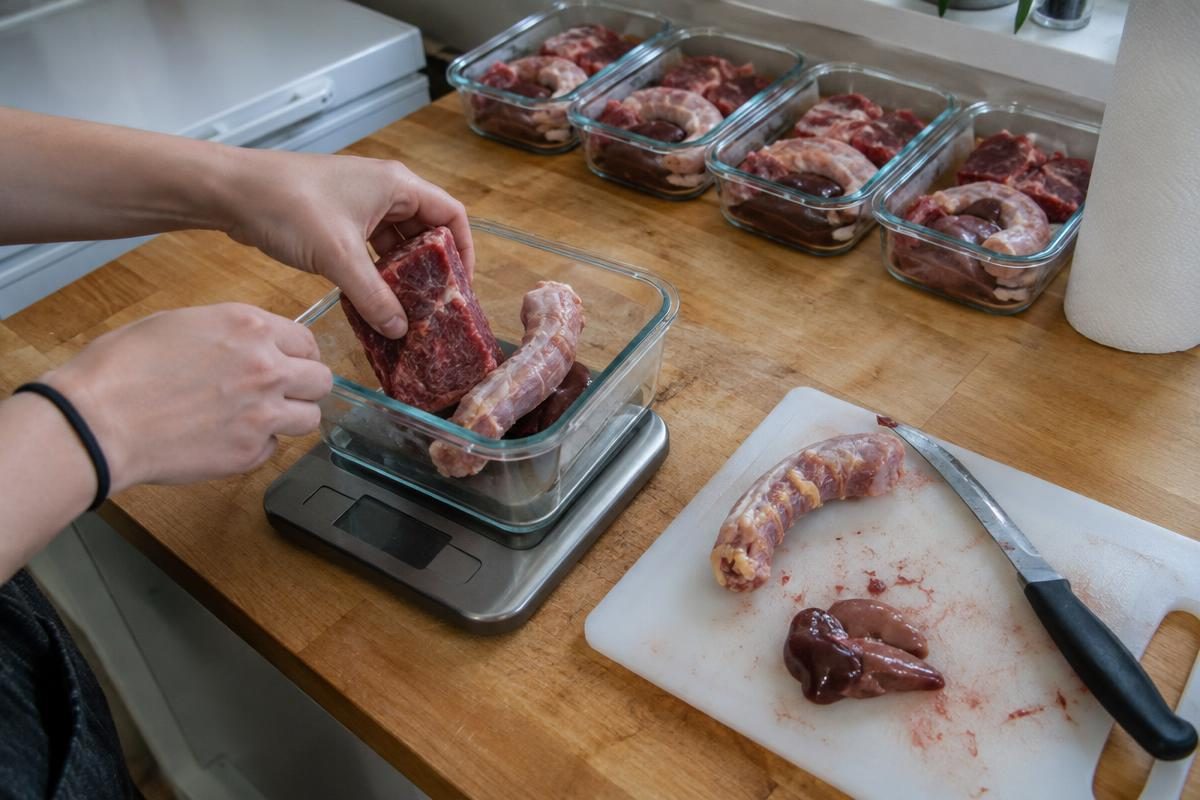
A 50 lb adult on a raw diet eats about 1.25 lb of raw muscle, bone and organ a day, which is 2.5 percent of its body weight. That single percentage is what every dog food calculator raw feeders rely on starts from. Where the ration comes from changes the bill far more than the ration itself: the same 20 oz a day costs $76 a month built from grocery chicken and $304 a month bought as commercial frozen patties. The tool below does both jobs. It sizes the daily portion by weight, age and activity, splits it into muscle meat, bone, liver and kidney or spleen, and prices it per day, month and year.
A Dog Food Calculator Raw Feeders Can Budget With
Pick an age band, enter pounds, select prey model or BARF, then set where the food comes from. Adults go in at their ideal weight. Puppies go in at what they weigh today, because the puppy percentages are built for that. Results include the ration per day, the amount per meal, each component in ounces, the pounds to buy each month and the cost per day, month and year.
Raw Dog Food Calculator (Portions and Cost)
Works out how much raw food to feed each day from body weight and a feeding percentage by age and activity, splits the portion into muscle meat, bone, liver, other organ and plants (PMR or BARF), and prices it per day, month and year. Compare DIY chicken, DIY beef and commercial frozen raw, or enter your own price per pound.
Daily Portion and Monthly Budget
Estimates only. Portions use the percent of body weight method common in raw feeding guides (2 to 3 percent for adults, 10 percent falling to 3 percent for growing puppies), not a calorie formula, so lean and fatty recipes feed differently. Ratios are the PMR and BARF conventions, not a complete-diet guarantee. Prices are US averages reviewed September 2026 (BLS retail meat prices, retailer listings). Feed to body condition and ask a vet before switching a dog to raw.
Most results for this search are phone apps on Google Play and the App Store, including a meal tracker, plus a few brand quizzes that end by suggesting a formula to buy. They split a ration into ounces, and some stop there. None we checked puts a dollar figure beside it, which is the number that decides whether an owner sticks with the diet past the second month.
How the Percent-of-Weight Method Builds a Daily Ration
Raw feeding rations are set as a share of body weight rather than from a calorie formula. The math takes four steps.
- Pick the percentage. Adults get 2 to 3 percent of ideal weight a day. Seniors sit near 2 percent, and working dogs can need 4 to 5 percent. The calculator uses 2, 2.5, 3 and 4 for low, moderate, very active and working adults.
- Multiply. A 50 lb dog at 2.5 percent needs 1.25 lb, or 20 oz, a day.
- Divide into meals. Adults eat twice a day here, so 10 oz per bowl. Young puppies eat four times.
- Price it. Pounds per day, times 30.44 days, times the price per pound, gives the month.
Puppies follow a different table. Their percentage applies to what they weigh now and falls as they grow, from 10 percent at 8 to 10 weeks down to 3 percent at 56 to 68 weeks:
| Age | Share of current weight | Meals a day | A 15 lb pup eats |
|---|---|---|---|
| 8 to 10 weeks | 10% | 4 | 24 oz |
| 10 to 16 weeks | 8% | 4 | 19.2 oz |
| 16 to 20 weeks | 7% | 3 | 16.8 oz |
| 20 to 24 weeks | 6% | 3 | 14.4 oz |
| 24 to 36 weeks | 5% | 2 | 12 oz |
| 36 to 56 weeks | 4% | 2 | 9.6 oz |
| 56 to 68 weeks | 3% | 2 | 7.2 oz |
The pup in that last column won’t stay at 15 lb, of course. The point is that a fixed size gets a smaller share each month, while real growth pushes the ounces up. Re-weigh every week or two. The puppy weight calculator projects adult size, which tells you when the percentage and the scale will meet at an adult ration.
What the 80/10/10 Rule Means in Ounces
The 80/10/10 rule is the prey model raw (PMR) ratio: 80 percent muscle meat, 10 percent edible bone and 10 percent secreting organ, usually written 80/10/5/5 so that half of it is liver. BARF, short for biologically appropriate raw food, trims muscle meat to 70 percent and adds 10 percent plant matter: 8 percent vegetables and fruit, 2 percent nuts and seeds.
| Component | Prey model share | BARF share | Amount per day, 20 oz prey model ration |
|---|---|---|---|
| Muscle meat | 80% | 70% | 16 oz |
| Edible bone | 10% | 10% | 2 oz |
| Liver | 5% | 5% | 1 oz |
| Other secreting organ (kidney, spleen) | 5% | 5% | 1 oz |
| Vegetables, fruit, nuts, seeds | 0% | 10% | none |
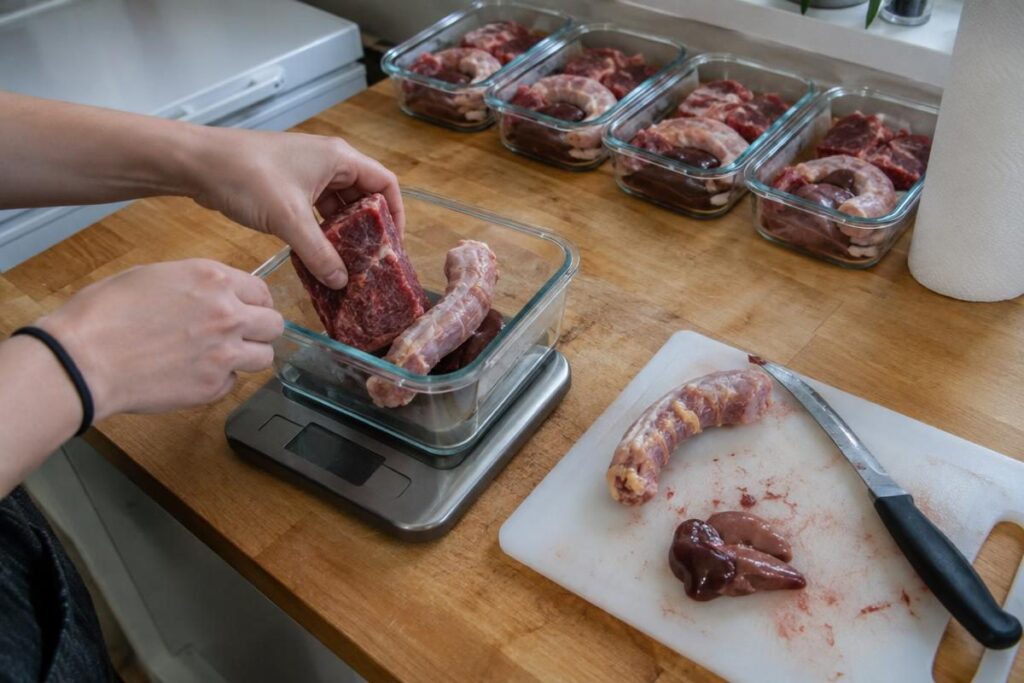
Bone at 10 percent is a share of the whole ration, not pure bone. A chicken leg is part muscle, so feeders count only its bone fraction. Liver at 5 percent is a ceiling worth respecting; it is rich in vitamin A, and doubling it to use up a pack is an easy DIY mistake. The calculator prints each component in ounces so a kitchen scale can do the rest.
Four Dogs, Four Rations, Four Grocery Bills
These are the calculator’s test scenarios. Enter the same inputs and you’ll get the same figures, to the dollar.
A 50 lb adult on commercial frozen patties
Moderately active, so 2.5 percent: 20 oz (567 g) a day in two 10 oz meals. The prey model split gives 16 oz of muscle meat, 2 oz of bone, 1 oz of liver and 1 oz of kidney or spleen. The month takes 38.1 lb. At $8.00 per lb for commercial frozen, the diet costs $10.00 a day, $304 a month and $3,653 a year.
The same dog on DIY chicken
Swap the source to DIY chicken at $2.01 per lb and the identical portion costs $2.51 a day, $76 a month and $918 a year. That is $228 a month less, paid for in freezer space and weekly prep time. A beef-based DIY batch at $6.92 per lb lands at $263, closer to the commercial bill than most owners expect.
A 15 lb puppy at 12 weeks on BARF
At 8 percent of its current 15 lb the pup eats 19.2 oz (544 g) a day across four meals of 4.8 oz. That splits into 13.4 oz muscle, 1.9 oz bone, about 1 oz each of liver and kidney or spleen, and 1.9 oz of vegetables and seeds. On DIY chicken that is 36.5 lb a month for $73. The puppy eats nearly as much as a 50 lb adult, and it’s a third of the size.
A 90 lb working dog on a co-op price
Working and sporting dogs run at 4 percent, so 57.6 oz (3.6 lb) a day in two meals of 28.8 oz. Buying through a bulk co-op at $4.50 per lb, entered in the price field, the month uses 109.6 lb and costs $493, or $5,917 a year. The same ration at the commercial default would be $877 a month. At this size, the price per pound decides everything.
One more for scale: a 10 lb senior at 2 percent eats 3.2 oz a day (the dog age calculator shows when a small breed reaches its senior stage). Commercial frozen feeds it for $49 a month, which makes small breeds the prime candidates for commercial raw.
DIY or Commercial Raw: How to Choose
Price per pound moves the monthly bill more than any other input. The three defaults in the calculator come from the September 2026 data:
- DIY chicken, $2.01 per lb. The Bureau of Labor Statistics August 2026 average for a whole chicken. Bone-in chicken legs averaged $1.67, the cheapest bone source in the store.
- DIY beef, $6.92 per lb. The same survey’s average for 100 percent ground beef. Beef more than triples the DIY cost.
- Commercial frozen, $8.00 per lb. Frozen patties and nuggets listed at Chewy ran $8 to $10 per lb, and Stella & Chewy’s frozen dinners $7.09 to $9.75.
Brands such as Primal and Steve’s Real Food in the US, Nutriment in the UK and Carnivora in Canada sell complete frozen blends, so the ratio and the supplements are done for you. What you pay for is formulation and convenience. DIY feeders pay in labor and in the risk of an unbalanced diet if they rotate too few proteins.
Freeze-dried products are left out on purpose. They are weighed dry, and at about $37 per lb for one name-brand bag, a percent-of-weight portion would badly overstate both the amount and the cost. Use the dog food cost per month calculator for freeze-dried, kibble, canned or fresh cooked food. It works from calories rather than a percentage, and it’s the better tool for comparing raw against those foods on cost per 1,000 calories.
When the Percentage Gets It Wrong
The percent method is a starting ration, not a prescription. It fails in predictable places:
- Fat content. A 70/30 ground beef and a lean turkey mince weigh the same but differ widely in energy. On a fatty blend, the same ounces add pounds.
- Overweight dogs. Feeding 2.5 percent of a heavy dog’s current size keeps it heavy. Enter the target in pounds instead and choose the 2 percent band.
- Toy breeds and giants. Small dogs often need a higher share and giants a lower one. The custom percentage field handles both.
- Growth spurts. A pup fed on last month’s number is underfed. Weigh often.
Check body condition after about a month. You should feel ribs under a thin layer of fat and see a waist from above. Adjust the percentage in small steps and re-run the numbers. Raw food also carries bacteria such as Salmonella, so thaw in the fridge, wash bowls after every feeding and ask your vet before switching a pet with a health condition.
For the rest of the budget beyond the food bowl, the pet cost calculator adds vet visits, vaccinations and insurance to the monthly food line.
Raw Dog Food Calculator Questions Owners Ask
How do I calculate how much raw food my dog needs?
Multiply your pet’s ideal body weight by 2 to 3 percent for an adult. A 40 lb dog at 2.5 percent needs 1 lb (16 oz) a day. Use the lower end for couch dogs and seniors and the upper end for active ones, then adjust after a month based on body condition.
What is the 80/10/10 rule for raw dog food?
It is the prey model ratio: 80 percent muscle meat, 10 percent edible bone and 10 percent secreting organ, with half the organ share as liver. On a 20 oz ration that works out to 16 oz muscle meat, 2 oz bone, 1 oz liver and 1 oz of kidney or spleen.
How much does a raw diet for dogs cost?
A 50 lb adult costs about $76 a month on DIY chicken, $263 on DIY beef and $304 on commercial frozen patties at September 2026 US prices. A 10 lb dog costs under $50 even on commercial food. The price per pound matters more than the brand.
How many grams of raw food should a dog eat a day?
Take 25 grams per kilogram of body weight for a moderately active adult, which is the 2.5 percent rule in metric. A 20 kg dog eats about 500 g a day, split into two 250 g meals. Puppies eat 30 to 100 grams per kilogram depending on age.
Is raw dog food complete on its own?
Commercial blends labeled complete and balanced are formulated to be. A DIY ration following 80/10/5/5 covers most needs but can fall short on nutrients such as vitamin E, zinc and omega-3 fats unless proteins rotate. Ask a veterinary nutritionist to review a DIY recipe before you feed it long term.
Start with the ration, not the recipe. Run the dog food calculator raw portions above at your pet’s ideal weight as a starting plan, buy one week of food at the price you actually pay, weigh every bowl for a month, then re-run it with the real receipt and adjust the percentage by body condition.
This page is general information, not veterinary advice. Portion percentages follow published raw feeding guides (caninebible.com, Raw & Fresh puppy table), ratios follow the prey model raw and biologically appropriate raw food conventions as described by The Little Carnivore, and prices use Bureau of Labor Statistics average retail prices for August 2026 and Chewy listings checked in September 2026. Last reviewed: September 2026.