
A cat spay cost in 2026 lands between $300 and $500 at a private veterinary practice, $50 to $150 at a low-cost nonprofit clinic, and $46 or less when a trapped community cat goes through a TNR program. A neuter for a male runs about $100 less at a private vet. Unlike dogs, felines aren’t priced by weight: one flat fee covers a small kitten and a big tom alike, so the bill moves on four things instead: sex, the kind of clinic, your state, and add-ons such as bloodwork or an in-heat fee.
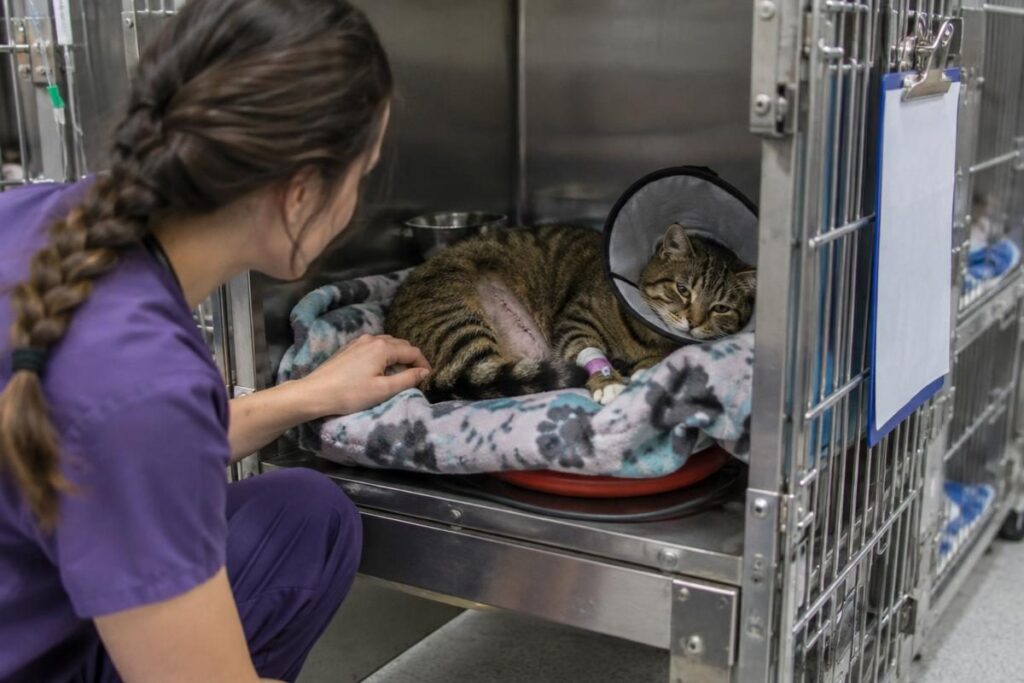
Spaying is the surgical removal of reproductive organs in a female, the ovaries and uterus, under general anesthesia, so she no longer comes into heat or has unwanted litters. Neutering (castration) is a shorter procedure that removes a male’s testicles through a small incision, which is why it costs less.
Of those four price drivers, only one is really in your hands: when you book. A female fixed before her first heat never triggers the in-heat or pregnancy line, and that line can be bigger than the gap between two clinics.
Cat Spay Cost Calculator by Clinic and State
Pick spay or neuter, the clinic type and your state, then tick what’s on the quote. You get the surgery fee, each add-on on its own line, and the gap to the next cheapest option.
Cat Spay and Neuter Cost Calculator
Choose spay or neuter, the kind of clinic and your state, then tick what the quote lists. Fees come from one nonprofit's posted 2026 schedule, the middle of vet-reviewed private practice ranges scaled by state, or a trap-neuter-return package, with each surcharge shown as its own line.
Your Surgery Estimate
Estimates only. Nonprofit fees are one California center's posted 2026 schedule or the middle of the national low-cost range; private practice fees are the midpoints of vet-reviewed 2026 ranges scaled by state; community packages use one Ohio clinic's posted fee. The written quote from your clinic always wins. Reviewed September 2026.
Nonprofit fees come from the East Bay SPCA Spay/Neuter Center’s posted schedule (updated July 2026) for California, New York, Massachusetts and Washington, and from the middle of the national nonprofit range for everyone else. Private practice figures are the middle of WebVet’s vet-reviewed 2026 ranges, scaled by its state table.
Book Before the First Heat: The Five-Month Guideline
The five-month guideline is a recommendation to spay or neuter cats by 5 months of age. It came out of the Veterinary Task Force on Feline Sterilization in 2016, and the American Veterinary Medical Association (AVMA), the American Association of Feline Practitioners (AAFP), the American Animal Hospital Association and the Association of Shelter Veterinarians have endorsed it. The public awareness campaign behind it is Feline Fix by Five.
Why five and not the old default of six? A female can get pregnant at 4 months, as task force supporters pointed out when the recommendation was published, so a six-month appointment leaves room for an unplanned litter. That was a real shift in veterinary medicine. WebVet’s vet-reviewed guide adds that kittens as young as 8 weeks and 2 pounds can be sterilized safely. The fee is the same flat rate either way.
How heat and pregnancy raise the cat spay cost
A queen in heat has a larger, more blood-rich reproductive tract, so the operation takes longer and keeps her under anesthesia for more time. The surcharge pays for that. At the East Bay SPCA it’s $36 in heat and $56 pregnant. A private practice charges $50 to $200 for either, and the calculator uses the $125 midpoint.
We break these out as their own lines on purpose: a phone quote for “a spay” rarely mentions them, and they’re the one charge an owner can still avoid by booking earlier. If she may already be expecting, the cat pregnancy calculator estimates how far along she is, which is useful to have in hand before you ask for a quote.
Adults: same flat fee, different extras
Age alone doesn’t move the base price. It matters in two other ways. An adult female is more likely to be in heat or pregnant on surgery day, which adds $36 to $56 at the nonprofit and $50 to $200 at a private practice. And overweight or older patients need more anesthesia and monitoring, which WebVet says raises the price. The cat age calculator translates your pet’s years into a life stage if you’re unsure where she sits.
What Private Vets, Nonprofits and Shelters Charge
Where you book matters more than anything about the animal. Here’s what each tier charges before extras.
| Where | Spay (female) | Neuter (male) | What’s usually included |
|---|---|---|---|
| Private full-service practice | $300 to $500 | $200 to $400 | Exam first; bloodwork, IV fluids and take-home pain relief often bundled |
| Bay Area nonprofit (East Bay SPCA) | $215 | $185 | Nail trim and a pain injection that lasts 3 days |
| Low-cost clinics nationwide | $50 to $150 | $25 to $100 | Surgery and basic pain control |
| Shelter or humane society | $40 to $120 | $20 to $80 | Varies by program |
| Community cat (TNR) package | Free to $46 | Free to $46 | Rabies, FVRCP, ear tip; flea dose at some |
State shifts the private tier a lot. WebVet’s table puts a private spay at $350 to $600 in California but $225 to $400 in Georgia or Ohio. CareCredit’s national average runs wider still: $255 to $587 for a spay and $168 to $385 for a neuter.
A full-service bundle can sit near the top. Gentle Vet Animal Hospital in Green Bay, Wisconsin posts $497.25 to spay and $376.25 to neuter, with bloodwork, IV fluids and pain control included. It schedules surgery only after a $94.50 wellness exam, and it offers a $30 bloodwork discount when you book 2 business days ahead.
Species matters as well. The East Bay SPCA fee sheet prices both side by side, and the feline column is lower on every line: a spay is $215 against $330 for the smallest dog band, the in-heat fee $36 against $77, pregnancy and overweight fees $56 against $82, and a retained testicle $35 against $56. A smaller patient needs less anesthetic drug and less time on the table. Our dog spay cost guide covers the canine side, where weight bands do move the price.
How the Calculator Builds Each Line
The estimate follows the order of a written veterinary quote:
- Surgery fee. At a private practice it’s $400 for a spay or $300 for a neuter, the midpoints of the national range, times a state factor: 1.125 for CA, NY, MA and WA; 0.906 for CO, IL, TX and FL; 0.781 for Georgia and Ohio. At a nonprofit it’s the posted $215 or $185 in those four higher-cost states and $100 or $62.50 elsewhere. A community package is a flat $46.
- Condition fees. The nonprofit charges $36 in heat, $56 pregnant, $56 overweight, $46 for a flat-faced breed and $35 per retained testicle. A private practice gets $125 for heat or pregnancy (midpoint of $50 to $200) and $250 for a cryptorchid neuter.
- Add-ons. Bloodwork $80, a basic health screen. A cone is $16.47 at the nonprofit, where the 3-day injection is already in the fee, or $32.50 with take-home pain relief at a private vet. A microchip is $20 at a nonprofit or community clinic and $47.50 at a private one.
- Headcount. The per-cat total times the number of cats, up to 20 for a colony or a litter.
Two things get no line at a private practice: extra weight and a flat face. Both raise anesthetic risk, but no published private price exists, so the calculator says so instead of guessing.
Four Quotes Worked Through to a Total
Each case below returns the same figure in the calculator and is locked into its test file.
A young female at a private vet, microchip added
No state picked, so the national midpoint applies: surgery $400, bloodwork $80, cone and pain relief $32.50, microchip $47.50. Total $560. The same list at a typical nonprofit clinic is $216.47, which makes the private visit $344 more.
A tom with one retained testicle at a California nonprofit
Neuter $185 plus $35 for the undescended testicle, no bloodwork, no cone: $220. A private practice in a higher-cost state would quote about $587.50 for that case ($337.50 surgery plus the $250 cryptorchid add-on), $368 more. The catch: the nonprofit only operates when the testicle sits in the groin.
A queen in heat in Georgia, full-service practice
The $400 midpoint times 0.781 is $312.50. Add $125 for the heat cycle, $80 bloodwork and $32.50 for the cone: $550. The local private range for the surgery alone is $234 to $391. A nonprofit clinic with the same add-ons would total $232.47, so $318 separates the two. Booked a few weeks earlier, before that heat, the same private quote drops by the full $125.
Four trapped strays through a community cat clinic
Four cats at $46 is $184, rabies and FVRCP shots and ear tips included. A regular nonprofit appointment for an owned female would be $100 for the spay alone, so the package saves $54 per cat before counting the vaccines.
Community Cats: How TNR Pricing Works
Trap-neuter-return (TNR) is a process in which a caretaker or rescue group humanely traps un-owned outdoor animals, which are then sterilized, vaccinated against rabies, ear-tipped and returned to where they live. The ear tip, a tiny piece trimmed from the top of one ear, marks a cat as already fixed so nobody traps it twice.
Prices are the lowest anywhere, and the rules are the strictest:
- AlterClinic in Ohio charges $46 per cat for surgery, rabies, FVRCP, flea prevention and the ear tip, and takes up to 50 trapped cats a day, one per trap.
- Spay Neuter Network in Texas does it free for Dallas residents with a city service request number and for $25 through San Antonio Feral Cat Coalition partners after a free TNR class.
- The real cost of each surgery to that network is about $100 before vaccines, so every fee you see is subsidized by donors or grants.
Owned pets don’t qualify. A tame kitten in a carrier goes to a regular nonprofit appointment instead. The subsidy exists to prevent litters in outdoor colonies, so access depends on proof that the animal really is un-owned: a city service request, a completed TNR class, or arrival in a humane trap rather than a carrier.
Where This Estimate Can Miss
- Your local nonprofit is cheaper. Many programs spay at low cost from about $50, and shelters from about $40, well under the Bay Area schedule used for higher-cost states.
- Vaccines at the counter. A catch-up on shots adds up quickly; the nonprofit charges $18.50 for FVRCP and $25.50 for rabies, and our cat vaccination cost page covers the rest.
- Testing. A FeLV/FIV test adds $40 at the East Bay SPCA, which wants a negative leukemia test within 3 weeks before it gives that vaccine.
- Complications. Many practices include a recheck 10 to 14 days later, but a licked-open incision can turn into an emergency vet bill.
- A fearful or aggressive cat. Special handling adds $65 at the nonprofit.
- Declawing on the same quote. A bundle that includes declawing (onychectomy) is pricing a second, separate surgery. The American Association of Feline Practitioners opposes it as an elective procedure, and the calculator leaves it out.
- Food after surgery. Sterilized pets generally need fewer calories than intact ones, so recheck portions with the cat calorie calculator once she’s healed.
Pet health insurance won’t cover the gap. Standard accident and illness policies treat spaying as elective care rather than medical treatment, though some wellness add-ons reimburse part of it; the pet insurance cost calculator shows whether one pays for itself.
Start with the calendar, then the quotes. If she’s under 5 months and hasn’t had a heat yet, book now, because that keeps the cat spay cost at the base fee with no condition line. Then call one low-cost clinic and one private practice, ask each for a written quote that lists every charge in detail, and run both through the calculator with the same boxes ticked. The difference is what the extra bloodwork, fluids and take-home meds are really costing you.
Cat Spay Questions Owners Ask
How much does it cost to spay a female cat?
About $300 to $500 at a private vet and $50 to $150 at a low-cost clinic in 2026. A Bay Area nonprofit posts $215. With bloodwork, a cone and a microchip, a private practice at the national midpoint comes to $560.
What is the best age to spay a female cat?
By 5 months, before her first heat, is the age the Veterinary Task Force on Feline Sterilization recommends, and the AVMA and AAFP have endorsed it. Kittens as young as 8 weeks and 2 pounds can be spayed, and the fee is the same flat rate as for an adult.
Why is neutering a male cheaper than spaying a female?
A neuter removes the testicles through a small incision outside the abdomen, so it’s faster and uses less anesthesia. Private practices charge about $100 less, and the East Bay SPCA charges $30 less ($185 against $215).
Is it too late to spay a 3-year-old cat?
No. Cats can be spayed at any age; an adult carries slightly more anesthetic risk and may need bloodwork first. The flat fee stays the same unless she’s in heat or pregnant on the day.
What can I do if I can’t afford to spay my cat?
Look for voucher programs, which help bring a spay to $0 to $75 after the subsidy, shelter clinics at $40 to $120, or a TNR program if the animal is un-owned. For a private practice, financing through CareCredit or Scratchpay spreads the bill over months.
Does pet insurance cover spaying a cat?
Standard accident and illness plans usually don’t, because the surgery is elective. Some optional wellness add-ons reimburse part of it.
This page is general information, not veterinary advice. Sources for the cat spay cost figures: the July 2026 price list of the East Bay SPCA Spay/Neuter Center, the 2026 WebVet feline analysis reviewed by a veterinarian, ThePricer, CareCredit, Gentle Vet Animal Hospital, AlterClinic and Spay Neuter Network. Your clinic’s written quote always wins. Last reviewed: September 2026.