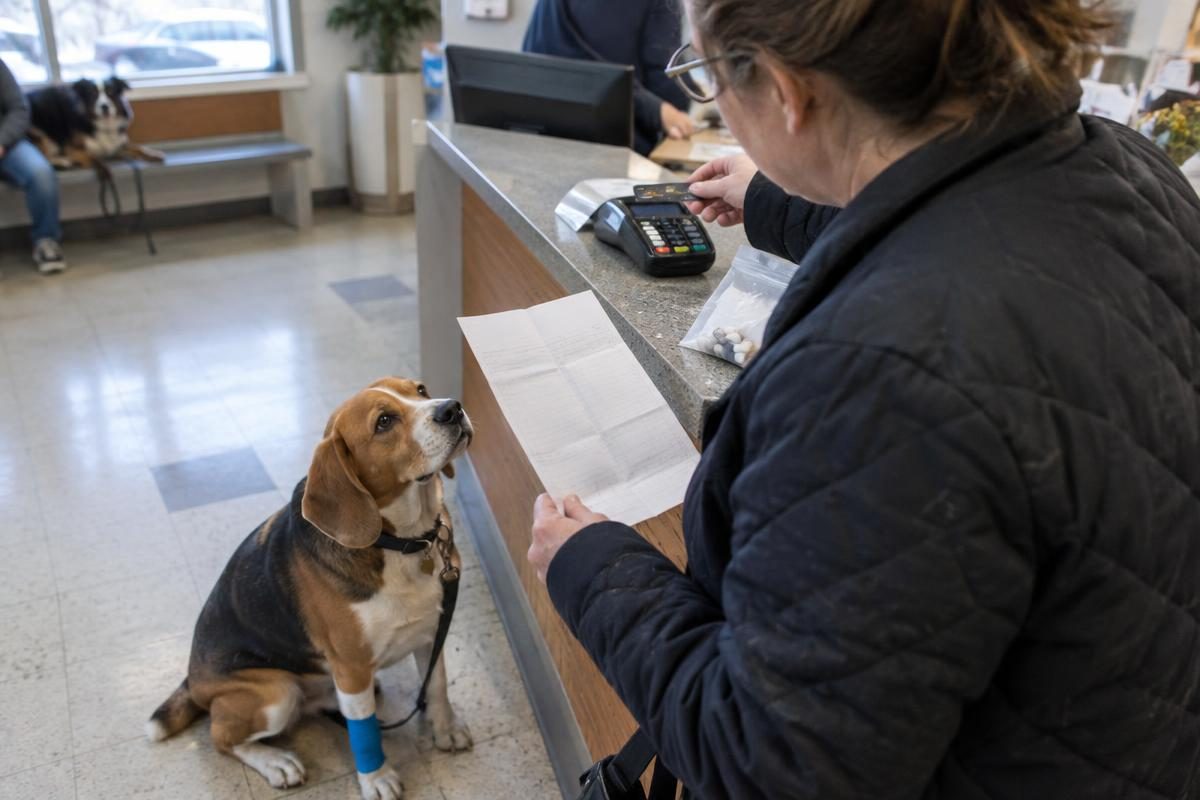
The average accident and illness policy cost $836 a year for a dog and $435 for a cat in 2025, according to the North American Pet Health Insurance Association (NAPHIA), the trade group whose yearly report covers about 99 percent of the premium written in the U.S. and Canada. That’s $70 and $36 a month. This pet insurance calculator starts from those figures, adjusts for age, breed and state, and then does the part most quote pages skip: it runs a real veterinary bill through your deductible, reimbursement rate and annual limit, so you can see what comes back and whether the policy beats putting the same money in savings.

Pet Insurance Calculator: Estimate the Premium, Then Test It Against a Bill
Pick a dog or cat (or a bird), the age at enrollment, breed group and state. Choose accident and illness or accident-only cover. Then set the policy terms you’re considering and enter one bill, such as a surgery estimate or a single emergency visit. Already have a quote? Switch to “I have a quote” and copy the monthly premium; the payout math works the same way.
Unlike a general pet cost calculator that adds up food, grooming and lifetime cost, this one covers a single line in the cost of owning a dog or cat: the insurance premium, and what it pays back.
Pet Insurance Cost Calculator
Estimates a monthly premium for a dog or cat from the NAPHIA 2025 national averages, adjusted for age, breed and state, or takes the price from your own quote. It then runs a sample vet bill through the deductible, reimbursement rate and annual limit to show what the policy pays back and the bill size where it breaks even.
Premium, Payout and Break-Even
Estimates only, not financial advice. Premiums start from the NAPHIA State of the Industry Report 2026 averages (2025 data) and are adjusted with published sample quotes by age, breed and state (NerdWallet, July 2026). The payout follows the standard reimbursement formula: bill minus deductible, times the reimbursement rate, up to the annual limit, with pre-existing conditions excluded. Real quotes differ by insurer, ZIP code and policy terms. Reviewed September 2026.
The line to watch is the break-even bill. It’s the covered bill, in a single year, at which the reimbursement equals twelve months of premiums. Below it, you’d have done better saving the money. Above it, the policy pays for itself.
What Coverage Costs for Dogs and Cats, by Plan Type
NAPHIA’s State of the Industry Report 2026, published in June, gives the annual cost per policy for coverage in force at the end of 2025.
| Plan type | Dogs, per year | Dogs, per month | Cats, per year | Cats, per month |
|---|---|---|---|---|
| Accident only | $190 | $16 | $112 | $9 |
| Accident and illness | $836 | $70 | $435 | $36 |
| Accident and illness with wellness built in | $1,414 | $118 | $859 | $72 |
Accident-only plans cover injuries such as a swallowed foreign body, cuts, a car accident, ligament tears or poisoning. Accident-and-illness plans add illnesses such as cancer, infections and digestive problems. Embedded wellness may include preventive care such as vaccinations and screening, plus nutrition consults and dental care.
Accident and illness premiums rose 11.5 percent for dogs and 12.6 percent for cats in one year. Still, most pet owners pay out of pocket: only 4.27 percent of the 163.6 million U.S. pets are insured, 5.99 percent of dogs and 2.29 percent of cats.
Quote sites show lower numbers. Insurify’s median from more than 250,000 quotes through May 2026 was $43 a month for a dog and $23 for a cat. Both figures are right; they measure different things. A quote median is dominated by young pets on entry-level terms. NAPHIA’s figure is what pet owners actually pay across every policy on the books, including 12-year-old dogs, unlimited payout plans and pets that have been through several renewals. Expect a first quote for a young dog to sit nearer the quote median.
How the Cost Estimator Works, Step by Step
- Base. NAPHIA’s yearly figure for the species and plan type.
- Age. NerdWallet quoted the same animal at age 2 and age 8 with four insurers in July. Dog prices averaged $39.50 at 2 and $86 at 8, 2.18 times higher; cats went from $20 to $39. The tool spreads that rise evenly, about 13.9 percent a year for dogs and 11.8 percent for cats, holds it flat before 2 and stops it at 14.
- Centering. NAPHIA’s number is treated as the typical adult policy, ages 1 to 7, which is how Insurify groups adults.
- Breed. In NerdWallet’s same-ZIP quotes, popular purebreds (Labrador, golden retriever, German shepherd, poodle) cost 1.36 times a medium mixed breed, and a French bulldog 2.27 times. Pedigree cats cost 1.46 times a domestic shorthair.
- State. Each state’s mean for a standard plan ($5,000 limit, 80 percent back, $250 to $500 deductible) divided by the 51-row mean. West Virginia dogs come out at 0.72, Washington, D.C. at 1.42.
- Payout. Insurer pays = (bill minus deductible) times the reimbursement rate, capped at the annual limit, and zero when the condition was there before cover began.
- Break-even. Deductible plus a year of premiums divided by the reimbursement rate.
Birds and other exotic animals skip steps 2 to 5. The Vet Desk puts bird coverage at $50 to $360 a year, so the estimator uses the $205 midpoint, $17.08 a month. For a reptile or small mammal, enter a real quote instead.
How Premiums Rise With Age
Age is the input that moves the number most. Here is the same accident and illness plan at the U.S. average, month by month:
| Age at enrollment | Mixed-breed dog | Domestic shorthair cat |
|---|---|---|
| 2 | $51 | $28 |
| 5 | $76 | $39 |
| 8 | $112 | $55 |
| 11 | $165 | $76 |
| 14 | $243 | $106 |
Premiums don’t stay at the enrollment price. Many insurers raise the price at renewal as the pet ages (the NAIC model law makes them disclose it), and veterinary expenses keep climbing, up nearly 5 percent in a year by NerdWallet’s count. So the table is also a rough path for one animal kept on the same plan. Check yours with the dog age calculator or the cat age calculator, which show how far each animal is from the senior stage.
The curve has a check built in. Insurify’s quotes put senior dogs, over 7, at 2.52 times the adult price. Averaged over ages 8 to 14, this curve gives 2.45 times, close enough to trust for planning. For cats the curve is gentler than Insurify’s brackets, so an older cat’s real quote may run higher.
Four Policies Run Through the Numbers
These are the scenarios in our test file; enter the same inputs and you’ll get the same numbers.
A 2-year-old mixed-breed dog and a $2,300 knee surgery
U.S. average, accident and illness, $500 deductible, 80 percent back, $5,000 limit. Premium: $51.32 a month, $616 a year. On a $2,300 surgery the insurer pays (2,300 minus 500) times 0.8 = $1,440 and you pay $860. The policy comes out $824 ahead for the year. Break-even: $1,270. Switch to accident only and the price drops to $11.66 a month, with a break-even of $675.
Tick the wellness box with its defaults, $48 a month for the add-on and $285 of routine vet care used, and the add-on loses $291 a year. The $48 is NAPHIA’s gap between dog plans with wellness built in and plain accident and illness plans. The spay and neuter cost guide quotes stand-alone add-ons at $10 to $25 a month, so enter the price on your own quote.
The same dog enrolled at 8
Price: $111.74 a month, $1,341 a year. The surgery still pays $1,440, but the year nets only $99, and break-even climbs to $2,176. Waiting six years more than doubled the cost of the same protection.
A 4-year-old pedigree cat in California and a $343 emergency visit
$250 deductible, 90 percent back, $10,000 limit. Price: $62.43 a month, $749 a year. The $343 figure is the American Pet Products Association’s average yearly emergency spend for cat owners. The insurer pays (343 minus 250) times 0.9 = $83.70. The year ends $665 behind. Small bills rarely justify coverage; the policy exists for the bill above $1,082.
A 3-year-old French bulldog in New York and a $42,300 claim
$250 deductible, 90 percent back. Price: $167.00 a month, $2,004 a year. $42,300 was the tenth-largest dog claim NAPHIA members paid in 2025 (the largest was $66,600). With a $10,000 annual limit the insurer pays $10,000 and you owe $32,300. With no limit it pays $37,845 and you owe $4,455. The tool doesn’t raise its estimate for a higher limit, so quote both and enter each price.
Is It Worth It? Find Your Break-Even Bill
Coverage is worth it when you couldn’t pay a large bill from savings or an emergency fund without debt, and when the premium is modest next to the break-even. It’s a poor deal for a healthy animal whose only vet visits are routine checkups, unless you’d struggle to cover a surprise $5,000 bill for an unexpected illness or injury. For an emergency vet visit or surgery, the math turns quickly in the policy’s favor.
So how much is good pet insurance? A plan is good value when three things line up:
- The limit covers a bad year. NAPHIA’s ten largest 2025 dog claims each topped $42,000. A $5,000 cap protects against a surgery, not cancer or a long hospital stay.
- The deductible is one you could pay tomorrow. A higher deductible lowers the premium but pushes the break-even up dollar for dollar.
- The reimbursement rate earns its price. Going from 80 to 90 percent costs extra every month but only pays more on large bills. Get both quotes and compare the two break-even figures.
Dental illness is a common gap. Routine cleanings are almost never covered, while extractions for disease may be, as the dog dental cleaning cost guide explains.
Pre-Existing Conditions: Exclusions, Waiting Periods and Curable Clauses
A pre-existing condition is any condition that, before coverage started or during a waiting period, got veterinary advice or treatment or showed related signs. That’s the definition in the NAIC model law, written by the National Association of Insurance Commissioners in 2022 for states to adopt. Insurers may exclude these conditions if they disclose it, and they carry the burden of proving the exclusion applies. Once a condition is covered, it can’t be reclassified as pre-existing at renewal.
The model also limits waiting periods. Illness and orthopedic waits can’t run past 30 days, accidents get no waiting period, and a veterinary exam must be able to waive the wait. Not every state has adopted it, and NerdWallet still finds plans with six-month to one-year waits for conditions such as knee injuries. Read the waiting period section of the policy for your state.
Curable and incurable conditions are treated differently. NAIC defines a chronic condition as one that can be managed but not cured, such as diabetes, and those stay excluded when they were diagnosed before enrollment. Some insurers do cover a curable pre-existing condition, like an infection that has cleared, once the pet has gone symptom-free and treatment-free for a set time. Pawlicy, an insurance broker, describes one that covers curable conditions after a year.
That’s the honest answer to “best pet insurance for pre existing conditions”: no plan pays for an incurable condition diagnosed before enrollment, so the best choice is the policy whose written curable-condition clause fits your pet’s record. Ask each insurer to review the medical history before you buy and tell you in writing what it excludes. Then tick the pre-existing box in the estimator to see what a related bill would cost you: every dollar.
Where This Estimate Can Be Wrong
- Your insurer’s rating. For one 2-year-old dog in one ZIP code, NerdWallet found quotes from $30 to $53 a month.
- ZIP code inside a state. The same dog ran $27 a month in Grand Rapids and $63 in New York City.
- Deductible and limit choices. They drive the payout here, not the estimated price.
- Senior cats and very old pets. Past 8 the curve extends a line drawn through two published ages.
- Breed. Two groups per species can’t capture breed-specific risk.
Frequently Asked Questions Before You Buy
How much is good pet insurance per month?
NerdWallet’s July 2026 quotes for a 2-year-old mixed-breed dog ran $30 to $53 a month for accident and illness cover, and $14 to $28 for a 2-year-old domestic shorthair cat. NAPHIA’s figures across all policies in force were $70 and $36.
Does pet insurance go up every year?
Usually, yes. Average accident and illness premiums rose 11.5 percent for dogs and 12.6 percent for cats in 2025, and many insurers also raise the price as the pet ages. Between age 2 and 8, sample quotes roughly doubled.
Is there pet insurance that covers pre-existing conditions?
Not for incurable ones diagnosed before enrollment. Some insurers cover a curable pre-existing condition after a symptom-free period, such as a year. Get the insurer’s decision on your pet’s records in writing before buying.
Is a $5,000 annual limit enough?
It covers most single surgeries but not a serious illness. The tenth-largest dog claim NAPHIA members paid in 2025 was $42,300. Price a $10,000 or unlimited plan too and compare the monthly difference with the risk.
Can you insure a bird or reptile?
Bird coverage exists; The Vet Desk puts it at $50 to $360 a year. For reptiles and small mammals, ask for a quote and enter it. The parrot cost guide includes insurance in its yearly budget.
Start with the pet insurance calculator on your pet’s real age and your state, then request two quotes, one at a $250 deductible and one at $1,000, with the same limit. Enter each price in quote mode, compare the break-even bills, and buy before the next birthday or the next vet visit that could create a pre-existing condition.
This page is general information, not financial advice. Average premiums come from the NAPHIA State of the Industry Report 2026 (2025 data); sample quotes by age, breed and state from NerdWallet (July 2026, state data from Wag!); quote medians from Insurify (May 2026); pre-existing condition and waiting period rules from the NAIC Pet Insurance Model Law (2022); bird coverage from The Vet Desk (January 2026). Last reviewed: September 2026.