
How much do parrots usually cost? The sticker price runs from about $25 for a budgie to $4,000 or more for a hand-fed macaw, and that is the smaller half of the bill. A parrot needs a cage sized to its wingspan, a pellet and produce diet, toys it will shred, and an avian vet. For an African grey bought from a breeder, the first year comes to about $3,650 and only $1,600 of that is the bird. Over ten years the purchase shrinks to a tenth of what you spend.
Pet Bird Cost Calculator for Parrots, Cockatiels and Budgies
Choose one of the common types of parrots, where it comes from and how much you plan to spend on housing and care. The estimator prices the purchase, setup and yearly care from 2026 published ranges by size class, then totals the first year and as many years as you enter.
Pet Bird Cost Calculator
Pick a species, where the bird comes from and how much you plan to spend on housing and care. The estimator prices the purchase or adoption fee, the one-time setup and the yearly food, toys and avian vet bill by size class from 2026 published ranges, then totals the first year and any number of years ahead.
Your Bird Budget
Estimates only. Purchase, setup and yearly ranges by size class come from a July 2026 published price guide, chain store prices from a 2025 PetSmart price check, and insurance from a January 2026 guide. Prices vary by region and seller, and emergencies are not predictable. Reviewed September 2026.
The comparison line measures your choice against a budgie bought the same way. It is a quick check on how much of the price is the species itself rather than the way you buy it.
How Much Do Parrots Usually Cost by Species?
A pet parrot’s purchase price tracks its size. Master Parrot’s July 2026 guide sorts pet birds into five size classes, and the setup and yearly budgets climb with each step. The first-year figure below assumes a breeder, one bird and the midpoint of each range, which the calculator uses as the average cost.
| Species | Breeder price | Size class | Setup | Care per year | First year |
|---|---|---|---|---|---|
| Budgie (parakeet) | $25 to $50 | Small | $275 | $500 | $813 |
| Lovebird | $25 to $150 | Small | $275 | $500 | $863 |
| Cockatiel | $120 to $350 | Small-medium | $350 | $650 | $1,235 |
| Green-cheek conure (GCC) | $250 to $700 | Medium | $500 | $850 | $1,825 |
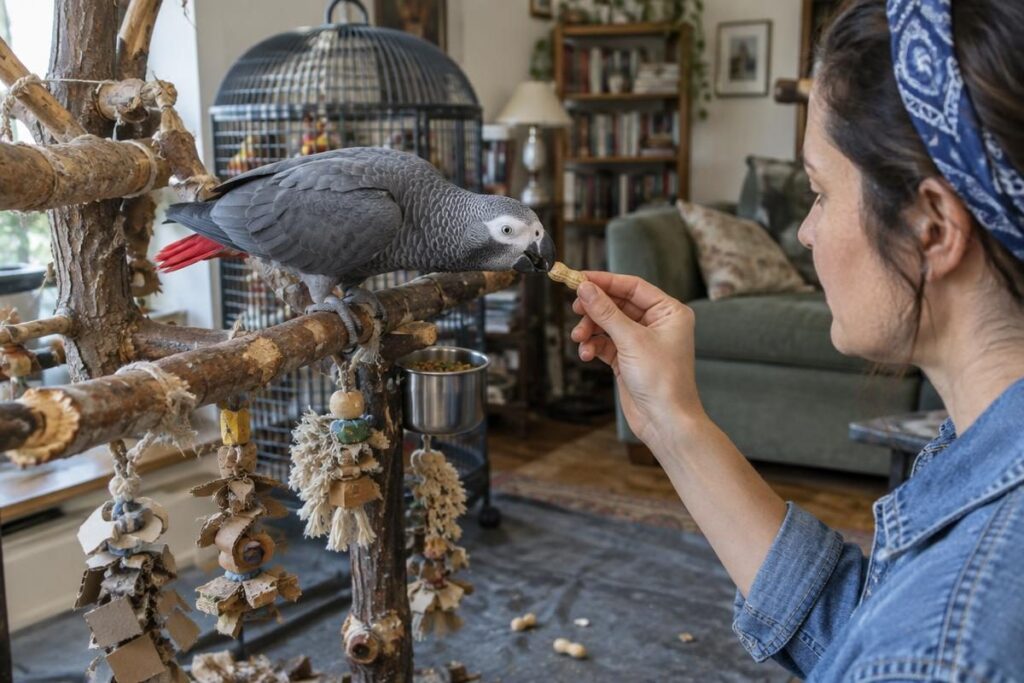
| African grey | $1,200 to $2,000 | Large | $750 | $1,300 | $3,650 |
| Amazon parrot | $800 to $2,500 | Large | $750 | $1,300 | $3,700 |
| Umbrella cockatoo | $1,500 to $4,000 | Extra-large | $1,100 | $1,750 | $5,600 |
| Blue-and-gold macaw | $1,500 to $4,000 | Extra-large | $1,100 | $1,750 | $5,600 |
Two things stand out. A macaw’s purchase is 49 percent of its first year, while a budgie’s is under 5 percent, so the lowest priced parrots are almost entirely a care expense. The expensive part of a small bird is never the bird. And the jump from medium to large class roughly doubles the first year, because a grey or an Amazon needs a cage that alone runs $350 to $900.
Other guides quote wider ranges. The Vet Desk’s January 2026 list puts African greys at $800 to $3,500 and cockatoos at $800 to $3,000. The calculator’s price level setting covers the low end, the average price at the midpoint, and the high end, where hand-fed baby parrots that are fully weaned and rare color mutations sit.
Breeder, Pet Store or Rescue: Where the Price Changes
Source moves the purchase line only. Care costs the same whichever door it walks in through.
- Breeder or specialty bird store. The full range in the table. A reputable breeder sells weaned babies and should be able to tell you the hatch date, the diet and what disease testing the bird has had.
- Chain pet stores. A 2025 Hepper price check found budgies at about $40 at PetSmart and cockatiels at $80 to $250, often out of stock. We found no PetSmart or Petco price for larger parrots, so the calculator uses the breeder range for them.
- Rescue or adoption. Master Parrot puts adoption fees at $50 to $400 even for large species. Mickaboo Companion Bird Rescue in the San Francisco Bay Area charges $15 to $650 depending on size.
Adoption saves money in proportion to the bird’s price. A cockatiel from a rescue at a $225 fee saves only $10 against a typical breeder bird. A blue-and-gold macaw at the same fee saves $2,525. Rehomed birds are often adults with a known personality, which matters more than the fee for an animal that can bite hard or scream. Some owners also rehome a bird for free through ads, The Vet Desk notes.
What the Estimate Adds Up, Line by Line
The calculator builds each total in four steps.
- Purchase. The low, midpoint or high price for the parrot and source you pick. A rescue fee is never set above the breeder price for the same level.
- Setup. The size class budget for a cage, perches, dishes, starter toys, a carrier and the first food supply and vet visit: $150 to $400 for small birds, up to $700 to $1,500 for large macaws and cockatoos.
- Yearly care. Food, replacement toys for mental stimulation as old ones wear out, and a routine avian exam by class, from $300 to $700 for a budgie to $1,000 to $2,500 for the largest birds. Add $200 for yearly bloodwork and fecal disease screening, $205 for insurance (the midpoint of $50 to $360), and any emergency fund you enter.
- Totals. First year is purchase plus setup plus one year of care. The multi-year total counts purchase and setup once and care every year, times the number of birds.
The spending level picks the low, midpoint or high end of the setup and care ranges together. Premium means a bigger cage, more toys and more fresh produce, not a different parrot.
Four Birds Priced Start to Finish
Each example is a scenario in the calculator’s test file, so the page and the tool always agree.
An African grey from a breeder
Typical price, typical spending, no extras. Purchase $1,600, setup $750, care $1,300 a year ($108 a month). First year: $3,650. Ten years: $15,350. That is 4.5 times what a budgie bought the same way costs in year one ($813).
Two budgies from a chain pet store
At $40 each plus $275 of setup and $500 of care, each budgie is $815 in the first year and the pair is $1,630. Over ten years the pair comes to $10,630. The two $40 birds are less than 1 percent of that.
A cockatiel from a rescue
Fee $225, setup $350, care $650 a year. First year $1,225, ten years $7,075. The same cockatiel from a breeder is $1,235 in year one. The cockatiel cost guide breaks the care line down further, and the budgie cost guide does the same for parakeets.
A blue-and-gold macaw with lab work and insurance
Purchase $2,750, setup $1,100. Care is $1,750 plus $200 of yearly lab work plus $205 of insurance, $2,155 a year or $180 a month. First year: $6,005. Over 20 years: $46,950. Macaws often outlive that window, so treat it as a floor for an animal that can pass 70.
Do Talking Parrots Cost More?
Yes, mostly because the best-known talkers are large birds. African greys, both the Congo (CAG) and the smaller Timneh, and Amazons such as the blue-fronted Amazon sit in the large size class, with purchase prices from $800 to $2,500 and care near $1,300 a year. No seller can promise a bird will talk, so a parrot talking price really pays for a species with a good record of it.
Budgies are the cheap exception. They are small, intelligent and often pick up words, and the first year costs about $813. Parrots are highly social, so if speech is the goal on a tight budget, a budgie with daily interaction is the realistic starting point.
Costs This Estimate Leaves Out
The yearly figure covers routine care. It misses these:
- Emergencies. The Vet Desk puts one emergency at $300 to $2,000, on top of routine vet visits. Enter a yearly amount in the emergency fund field or price a visit on the emergency vet cost page.
- Boarding and sitters. Boarding runs $15 to $40 a day, so a week away from the household costs $105 to $280. Chewy’s editors report $30 a day and up at a vet and $40 a day and up with a sitter.
- A bigger cage later. Many first cages are starter models that need an upgrade later. The bird cage size calculator checks the minimum before you buy.
- Grooming. One owner Chewy quoted pays $18 per bird for grooming every quarter.
Region matters too. Parrot forum members in Seattle and on Long Island report about $350 for a wellness exam with blood panels, well above a $100 basic exam. If your avian vet quotes higher, use the premium spending level.
Parrot Price Questions
What is the cheapest parrot to own?
The budgie. It costs $25 to $50 from a breeder or about $40 at a chain store, and its first year runs about $813 with typical setup and care. Lovebirds are close at about $863.
Is it cheaper to adopt a parrot than buy one?
For large species, much cheaper. Adoption fees of $50 to $400 save up to $2,525 on a typical macaw. For budgies and cockatiels the fee is close to the store or breeder price, so the saving is small.
How much does an African grey cost per month?
About $108 a month for food, toys and a routine avian exam at typical spending, or $67 to $150 from budget to premium. Yearly lab work and insurance add about $34 a month.
Should I get one or two parrots?
Two birds double the cost of care. Each needs its own feeding bowls and toys, and larger parrots usually need separate cages. Two budgies from a store cost about $1,630 in the first year. A pair of small birds sharing one cage costs a little less than the calculator shows.
How long will I be paying for a parrot?
Small parrots have a lifespan of about 10 to 20 years and large ones 40 to 70 or more. A grey’s care alone is $13,000 over ten years of ownership at typical spending, and the bird may outlive the owner, so the commitment needs a plan for who takes it on.
So how much do parrots usually cost once you add it up? Pick the type, run the calculator at the typical level, then again at premium, and budget between the two. If the premium total over ten years is more than you can carry, choose a smaller species or look at a rescue before you look at a breeder, and price pet insurance the same week.
This page is general information, not veterinary advice. Purchase, setup and yearly ranges come from Master Parrot’s July 2026 price guide, insurance and cross-check prices from The Vet Desk (January 2026), store prices from a 2025 Hepper PetSmart check, and owner costs from Chewy’s editors. Prices change by region and seller. Last reviewed: September 2026.