
Cat vaccination cost for a kitten’s first year comes to about $367 at a nonprofit vaccination clinic and $938 at a private animal hospital that bills a $94.50 exam at each of five visits. Adult years are far cheaper. An indoor adult on three-year products averages $23 to $60 a year, because its shots all land in one visit every third year. Go outdoors, or choose a one-year rabies shot, and that yearly figure climbs to $150 or more.
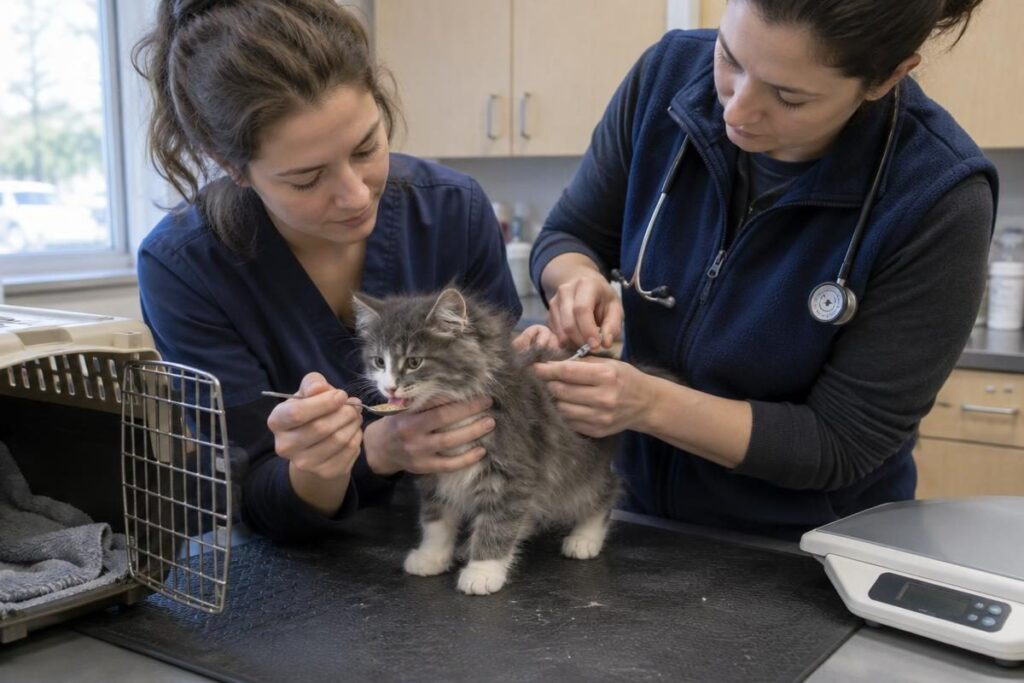
A feline vaccination is an injection that primes the immune system against a specific virus before the animal meets it. Core vaccines are essential for nearly every household: FVRCP, rabies and, for cats under a year old, feline leukemia (FeLV). Non-core cat vaccines are recommended only when lifestyle creates a specific risk.
Estimate Your Cat’s Vaccine Bill
Set the life stage, indoor or outdoor lifestyle, rabies product and clinic type. The estimator counts doses and visits using the 2020 AAHA/AAFP task force recommendations, then prices each line from a posted 2026 fee list.
Cat Vaccination Cost Calculator
Choose the life stage, indoor or outdoor lifestyle, rabies product and clinic type. The estimator counts FVRCP, rabies and FeLV doses and visits from the 2020 AAHA/AAFP feline guidelines, prices them from one private hospital's and one nonprofit clinic's posted 2026 fees, and shows what an average adult year runs over a three-year booster cycle.
Estimated Vaccine Bill
Estimates only. Dose counts follow the 2020 AAHA/AAFP Feline Vaccination Guidelines; prices are one Wisconsin private hospital's February 2026 list and one Pennsylvania nonprofit clinic's June 2026 list, with regional factors from a hospital chain's city prices. Your veterinarian decides which vaccines your pet needs. Reviewed September 2026.
Hospital prices for vaccines and tests: the February 2026 feline list at Gentle Vet Animal Hospital, Green Bay, Wisconsin. Nonprofit prices: the Pittsburgh Humane Animal Rescue clinic’s June 2026 list. Cat vaccine costs vary more by clinic type than by region, so that is the setting to get right.
Which Vaccines Does Your Cat Need? Follow Its Lifestyle
The 2020 AAHA/AAFP Feline Vaccination Guidelines, from the American Animal Hospital Association and the American Association of Feline Practitioners, sort shots by exposure. Stop at the first line that fits your household.
- Indoor-only, single cat. The two core shots only. After the kitten series and its 6-month or 1-year booster, FVRCP repeats on a three-year cycle and the other core shot follows its label and local law.
- Indoor, with housemates that go out or have unknown FeLV status. Add a yearly leukemia booster. The guidelines treat this cat as at risk even though it never leaves home.
- Outdoor access, even part-time. Both core shots plus the yearly leukemia shot. The virus spreads through close contact such as mutual grooming and bite wounds.
- Shelter or multi-cat home with a confirmed outbreak. Here the non-core shots for Chlamydia felis and Bordetella bronchiseptica come in, both aimed at respiratory infection and left to the veterinarian’s judgment.
Two products rarely belong on an invoice. The guidelines do not generally recommend the FIP (feline infectious peritonitis) vaccine, and the FIV vaccine is no longer sold in the United States or Canada. If a quote lists either, ask why.
Cat Vaccination Cost by Clinic: Private Hospital vs Nonprofit
Per dose, the full-service hospital charged 1.7 to 2.0 times the nonprofit’s price. The exam fee is the bigger gap, because it repeats at every visit.
| Item | Core or non-core | Private hospital | Nonprofit clinic | Adult interval |
|---|---|---|---|---|
| FVRCP | Core | $45.00 | $27 | Every 3 years |
| Rabies | Core, often required by law | $40.00 | $21 | 1 or 3 years, by product |
| FeLV (feline leukemia) | Core under age 1, then by risk | $55.00 | $28 | Yearly for at-risk adults |
| FeLV/FIV blood test | Before the first leukemia shot | $90.37 | $45* | Once, or when status is unknown |
| Exam or visit fee | $94.50 per exam | $22 per visit | Each visit |
*The Pittsburgh clinic can’t run the test during vaccine hours, so the $45 comes from the East Bay SPCA clinic in Oakland. That $22 nonprofit charge combines a $14 technician fee and $8 for biohazard disposal; staff administer vaccines without a physical exam. Its Elite Cat Package bundles all three shots in the table for $73, three dollars under list.
FVRCP is a combination shot covering feline viral rhinotracheitis (a herpesvirus), calicivirus and panleukopenia, the feline parvovirus also called feline distemper. Hospital prices get a market factor: 1.22 for the Bay Area, 1.09 for a high-cost metro such as Boston or Seattle, 1.00 for most cities and 0.96 for cheaper markets. Those factors come from one chain’s canine shot prices, so treat them as an estimate.
The Kitten Year: Visits, Doses and Totals
Most kittens need four to six visits, depending on age at the first appointment and whether your vet adds the six-month booster.
- FVRCP series. No earlier than 6 weeks of age, then every three to four weeks until 16 to 20 weeks. The estimator uses 3-week gaps, so a kitten first seen at 8 weeks gets doses at 8, 11, 14 and 17 weeks.
- Six-month booster. The 2020 guidelines suggest repeating the combination shot at 6 months rather than 1 year, in case maternal antibodies blocked earlier doses.
- Leukemia and the 12-week shot. Two leukemia doses 3 to 4 weeks apart from 8 weeks, after a negative blood test, plus one rabies dose at 12 weeks or later. Both ride along on series visits, so they add shot fees but no extra exams.
An 8-week indoor kitten at a private hospital
These are the estimator’s defaults. Five FVRCP doses ($225), the 12-week dose ($40) and two leukemia doses ($110) make $375 in vaccines. The test is $90.37 and five exams add $472.50, for a total of $938. Billed for one exam only, the total falls to $560.
The same kitten at a nonprofit clinic
Vaccines run $212 at nonprofit prices, the test $45 and five visits $110. Total: $367, $571 below the hospital. Skip the six-month booster and it’s $318.
Do Indoor Cats Need Vaccines Every Year?
No. An indoor-only adult needs FVRCP every three years and its other core shot on whatever interval the product and local law allow, so two of every three years can carry no vaccine at all.
At the Wisconsin hospital, the booster year costs $179.50 (exam plus both core shots). Divide by three and the average cost is $60 a year; at the nonprofit it’s $23. Book the wellness exam anyway. It’s part of keeping your cat healthy, just not a vaccine expense.
Two things put adult cats back on a yearly vaccination schedule: a one-year rabies product, which lifts the private average from $60 to $150, and leukemia exposure, which adds a yearly FeLV shot.
An outdoor adult in Boston on 1-year shots
A private booster year in a high-cost metro totals $234.50 before the 1.09 factor, so $256. Each in-between year still needs both annual shots, at $206.56, which puts the average adult year at $223. The same booster year at the nonprofit is $98.
An adopted adult with no records
An outdoor adult of unknown history at the nonprofit gets two FVRCP, one rabies and two leukemia doses ($131), the test ($45) and two visit fees ($44): $220. A typical private hospital would charge $519.
1-Year or 3-Year Rabies Vaccine: Which Costs Less Over Time?
A rabies vaccine for cats comes in one-year and three-year versions, and over three years the longer product usually wins. East Bay SPCA charges $25.50 for PureVax 1-year and $66.50 for PureVax 3-year. Three annual shots come to $76.50, so the longer product saves $10 before counting visits.
Visits widen the gap. At a private hospital, an indoor pet on the one-year shot needs a $94.50 exam every year just to get it. The 2020 task force recommends a three-year labeled product where local law allows. Some owners and veterinarians still prefer PureVax 1-year, a non-adjuvanted recombinant vaccine, a reasonable medical choice with a real price: about $90 a year more at the Wisconsin hospital. That hospital posts one price for both products, so the estimator understates a three-year PureVax at clinics that charge more for it.
The Leukemia Test and Injection Sites: Two Lines Owners Question
The vaccine does nothing for a cat that already carries feline leukemia virus, so the guidelines call for a negative test before the first leukemia shot. One catch: in kittens under about 6 months, a positive FIV result can reflect antibodies from the mother rather than infection, so a veterinary team may suggest a retest later.
The guidelines also recommend giving each vaccine low on a limb and recording which shot went where. Feline injection-site sarcoma is a rare tumor that can form at a shot site, and on a lower leg it can be removed with wide margins. Clinics use the 3-2-1 rule: have a lump checked if it lasts 3 months, grows past 2 cm, or is still growing 1 month after the shot. That check is an exam fee, not a vaccine charge.
Costs This Estimate Leaves Out
- Stool tests and deworming. A fecal analysis was $53.50 on the Wisconsin list. Many clinics add one to kitten visits.
- Flea and parasite prevention. Frequently sold at vaccine visits.
- Lower-risk leukemia schedules. A cat with limited outdoor time may be boosted every 2 to 3 years instead of yearly, which the estimator doesn’t model.
- Microchips. $23 at the Pittsburgh nonprofit and $20 at East Bay SPCA.
Before you vaccinate, run your numbers above, then ask two clinics for a written quote on the same doses. Ask the private hospital whether booster visits are full exams, and ask the nonprofit whether it can run the FeLV/FIV test. Those two answers explain most of any cat vaccination cost difference you’ll see. For the rest of a first-year pet care budget, see the spay and neuter price guide, the calorie and food cost calculator, the age calculator and the cat dental cleaning price guide. Puppy vaccination prices from the same clinics are in the canine vaccine price guide. The insurance cost calculator compares wellness add-ons, and the emergency vet bill estimator covers what vaccines help prevent.
Cat Vaccine Questions, Answered
How often does an adult need boosters?
FVRCP every third year. Rabies every one or three years, depending on the product and local law. FeLV yearly only for adult cats at risk, such as those that go outdoors.
Is a low-cost vaccination clinic safe?
Nonprofit clinics give the same licensed vaccines. What they skip is the full physical exam, so plan a yearly checkup elsewhere, and bring prior records so doses aren’t repeated.
Can I vaccinate my cat myself?
Feed stores sell FVRCP for home use, but a rabies vaccination generally counts for licensing only when a licensed veterinarian gives or supervises it. Home shots also skip the exam and the injection-site record, so owners save less than they expect.
Does pet insurance pay for vaccines?
Accident and illness pet insurance policies don’t. Wellness add-ons do, for a monthly fee, and they only save money when that fee adds up to less than your yearly shot bill from the estimator.
This page is general information, not veterinary advice. Price figures come from Gentle Vet Animal Hospital (feline list, February 2026), Humane Animal Rescue in Pittsburgh (June 2026), the East Bay SPCA vaccine clinic and Banfield city prices compiled by ManyPets; dose schedules follow the 2020 AAHA/AAFP Feline Vaccination Guidelines. Which shots your cat gets is a decision for your own veterinarian. Last reviewed: September 2026.