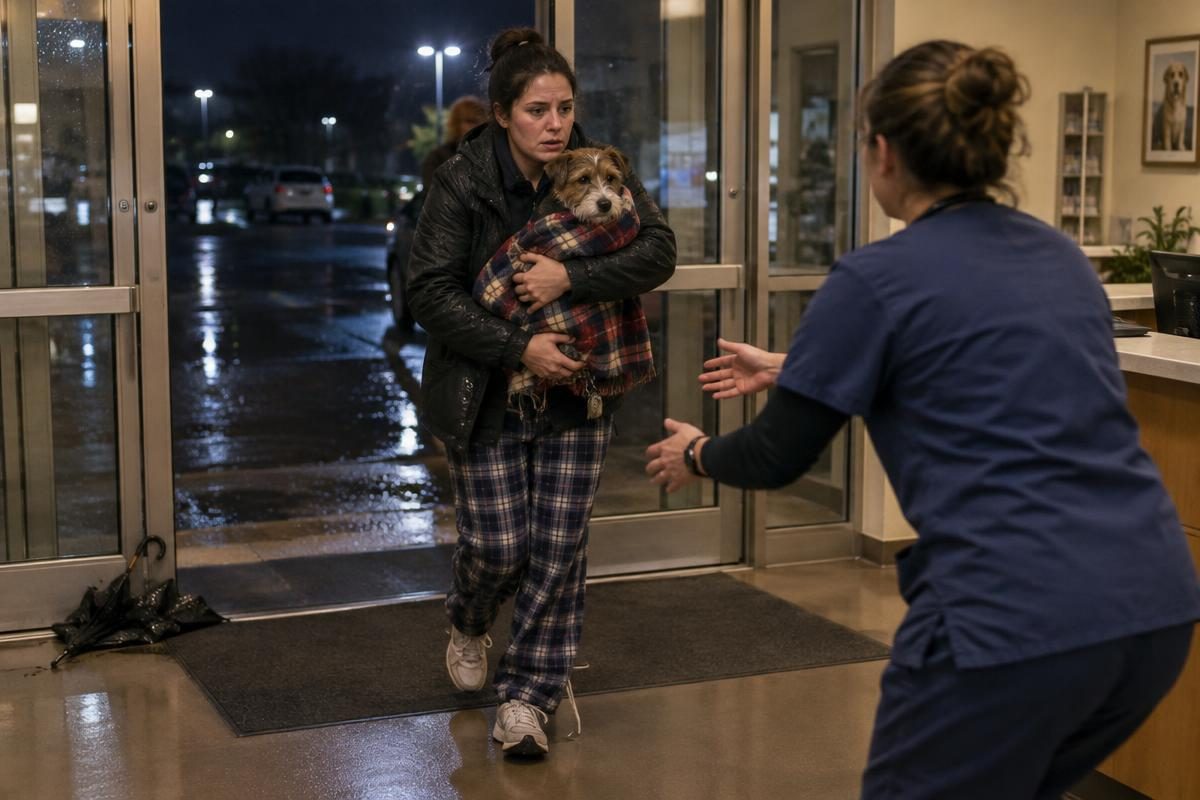
The typical emergency vet cost starts with an exam fee of about $135 for a dog and $143 for a cat, the 2025 national averages from a 50-state price survey run for CareCredit. That fee only gets your pet seen. Add bloodwork, x-rays, IV fluids and one night on the ward, and a vomiting dog lands near $1,600. A blocked male cat in Massachusetts runs about $4,500. A large dog with a twisted stomach in intensive care can pass $9,700. The estimator below builds your bill line by line from the state you live in, the problem and the number of nights.
How Much Does an Emergency Vet Visit Cost in 2026?
Plan on $600 to $1,600 for an ER visit that goes home the same day or after one night, $3,800 to $6,500 for most surgery cases, and $7,700 to $11,000 for bloat surgery, depending on dog size and ward or intensive care nights. Those figures come from running real 2025 and 2026 price data through the tool, not from a guess. Pick dog or cat, the closest match to what happened, your state and the tests on the written estimate.
Emergency Vet Cost Estimator
Pick dog or cat, what happened, your state and the tests the vet is likely to run. The estimator starts from 2025 state averages for an ER exam, adds diagnostics, treatment and nights in the hospital line by line, and shows what the same case costs at a specialty or university hospital and with intensive care nights.
Estimated Emergency Bill
Estimates only, not a quote. Exam, test, IV fluid, hospital night and foreign body surgery prices come from the 2025 ASQ360 survey for CareCredit (dog and cat columns, state ER exam averages). Toxin, gastro, GDV, fracture and urinary blockage treatment lines use the itemized Healthy Paws claim examples (Nov 2025); ICU nights use the midpoint of the Healthy Paws range; dog size factors come from the Hepper emergency cost table; the specialty exam uses the NC State emergency exam fee. Every line except the hotline fee is scaled by the state index. Reviewed September 2026. Only the ER team's written estimate is a real price.
Look at the “same case, other settings” row before you leave home. It prices the identical case at a 24-hour animal hospital and at a specialty or university teaching hospital, and it shows what intensive care nights would do to the total. The ICU line, the critical care rate, is where estimates most often jump after admission.
The Exam Fee Is Only the Cover Charge
An emergency exam is the triage assessment a veterinarian does before any test or treatment. It’s the one number every emergency hospital will quote over the phone, which is why it gets repeated so often. CareCredit’s survey found it varies more than twofold by state:
| State | Dog ER exam | Cat ER exam | Price index |
|---|---|---|---|
| Mississippi | $108 | $115 | 0.80 |
| Texas | $120 | $127 | 0.89 |
| US average | $135 | $143 | 1.00 |
| New York | $159 | $170 | 1.18 |
| California | $180 | $190 | 1.33 |
| Massachusetts | $188 | $200 | 1.39 |
| Hawaii | $241 | $257 | 1.79 |
We use that state index to scale every other line, not just the exam. Is that fair? A vet-reviewed Webvet guide from July 2026 says coastal metros like Boston and San Francisco run 30 to 50 percent above the national average. The survey index for Massachusetts (1.39) and California (1.33) falls right inside that band, which gave us confidence the one index carries across the bill.
Tests, Fluids and a Night on the Ward: Line-Item Prices
Once the exam is done, the emergency team writes an estimate. These are the national averages the calculator starts from. Dogs and cats have separate columns because the survey priced them separately.
| Line on the estimate | Dog | Cat | Source |
|---|---|---|---|
| Bloodwork (CBC plus chemistry panel) | $268 | $223 | CareCredit 2026 |
| X-rays, 2 to 3 views | $334 | $310 | CareCredit 2026 |
| Ultrasound | $483 | $323 | CareCredit 2026 |
| IV catheter and fluids | $130 | $121 | CareCredit 2026 |
| Hospital ward, per night | $619 | $582 | CareCredit 2026 |
| Intensive care, per night | $1,250 | $1,250 | Healthy Paws range midpoint |
One detail most price guides blur: “hospitalization” means two very different things. Healthy Paws puts standard care at $200 to $600 a day and ICU care at $500 to $2,000. Webvet quotes $600 to $3,500 or more per day. Both are right. They are describing different levels of care, so always ask which one the estimate assumes.
Six Emergencies and What Each Usually Costs
The treatment line depends on the type of emergency. Healthy Paws published itemized bills built from its 2022 to 2024 claims, and CareCredit priced blockage surgery separately. The calculator uses those treatment figures and the stay each example describes.
| Emergency | Typical total (Healthy Paws) | Treatment line in the tool | Typical nights |
|---|---|---|---|
| Vomiting or diarrhea, kept overnight | $500 to $3,000+ | $100 medications | 1 |
| Toxin ingestion | $300 to $5,000+ | $250 induced vomiting and charcoal | 2 |
| Swallowed object, surgery | $800 to $7,000+ (Webvet) | $2,217 dog, $2,367 cat (CareCredit) | 2 |
| Bloat with twisted stomach (GDV), dogs | $2,500 to $8,000+ | $5,000 surgery | 3 |
| Hit by a car, fracture repair | $1,000 to $6,000+ | $3,500 surgical repair | 3 |
| Urinary blockage, male cats | $1,500 to $3,500+ | $700 catheter and medications | 3 |
Toxin cases have one more line owners forget. Many ER vets want a protocol from a poison hotline before they treat, and Pet Poison Helpline charges $89 per incident, which covers follow-up calls with your vet. A 40 lb dog in Ohio that ate rat bait, with the call, two nights and standard tests, comes to about $2,217.
For dogs, size moves the surgery and hospital lines. Hepper’s cost table shows the exam and diagnostics priced the same for a small or large dog, but emergency surgery midpoints of $2,400 and $3,500. The tool turns that into factors of 0.81 for dogs under 25 lb and 1.19 for dogs over 60 lb, with smaller factors (0.90 and 1.10) on hospital nights.
How the Estimator Builds an Emergency Vet Cost
Every total follows the same six steps, and each figure traces to a named 2025 or 2026 source.
- State index. Your state’s ER exam average divided by the national average for that species. Hawaii dogs are 1.79, Texas dogs 0.89.
- Exam. The state exam average. For a specialty or teaching hospital, the tool multiplies it by 2.13, the ratio of the $270 NC State exam fee to North Carolina’s $127 survey average.
- Tests and fluids. Each box you tick, at the national price times the index.
- Treatment. The package for the emergency you picked, times the index and, for dogs, the size factor.
- Nights. Ward or ICU rate times the index, the size factor and the number of nights. Use the typical stay or enter the number on your estimate.
- Deposit. Half the total. Webvet says most hospitals want 50 to 100 percent of the low end of the estimate up front, and Oregon State’s teaching hospital asks for 50 percent of the high end.
As a check, the default case (a 50 lb dog, overnight for vomiting, US prices) comes out at $1,586. Healthy Paws’ own itemized gastro bill totals $1,525. Its bloat bill is $7,725; the tool gives $7,724 for the same dog with ward nights.
Four ER Bills Worked Through
Each example uses the inputs you can type into the tool above. Lines are rounded; totals are not, so a line sum can be off by a dollar.
1. A 50 lb dog with vomiting, US average prices
Exam $135, bloodwork and x-rays $602, IV fluids $130, medications $100 and one ward night $619. Total $1,586, with a deposit near $793. At a specialty hospital the exam alone pushes it to $1,738. If the dog moves to ICU for the night, $2,217.
2. A male cat with a urinary blockage in Massachusetts
The index is 1.40. Exam $200, tests $745, IV fluids $169, catheter and medications $979, and three ward nights at $814 each, $2,442. Total $4,536. The same cat at US prices comes to $3,243. Three ICU nights instead would make it $7,338.
3. An 80 lb dog with bloat (GDV) in Texas, in intensive care
Texas runs 11 percent below average, but a large dog carries the 1.19 surgery factor. Exam $120, tests $535, IV fluids $116, surgery $5,273 and three ICU nights at $1,222, which is $3,667. Total $9,710, and the deposit request would be around $4,855. On the ward instead of ICU: $7,859.
4. A 15 lb dog that swallowed a sock, California
The vet adds an ultrasound to find the object. Exam $180, tests $1,447, IV fluids $173, surgery $2,405 (small dog factor 0.81) and two ward nights at $743, $1,486. Total $5,690. At a teaching hospital, $5,893.
24-Hour ER, Specialty Hospital or Urgent Care?
A 24-hour emergency hospital is the default for a medical emergency at night and on weekends, and its prices are what the survey measured. Emergency and critical care is its own board-certified specialty in veterinary medicine, so these hospitals staff for the worst cases. A specialty referral or university teaching hospital charges more for the exam (NC State lists $270, Colorado State $175) and often for treatment too, so read the specialty total as a floor. Some areas have a middle option. Oregon Humane Society’s clinic charges $110 for a sick-pet exam and $140 for an urgent-care exam, but urgent care clinics usually can’t keep a pet overnight or operate. If breathing, heavy bleeding or a blocked bladder is involved, treat it as a life-threatening emergency and go straight to the ER. Your regular vet clinic is the cheapest route only when the problem can wait for office hours.
Paying When the Deposit Is Due Tonight
Most emergency hospitals won’t start sustained treatment until part of the bill is paid, so the deposit matters as much as the total. Four ways pet owners cover emergency vet bills:
- CareCredit. A health credit card many animal hospitals accept, with promotional financing on qualifying amounts. Apply before you arrive if you can.
- Scratchpay. Payment plans offered through participating clinics. Ask the front desk whether they take it.
- Pet insurance. Accident and illness policies reimburse emergency veterinary care after the deductible, but only for problems that start after enrollment. It helps with the next emergency, not this one. Our pet insurance cost calculator compares premiums with a bill like the ones above.
- Ask for a staged estimate. Request a low and high estimate, and ask which tests can wait until your pet is stable. That’s a fair question, and the team will tell you what can’t be skipped.
When This Estimate Will Be Wrong
The tool works from survey averages, so some cases will miss by a lot. Big-city hospitals often charge above their state figure. Complications (a second surgery, a blood transfusion, a cat that blocks again) aren’t in any package. Exotic pets aren’t covered; Colorado State charges $250 for an exotic ER exam against $175 for a dog or cat. And after-hours or holiday visits can carry a surcharge on top of the emergency exam, which Healthy Paws notes but no survey prices. Treat the result as the price of a typical case, then compare it line by line with the written estimate.
Start by picking the closest emergency in the tool and the state you’re in, then ask the emergency team for an itemized estimate and check each line against it. If you’re still planning your pet care budget, set aside the deposit for a mid-size case, around $800 to $2,300 from the examples above, or look at insurance now. Knowing the likely emergency vet cost before the crisis is what lets you say yes to treatment quickly. For planned procedures, the dog dental cleaning cost, dog spay cost and cat spay cost guides use the same line-by-line pricing, and dog vaccination cost covers the core shots, parvo included, that keep some of these visits from happening.
Questions About ER Vet Bills
Why is the emergency vet so expensive?
An emergency hospital is staffed all night with vets, technicians, imaging and surgery on standby, and that overhead lands on the cost of care for each case. The exam alone averages $135 for a dog, and an overnight stay adds $619 a night at US prices before any surgery.
How much does an emergency vet visit cost for a cat?
The ER exam averages $143 for a cat. A cat treated and sent home runs about $600 with bloodwork, while a male cat with a urinary blockage and three nights in hospital totals about $3,243 at US prices and $4,536 in Massachusetts.
What do I do if I can’t afford an emergency vet?
Ask for a low and high estimate and which steps can safely wait, then ask what payment the hospital accepts. CareCredit and Scratchpay are two financing options many animal hospitals accept. Nonprofit clinics and humane societies sometimes see urgent cases for less, such as Oregon Humane Society’s $140 urgent-care exam.
Does pet insurance cover emergency vet visits?
Accident and illness policies usually do, after the deductible and at the policy’s reimbursement rate. They don’t cover a condition that began before you enrolled, so buying a policy during an emergency won’t pay for it.
How much of a deposit does an emergency vet ask for?
Usually half or more of the estimate. Webvet reports most hospitals ask for 50 to 100 percent of the low end, and Oregon State’s teaching hospital asks for 50 percent of the high end. On a $1,586 case, plan on about $793 at check-in.
Where these emergency vet cost figures come from: 2025 survey prices published by CareCredit (ASQ360), itemized claim examples from Healthy Paws, and 2026 figures from Webvet, Hepper, ThePricer and Pet Poison Helpline. This page is an estimate and not veterinary advice; if your pet is in distress, call the nearest ER now. Last reviewed: September 2026.