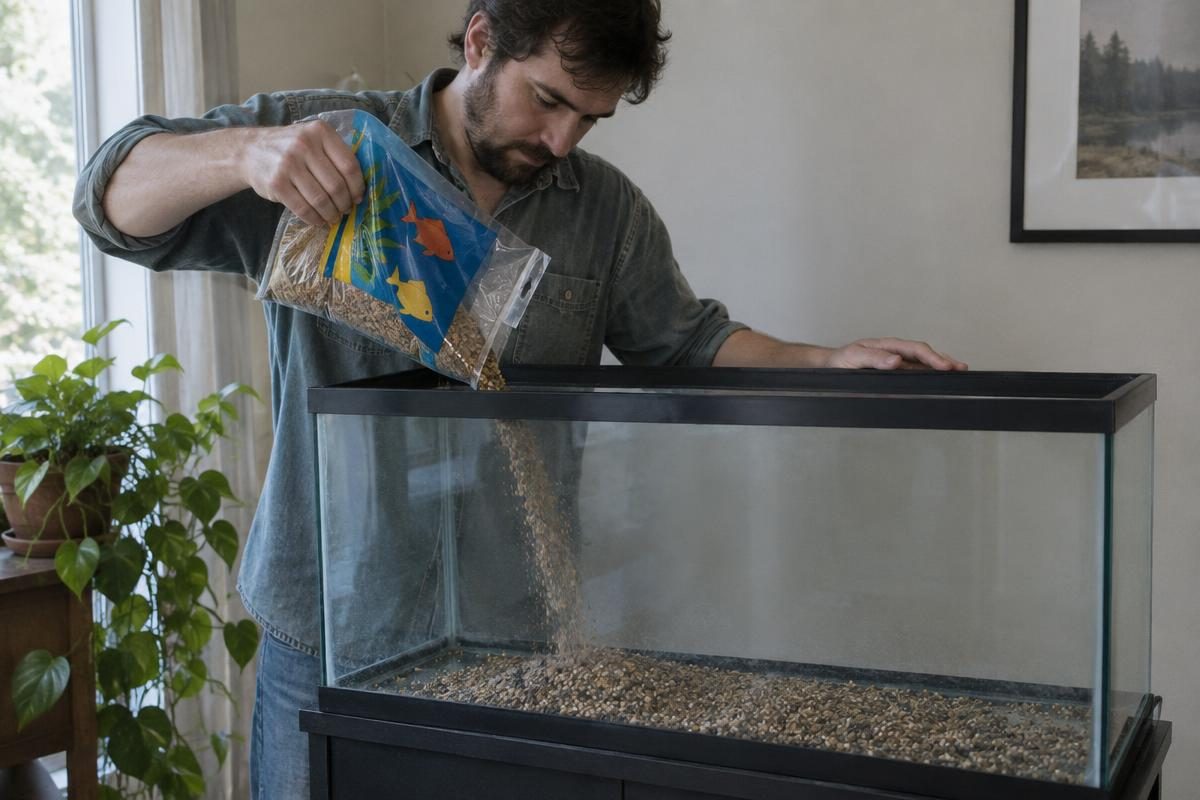
A fish tank gravel calculator turns the floor of your aquarium into a shopping list: how many pounds to buy, which bags, and what they cost. The math is short. Multiply the inside length by the width and the depth you want, convert that to cubic feet, and multiply by how much the material weighs per cubic foot. Gravel runs about 105 lb per cubic foot, sand 97, and a volcanic aquasoil such as Fluval Stratum closer to 62. That spread is why one “pounds per gallon” rule can’t cover all three. A 20 long with 2 inches of gravel needs 43.8 lb, two 25 lb bags, $51.98 at PetSmart.
Fish Tank Gravel Calculator: Pounds, Bags and Price
Enter the footprint in inches or centimeters, pick the substrate type, and set the desired depth. Choose “sloped” if the bed rises toward the back glass, a common aquascaping layout, and the tool averages the two depths. The fourth option builds a planted bed in two layers: nutrient soil underneath, a gravel or sand cap on top.
Fish Tank Gravel Calculator
Enter the inside footprint of the tank and the depth you want, pick gravel, sand, aquasoil or a capped planted bed, and get pounds, bags and cost. Each material is weighed with its own bulk density, sloped beds use the average depth, and bags are the cheapest mix of two shelf sizes at September 2026 prices.
What to Buy for the Bottom of Your Tank
Estimates only. Pounds are bed volume times the dry bulk density of each material (Engineering ToolBox for gravel and sand, Fluval's 1 kg per liter sizing rule for aquasoil). Real products vary by grain size, so buy a bag extra if the bed must be exact. Prices are PetSmart regular prices reviewed September 2026 and change with sales.
This aquarium substrate calculator assumes a rectangular floor. For a bow front or another tank shape, enter the length and width at the widest points and treat the answer as a slight overestimate.
The bag line is the cheapest mix of the two shelf sizes that covers your weight, bought once for every tank you entered. Those prices come from PetSmart product pages on September 30, 2026: Top Fin aquarium gravel at $7.99 (5 pounds) and $25.99 (25), Top Fin sand at $9.99 (5) and $29.99 (20), and Fluval Stratum at $16.99 (8.8) and $35.49 (17.6).
How Heavy Is an Inch of Substrate?
Bulk density is the weight of a loose, dry pile of material per unit of volume, air gaps included. It’s the only number that turns a depth into a weight. Engineering ToolBox lists dry gravel at 105 lb per cubic foot (1,680 kg per cubic meter) and dry sand at 97 (1,555). Fluval sizes Stratum at 1 kg per liter of bed, which works out to 62.4 lb per cubic foot. Porous volcanic soil is mostly air.
| Material | Pounds per cubic foot | Pounds per inch over a 30 x 12 footprint | Shelf price per pound |
|---|---|---|---|
| Pea gravel | 105 | 21.9 | $1.04 (25 lb bag) |
| Sand | 97 | 20.2 | $1.50 (20 lb bag) |
| Aquasoil | 62.4 | 13.0 | $1.93 (8.8 lb bag) |
Read the last two columns together. Aquasoil costs almost twice as much per pound as pea gravel but weighs 40 percent less, so an inch of it costs only about a tenth more. Sand is the expensive one per inch, roughly a third more than gravel, because it’s nearly as dense and priced higher. Top Shelf Aquatics’ calculator, typical of the tools ranking for this search, applies one band of 85 to 105 lb per cubic foot and has no soil option. Used for aquasoil, that band over-orders by a third or more.
The Arithmetic From Footprint to Bag Count
- Footprint. Inside length times inside width in square inches. Centimeter entries are divided by 2.54 first. Outside measurements add a few percent, which is harmless.
- Average depth. The depth you entered, or front plus back divided by two for a slope.
- Bed volume. Footprint times average depth, divided by 1,728 for cubic feet. The tool also reports liters and the gallons of water column the layer takes up.
- Weight. Cubic feet times the density from the table, plus any extra percent you asked for, times the number of tanks.
- Bags. Every combination of large and small bags that covers the weight gets priced, and the cheapest wins. Ties go to fewer bags.
For a capped planted bed the cap is a uniform layer, so the soil base is the average depth minus the cap. Each layer gets its own density and its own bags.
Four Setups Priced Bag by Bag
Every figure below is what the tool shows for those inputs, and the same scenarios run in its automated test file.
A 20 long with 2 inches of pea gravel
Footprint 30 x 12 inches, flat, 2 inches deep. That’s 720 cubic inches, or 0.417 cubic feet, and 43.8 lb (19.8 kg) of gravel. Two 25 lb bags cover it for $51.98. The layer occupies 3.1 gallons of the tank’s water column. Adding 10 percent for a hill behind a rock pushes it to 48.1 lb, still two bags. Set up two identical tanks and the order becomes three 25s and three 5s, $101.94.
A 55 gallon with a 2 inch sand bed
48 x 13 inches with 2 inches of sand needs 70.1 lb. The cheapest mix is three 20s plus three 5s, $119.94. The same bed in gravel would weigh 75.8 lb and cost $85.96, so choosing sand adds $33.98. Plenty of keepers pay it for corydoras and other bottom dwellers that sift through fine grains, but it’s a real line item.
A 40 breeder aquascape sloped from 2 to 4 inches
36 x 18 inches of Fluval Stratum, 2 inches at the front glass and 4 at the back, averages 3 inches. The bed is 1.125 cubic feet (31.9 liters) and weighs 70.2 lb. Eight 8.8 lb bags cover it for $135.92. Gravel at the same shape would be $129.95, a difference of only $5.97, which surprises people who assume soil is the luxury option.
A 29 gallon planted bed with a gravel cap
30 x 12 inches, 3 inches total, with the top inch in gravel. The 2 inch aquasoil base weighs 26.0 lb and takes three 8.8 lb bags ($50.97). The cap is 21.9 pounds, one 25 pound bag ($25.99). Total: 47.9 lb for $76.96. All soil at 3 inches would cost $84.95 and all gravel $77.97. If your base is organic potting soil instead, buy it by volume: the tool shows 12.5 quarts for that base.
In metric, a 60 x 30 cm tank with 5 cm of sand holds a 9.0 liter bed, 30.8 lb or 14.0 kg, bought as one 20 lb bag and three 5 lb bags for $59.96.
Substrate by the Bag for Common Aquarium Sizes
These are outside footprints from Top Shelf Aquatics’ size chart at a flat 2 inch depth. Each cell is the weight in pounds, then the cheapest PetSmart order.
| Tank | Footprint (in) | Gravel (pounds, cost) | Sand | Aquasoil |
|---|---|---|---|---|
| 10 gallon | 20 x 10 | 24.3, $25.99 | 22.5, $39.98 | 14.5, $33.98 |
| 20 high | 24 x 12 | 35.0, $41.97 | 32.3, $59.96 | 20.8, $50.97 |
| 20 long or 29 | 30 x 12 | 43.8, $51.98 | 40.4, $69.97 | 26.0, $50.97 |
| 40 breeder | 36 x 18 | 78.8, $85.96 | 72.8, $119.94 | 46.8, $101.94 |
| 55 gallon | 48 x 13 | 75.8, $85.96 | 70.1, $119.94 | 45.1, $101.94 |
| 75 gallon | 48 x 18 | 105.0, $111.95 | 97.0, $149.95 | 62.4, $135.92 |
Notice that a 20 long and a 29 need exactly the same amount. Height doesn’t matter here, only the floor. That’s also why a 40 breeder takes more than a 55: its footprint is 648 square inches against 624.
Per-Gallon Rules Versus Actual Depth
Bag labels and shopping lists quote pounds per gallon because everyone knows their tank size. Those rules ignore shape, and they land at very different depths:
- 1 lb per gallon (Aquarium Co-Op’s shopping list) gives a 55 about 55 pounds, which is 1.45 inches of gravel. Fine for a fish-only community tank.
- 1.5 to 2 lb per gallon (printed on the Top Fin gravel bag) gives 82.5 to 110 lb, or 2.2 to 2.9 inches on the same floor.
- 1 to 2 lb per gallon (the Top Fin sand bag) spans a factor of two by itself.
Pick the depth first, then let the weight follow; that’s how much substrate you actually need. A useful guide from common hobby practice: 1 to 2 inches for fish-only setups, 2 to 3 inches where rooted plants grow, and a slope from about 2 inches at the front to 4 at the back for a planted aquascape. Deep beds lose water column too. On a 55 every inch of substrate costs about 2.7 gallons, which the fish tank volume calculator subtracts when it works out real water for dosing.
Choosing Between Gravel, Sand and Soil
Price per inch is only one input. Aquarium Co-Op’s planted tank guide makes three practical points worth weighing before you buy:
- Nutrient soils run out. Active substrates like ADA Aqua Soil and Stratum lower pH and soften water, then are spent after one to two years and need root tabs. Plan on that recurring cost.
- Inert planted gravels last. CaribSea Eco-Complete and Seachem Flourite don’t break down, and root tabs turn them into a feeding bed for Amazon swords when needed.
- Grain size matters for roots. Very fine sand compacts and fights roots, coarse sand works, and large river stones leave gaps too wide for plants to anchor.
A cap over soil keeps it from clouding the water, and it works as long as you rarely uproot plants. Rinse pea gravel and sand until the water runs clear before adding them. Stratum is different: Fluval’s directions say to rinse it gently in a colander without agitating it.
Stocking choices feed back into this. Bottom sifters want sand, and the fish stocking calculator will tell you how many of them the tank can carry. Heater sizing doesn’t depend on the substrate, but it’s the next purchase on most setup lists, so the aquarium heater size calculator is a sensible next stop.
Where the Estimate Runs Short or Long
- Soil density is the softest number. Fluval’s sizing rule implies 1 kg per liter; one retailer’s bag guide works out nearer 0.85. The tool may over-order aquasoil by 10 to 15 percent.
- Grain size. The gravel and sand figures are dry construction aggregate. Coated craft gravel or very fine sand can land 5 to 10 percent either way.
- Hardscape. Rock and wood sit on or in the bed. A big stone set before the substrate goes in saves material; one set on top saves nothing.
- Prices. The 8.8 lb Stratum bag was cheaper per pound than the 17.6 lb bag when we checked, which may be a promotion. Other retailers and other colors run a dollar or two apart.
Gravel and Sand Questions Owners Ask
How do I work out how much gravel I need for my fish tank?
Multiply inside length by width by depth in inches, divide by 1,728 for cubic feet, and multiply by 105 for pea gravel. A 30 x 12 inch floor at 2 inches deep is 0.417 cubic feet, about 43.8 lb.
How many pounds of gravel do I need for a 20 gallon aquarium?
It depends on which 20. A 20 long (30 x 12 inches) needs 43.8 lb for 2 inches of gravel; a 20 high (24 x 12) needs 35.0 lb. Two 25 lb bags cover the long, one 25 plus two 5s the high.
How many pounds of gravel do I need for a 55 gallon aquarium?
About 75.8 lb for 2 inches on a standard 48 x 13 inch floor, bought as three 25s and one 5 for $85.96. Each extra inch adds 37.9 lb.
How much will a 50 lb bag of gravel cover?
Fifty pounds of pea gravel fills about 0.48 cubic feet, roughly 823 cubic inches. That’s 2.3 inches over a 30 x 12 floor or 1.3 inches over a 55’s 48 x 13 floor.
Is sand or gravel better for an aquarium?
Gravel is cheaper per inch. Sand suits fish that dig or sift and costs about a third more for the same depth at September 2026 shelf prices. Coarse sand grows plants better than very fine sand.
Does aquarium substrate need replacing?
Gravel, sand and inert planted gravel don’t wear out. Nutrient aquasoil is exhausted after one to two years and then needs root tabs, or replacement if it has broken down into mud.
Start by measuring the floor inside the glass, decide on a depth before you think about weight, and run both your first choice and plain pea gravel through the fish tank gravel calculator. The price check line shows what the upgrade really costs for your footprint.
This page is general information, not veterinary advice. Bulk densities come from Engineering ToolBox (gravel and sand) and Fluval’s Stratum sizing rule; substrate guidance from Aquarium Co-Op; tank footprints from Top Shelf Aquatics; bag prices from PetSmart product pages checked September 2026, which change with sales. Last reviewed: September 2026.