
The leopard gecko cost that surprises new keepers isn’t the animal. A normal (wild type) leopard gecko sells for $20 to $40 from a breeder and $34.99 at PetSmart, while the enclosure, heat and lighting run $118 to $950. With insects, supplements, a yearly vet check and electricity, a normal bought from a breeder and housed in a 36 x 18 x 18 terrarium comes to about $1,284 in the first year. The lizard itself is 2 percent of that.
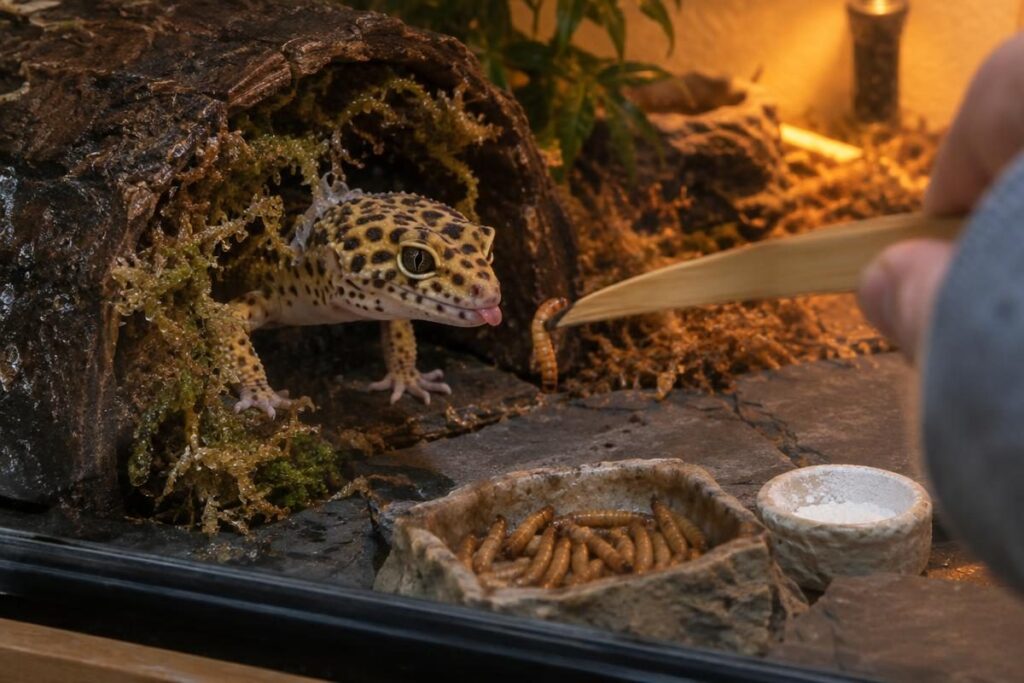
The species (Eublepharis macularius) is a ground-dwelling lizard from the dry grasslands of Afghanistan, Pakistan, northwest India and Iran. Leopard geckos are mostly nocturnal, docile and easy to handle, so care sheets rank them as a beginner reptile. They are also long-lived, which is what turns a cheap animal into a large total.
Leopard Gecko Cost Calculator: Morph, Source and Build
Pick the morph, where it comes from and the kind of build you plan. The estimator adds the purchase, a one-time setup and a year of care, then carries the care forward for as many years as you enter.
Leopard Gecko Cost Calculator
Pick a morph, where the gecko comes from and the kind of enclosure you plan to build. The estimator prices the purchase, the one-time setup, yearly insects, supplements, upkeep, a vet check-up and the electricity for heat and light from 2026 published prices, then totals the first year and any number of years ahead.
Your Leopard Gecko Budget
Estimates only. Morph prices, supplies and yearly care ranges come from a January 2026 published price guide, the larger setup from the ReptiFiles shopping list, the chain store price from a PetSmart listing checked September 2026, and power from the EIA July 2026 average rate. Prices vary by region and seller. Reviewed September 2026.
The electricity line uses your own rate. Find the price per kWh on your power bill; the default is the July 2026 US residential average of 18.31 cents from the EIA.
- Purchase. The price range for your chosen variety and level, the chain-store price for a store normal, a $50 rescue fee, or $20 to $350 for a rehome.
- Setup. $118, $209 or $300 for the starter kit; $650, $800 or $950 for the 36-inch build, following your spending level. A rehome is $0.
- Yearly care. Feeder insects $60 to $120, calcium and vitamin supplements $60 to $120, substrate, bulbs and decor $70 to $180, plus $10 for enrichment. Typical is $315.
- Exotic vet check-up. $80 a year when ticked, the upper end of The Vet Desk’s check-up range.
- Electricity. Watts x hours x 365.25 / 1,000 gives kWh a year, times your rate. The heat mat counts as on around the clock; lamps run half the day, matching the chain’s care-sheet advice to switch heat and light off for 12 hours at night.
- Totals. First year = purchase + setup + yearly care. Over N years = purchase + setup + yearly care x N, for each gecko.
The Build Sheet: Starter Kit or 36-Inch Terrarium
The enclosure decision moves the first-year bill more than anything short of a collector line. The big chain store rates the species as beginner level, and that label is about care, not the price of the habitat. Its care sheet says a 20-gallon tank or larger works and that one or two geckos can share one. ReptiFiles, a widely used reptile husbandry site, builds its shopping list around a 36 x 18 x 18 inch terrarium instead, with a 50 W halogen basking lamp and a 24-inch Arcadia ProT5 UVB fixture.
| Build | What it includes | Setup range | Power used |
|---|---|---|---|
| Starter glass kit | Glass tank, heat mat, hides, reptile carpet or substrate, dishes, thermometer and hygrometer for humidity | $118 to $300 | 8 W mat, about 70 kWh a year |
| 36 x 18 x 18 build | Terrarium, halogen, T5 UVB, timer, clay substrate, temp gun, supplements | $650 to $950 | 74 W for 12 hours, about 324 kWh a year |
A PVC 36 x 18 x 18 enclosure runs about $195 to $200 on its own at reptile suppliers, so most of the gap between the two builds is lighting, the timer and a thermometer gun rather than the box.
Old fish tanks can cut the starter bill. A gecko uses floor space, not height, so a 20-gallon long (30 x 12 inches of floor) works and the tall version does not. Check what you own with the fish tank volume calculator, and fit a screen top so warm air escapes and humidity stays low. An under-tank heating pad heats only the glass it touches: cover about a third of the floor and run it through a thermostat so the tank keeps a warm-to-cool gradient.
Watts to Dollars: Running the Heat and Light
Electricity is the smallest line, not the largest. The two builds draw very different power; neither moves the yearly bill much.
| Heat and light | Use | kWh a year | At 18.31 cents | At 33.61 cents (California) |
|---|---|---|---|---|
| 8 W heat mat (starter kit) | Around the clock | About 70 | $1.07 a month | About $1.96 a month |
| 50 W halogen plus T5 tube (36-inch build) | Half the day on a timer | About 324 | $4.95 a month ($59.39 a year) | $9.08 a month |
On California’s rate, the first year of a $30 normal in the 36-inch build rises from $1,284 to $1,334. A mat on a thermostat cycles off, so its real draw sits below the table. A ceramic heat emitter of the same wattage costs exactly what the halogen does; a 50 W heat source draws 50 W whether it glows or not. The bulb that does cost money is the tube: UVB output fades long before it goes dark, Arcadia advises replacing it about once a year, and that sits inside the $70 to $180 yearly line.
Leopard Gecko Morphs: From a $20 Normal to a $3,000 Collector Line
A morph is a color and pattern variety bred from a known gene or line. It sets the price tag and nothing else: a $30 normal and a $650 tangerine eat the same insects and need the same heat. The ranges below are breeder prices from The Vet Desk’s January 2026 guide.
| Morph | Breeder price | Typical (midpoint) | First year, full build |
|---|---|---|---|
| Normal (wild type) | $20 to $40 | $30 | $1,284 |
| Hypo melanistic | $80 to $200 | $140 | $1,394 |
| High yellow | $85 to $100 | $92.50 | $1,347 |
| Albino (Tremper, Bell, Rainwater) | $80 to $300 | $190 | $1,444 |
| Carrot tail | $130 to $350 | $240 | $1,494 |
| Blizzard | $130 to $500 | $315 | $1,569 |
| Tangerine | $300 to $650 | $475 | $1,729 |
| Black Night (collector line) | about $3,000 | $3,000 | $4,254 |
The last column assumes the 36-inch build, typical spending and a vet check. Black Night comes from a single 2022 listing in Reptile Guide’s price survey; collector lines swing hard from one breeding season to the next, so treat it as an order of magnitude. Combination morphs, which stack several genes, usually price at or above the costliest gene they carry. Within one variety, an unsexed hatchling or juvenile tends to sit at the low end of the range and a sexed adult at the top.
Where You Buy It Sets the First Bill
- Chain pet store. PetSmart’s product page listed its leopard gecko at $34.99, on sale for $27.99, on September 30, 2026. Stores sell mostly normals, so anything fancier means a breeder.
- Breeder, expo or online seller. The full $20 to $650 spread lives here. Leopard geckos for sale at expos such as Repticon can be inspected before paying; geckos for sale online ship by courier, which adds to the bill. A reputable breeder can tell you the hatch date and sex.
- Rescue or shelter. Adoption fees start around $50. That’s more than a store normal, so adopt for the animal’s sake, not to save money.
- Private rehome. Owners rehoming a pet ask $20 to $350, and the price often includes the tank, heat mat and hides. The calculator sets setup to $0 here, so a $185 gecko with its tank comes to $593 in the first year, 31 percent of it the animal.
A rehome is the cheapest honest start. It also carries the most unknowns: a heat mat with no thermostat, a lighting tube past its useful life, or a gecko that hasn’t had a health check. Budget for one replacement part.
What It Costs Per Month After Year One
Expect $34 to $38 a month at typical spending with a yearly vet check, or $64 with premium care and an emergency fund. The Vet Desk’s own annual total averages $33 a month.
Insects are the line that varies most between guides. That guide puts food at $60 to $120 a year, while Reptile Guide’s 2022 survey had $15 to $25 a month. Bulk orders of crickets, mealworms or dubia roaches shipped from a supplier cost far less per insect than small cups from a store, so the buying habit matters more than the animal. Super worms are fattier and suit the occasional treat, not the staple.
The supplement line is mostly calcium powder dusted on feeders, plus a multivitamin. Calcium with vitamin D3 matters most in a build without UV lighting, since the gecko then has no other way to make D3.
Leopard Gecko Cost Over a 15 to 20 Year Lifespan
The chain’s care sheet gives an average lifespan of 15 to 20 years in captivity. A $30 normal in the 36-inch build costs $1,284 the first year and $7,646 over 15 years; a store normal in a $209 starter kit costs $652, then $6,362. A $650 tangerine with a $950 build, premium care and a $200 yearly emergency fund reaches $2,369 and then $13,141. Its price premium is $610 over a high-end normal, while care over those 15 years runs about $11,541. The floor, a $20 normal in a $118 kit on budget care with no vet visit, is $351 for the first year, and it leaves nothing for a sick animal.
Costs the Calculator Leaves Out
- Illness. Parasite treatment ($0 to $80+) and ongoing medication ($0 to $100+) are left out because most geckos never need them. The same price guide lists emergencies at $200 or more; the emergency fund field is there for that.
- Your area. Reptile vets are scarce in some regions, and a longer drive or a specialist fee pushes the check-up past $80.
- Housing two together. The calculator prices each gecko with its own setup. Two animals sharing one tank costs less up front, but a territorial pair ends up needing a second one anyway.
- Price drift. Prices fall as a gene becomes common. Gecko Time notes Tremper albinos sold for about $3,000 a pair when they appeared in 1999, about $1,000 a pair a year later, and eventually near the price of a normal.
Before you pay for the animal, price the build you will actually set up and run the calculator at typical and premium spending. Put the difference in a savings pot for vet visits. That is the honest leopard gecko cost, and the morph is the last decision, not the first. For comparison, see what a bearded dragon costs to keep or what a hamster costs as a smaller starter pet, check a pet insurance quote, or price an emergency vet visit before you need one. Bird owners have their own pet bird cost estimator.
Leopard Gecko Money Questions
How much is a leopard gecko at PetSmart?
$34.99 at the regular price and $27.99 on sale on the chain’s listing as of September 30, 2026. Stores stock mostly normals; designer varieties come from expos and specialist sellers.
How much does it cost to keep a leopard gecko per year?
About $408 to $454 at typical spending with a yearly vet check and power, depending on the build. Budget care without the vet visit can be as low as $213; premium care with an emergency fund runs about $769.
Should I get one or two leopard geckos?
One is the simpler budget. The chain’s care sheet says two can share a 20-gallon tank, but it also says to enlarge the habitat if they turn territorial, and keepers who separate a pair pay for a second setup. Two males fight, and a male and female pair will breed. Wash your hands after handling either, since reptiles can carry Salmonella. Two $30 normals in the 36-inch build cost $2,569 in the first year.
How long will I be paying for a leopard gecko?
The average lifespan is 15 to 20 years. At typical spending with a new setup that’s $6,362 to $7,646 over 15 years, and more if yours reaches 20.
Why do some morphs cost hundreds more?
Rarity. A variety from a newer or recessive gene has fewer keepers producing it, so it sells high until supply catches up. The animal’s care costs exactly the same as a normal’s.
This page is general information, not veterinary advice. Morph, supply and yearly care prices come from The Vet Desk (January 2026), the chain store price and lifespan from PetSmart’s listing and care sheet (checked September 2026), the larger build from the ReptiFiles shopping list, the Black Night price from Reptile Guide (2022), and electricity from the EIA (July 2026). Prices change by region and seller. Last reviewed: November 2026.